No products in the cart.
All rights of this website are reserved for EXTRUTEX Austria and its partner companies, © 2026
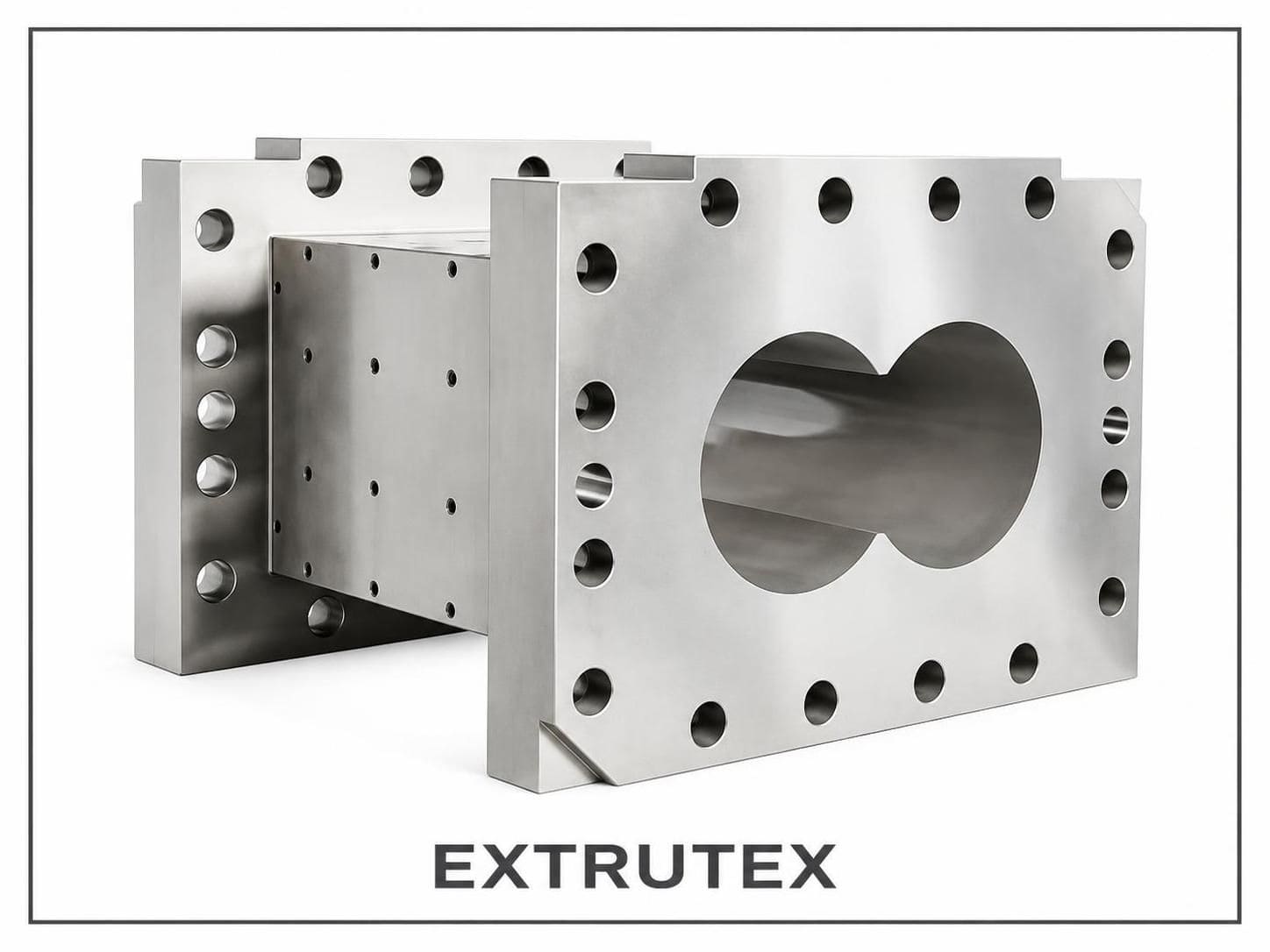
EXTRUTEX Twin-Screw Extruder co-rotating Barrels and Barrel Liners




EXTRUTEX manufactures and supplies twin-screw extruder barrels, barrel sections and high-performance barrel liners for plastics compounding, polymer processing, food and feed extrusion, and large-scale industrial production. The barrel is one of the most important components of a twin-screw extruder. It houses the screws, establishes the working clearance and provides the controlled environment in which materials are conveyed, mixed, melted and processed.
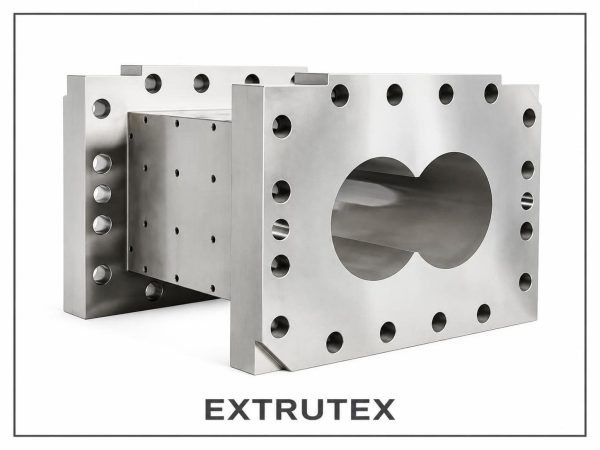
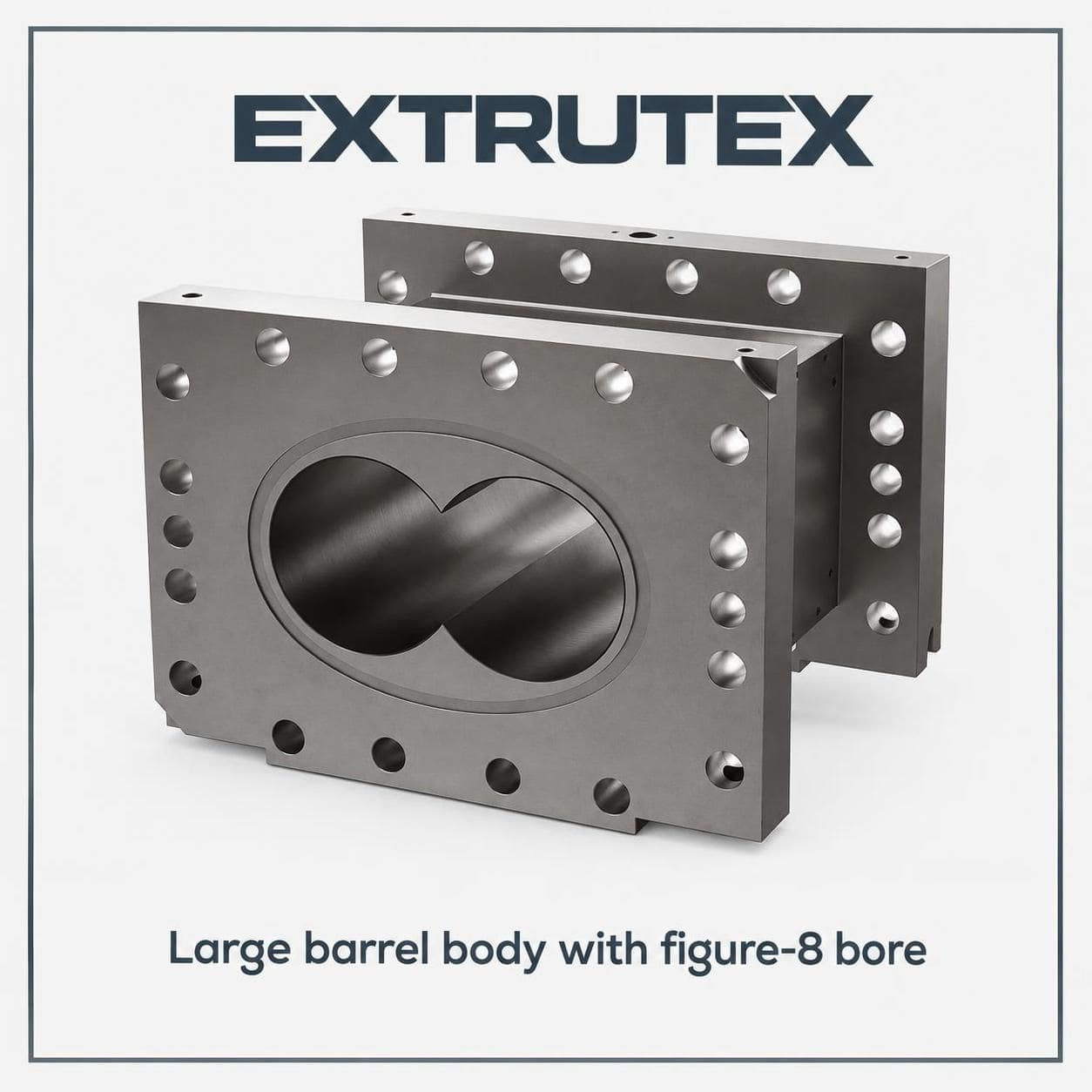
A twin-screw extruder barrel normally features a figure-8, or bilobal, internal bore. The two connected circular bores accommodate the intermeshing screws, allowing them to work closely together. The geometry, centre distance, bore diameter, surface finish and wear resistance all influence extrusion performance, processing stability and equipment service life.
EXTRUTEX provides complete barrel sections and replacement liners in different steel grades and wear-resistant materials. Available solutions include nitrided steel, α101, hot isostatically pressed powder metallurgy (HIP PM), and nickel-based tungsten-carbide laser cladding. Both replaceable-liner and linerless constructions are available, covering screw diameters from 7 mm to 486 mm.
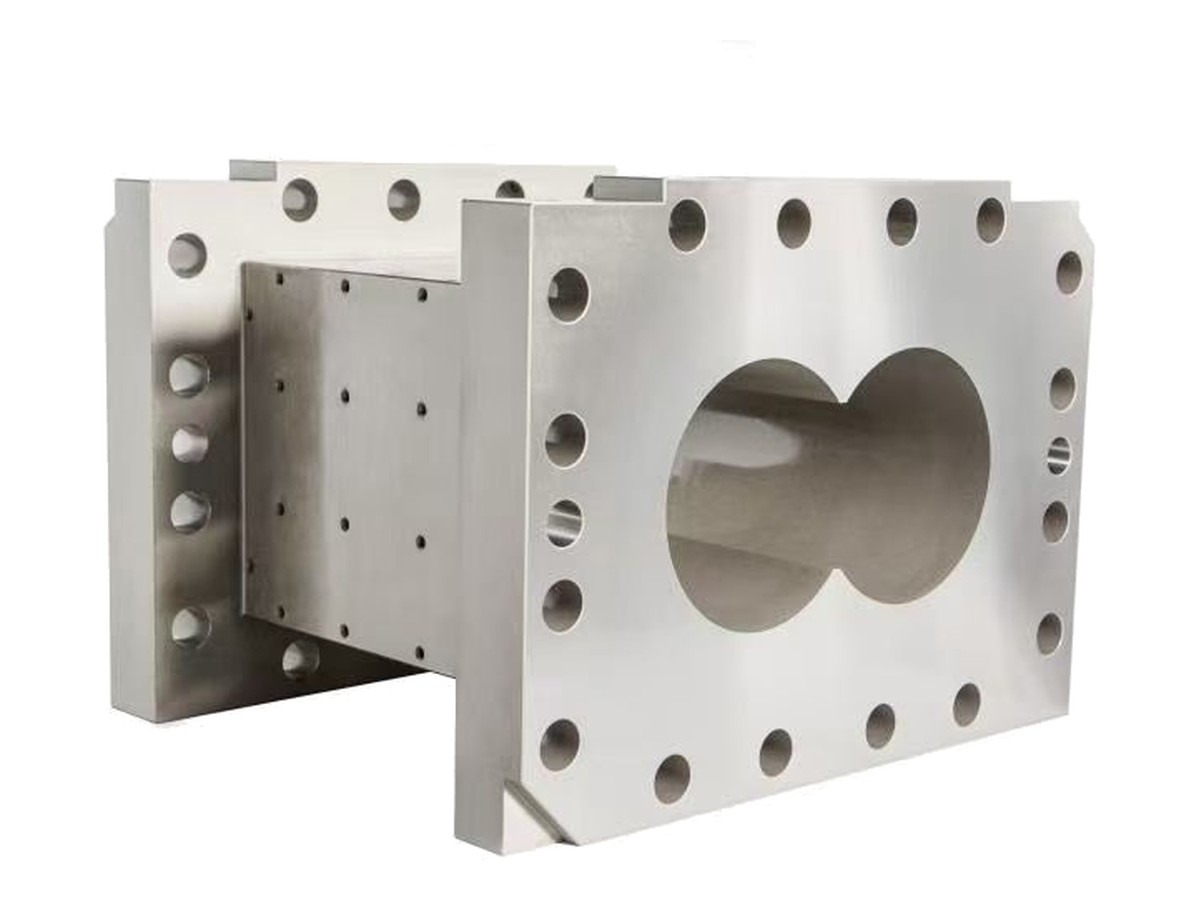
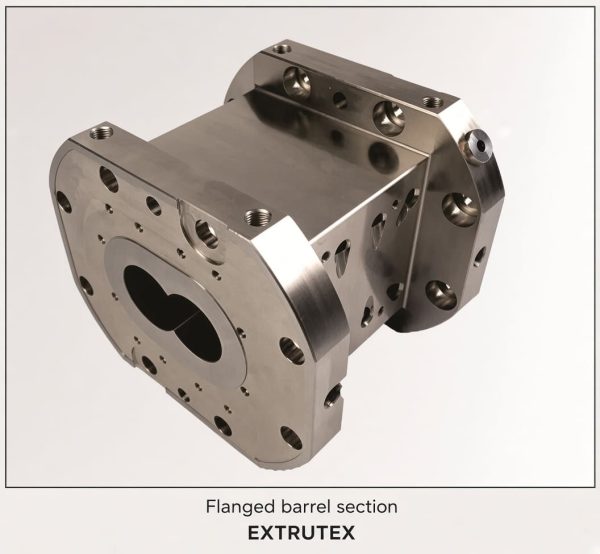
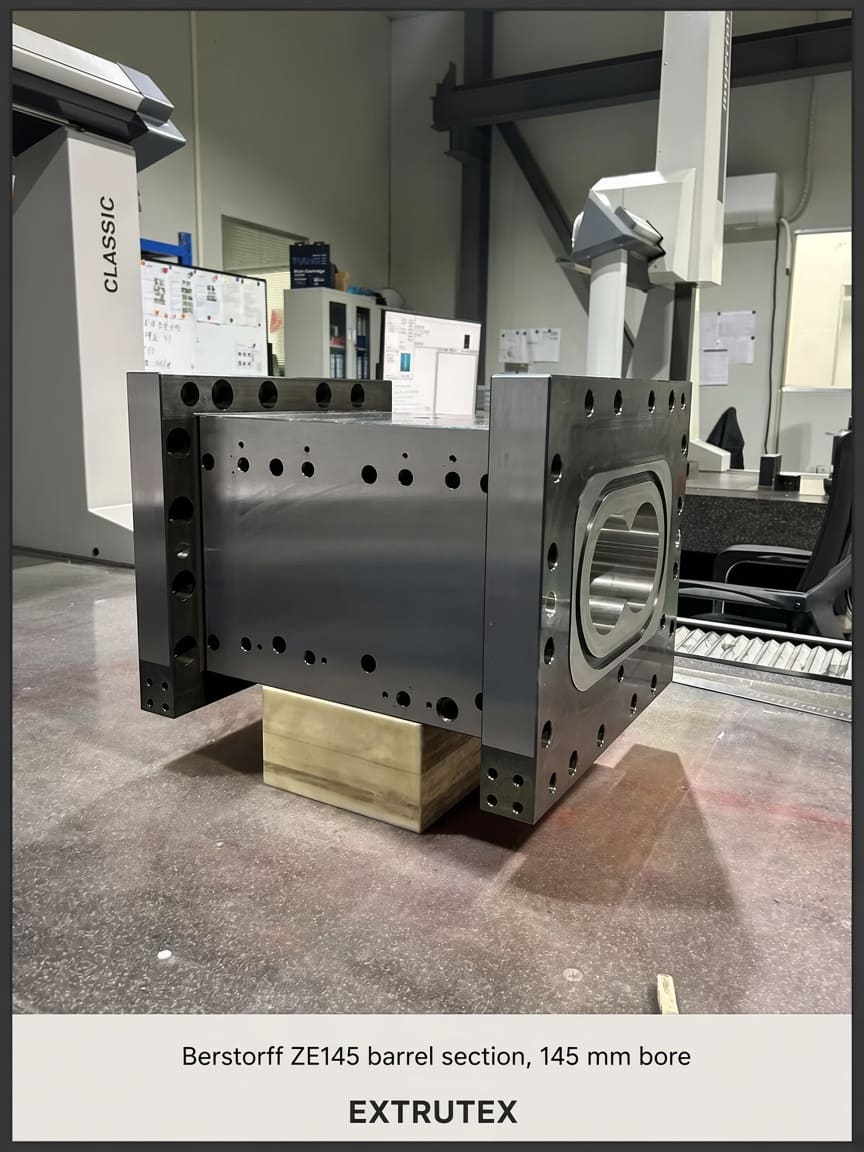
EXTRUTEX twin-screw extruder barrel section with precision figure-8 internal geometry.
Barrel dimensions and construction are determined by the extruder model, screw configuration, processing material and operating conditions. Each replacement barrel must maintain the correct relationship between the two bores and the screw centre distance. Even small dimensional differences can affect screw clearance, material processing and mechanical reliability.
EXTRUTEX manufactures standard and customized barrel sections according to supplied drawings, samples or dimensional requirements. The following table presents the general technical range.
| Technical Parameter | EXTRUTEX Specifications |
|---|---|
| Bore geometry | Figure-8, bilobal, self-wiping twin-screw configuration |
| Liner materials | Nitrided steel, α101, HIP powder metallurgy and nickel-based tungsten-carbide laser cladding |
| Construction | Replaceable liner construction or linerless construction with wear-resistant cladding applied directly to the bore |
| Hardness | 950–1100 HV for nitrided steel; other grades according to material selection |
| Section length | 3D–6D per barrel section |
| Heating system | Cartridge heaters or oil heating channels |
| Screw diameter range | 7–486 mm |
| Refurbishment | Re-boring, precision honing, liner replacement and bore restoration |
| Dimensional inspection | Coordinate measuring machine (CMM) verification |
| Manufacturing | Custom production according to customer drawings or original component samples |
| Lead time | Chinese standard-machine replacement parts: ex-stock where available. Imported-machine replacement parts: approximately 30–45 days after material availability and drawing confirmation. |
For replacement orders, EXTRUTEX recommends confirming the bore diameter, screw centre distance, barrel section length, flange dimensions, bolt pattern and heating configuration before production. This ensures that the replacement component matches the original installation.
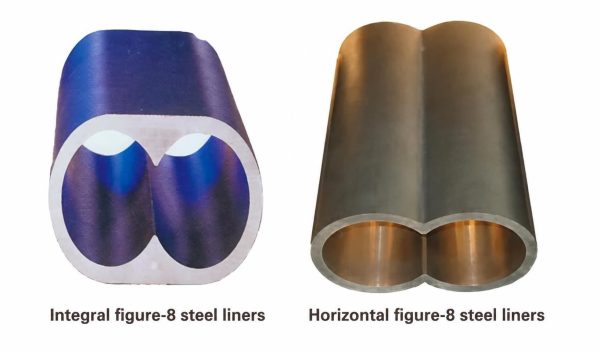
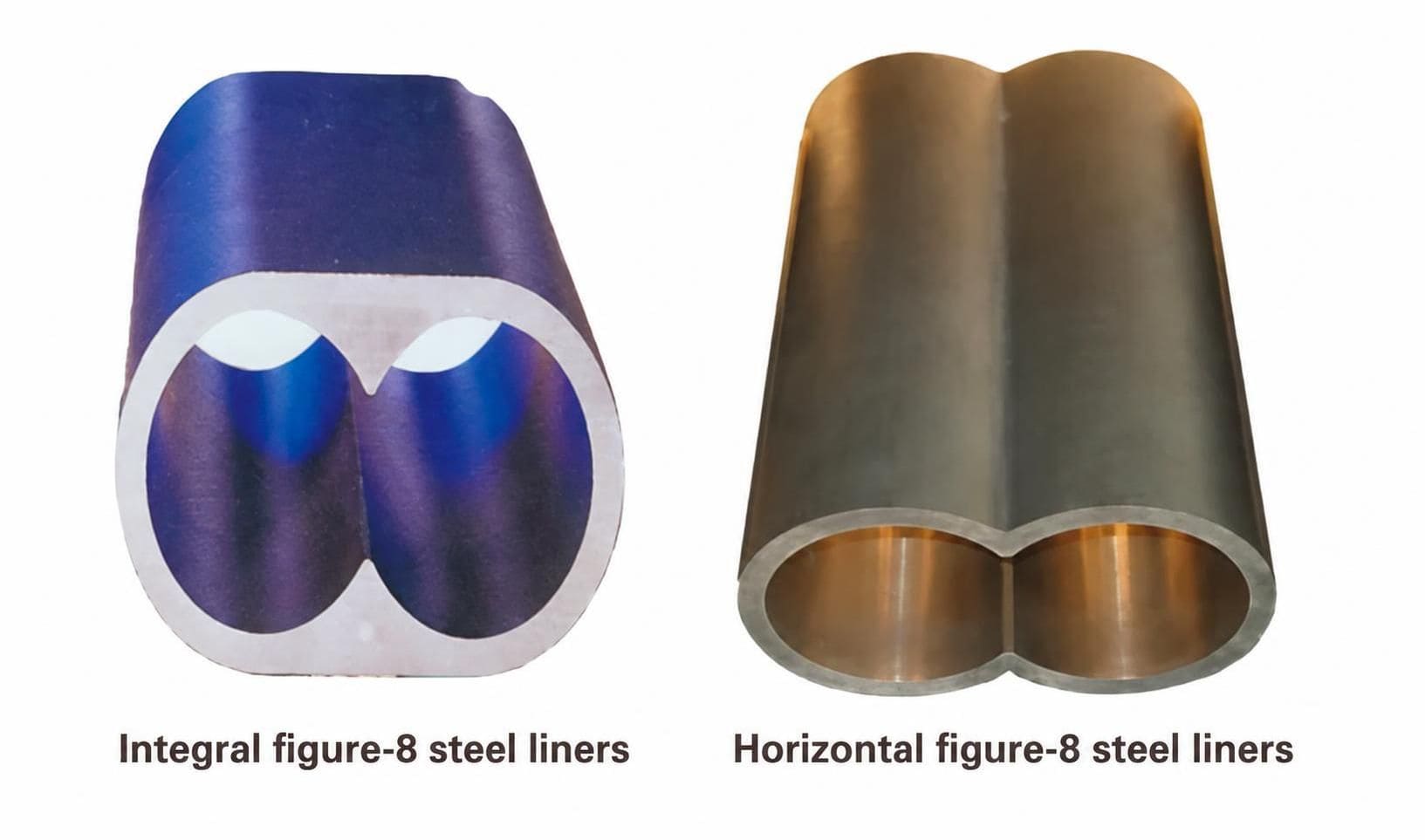
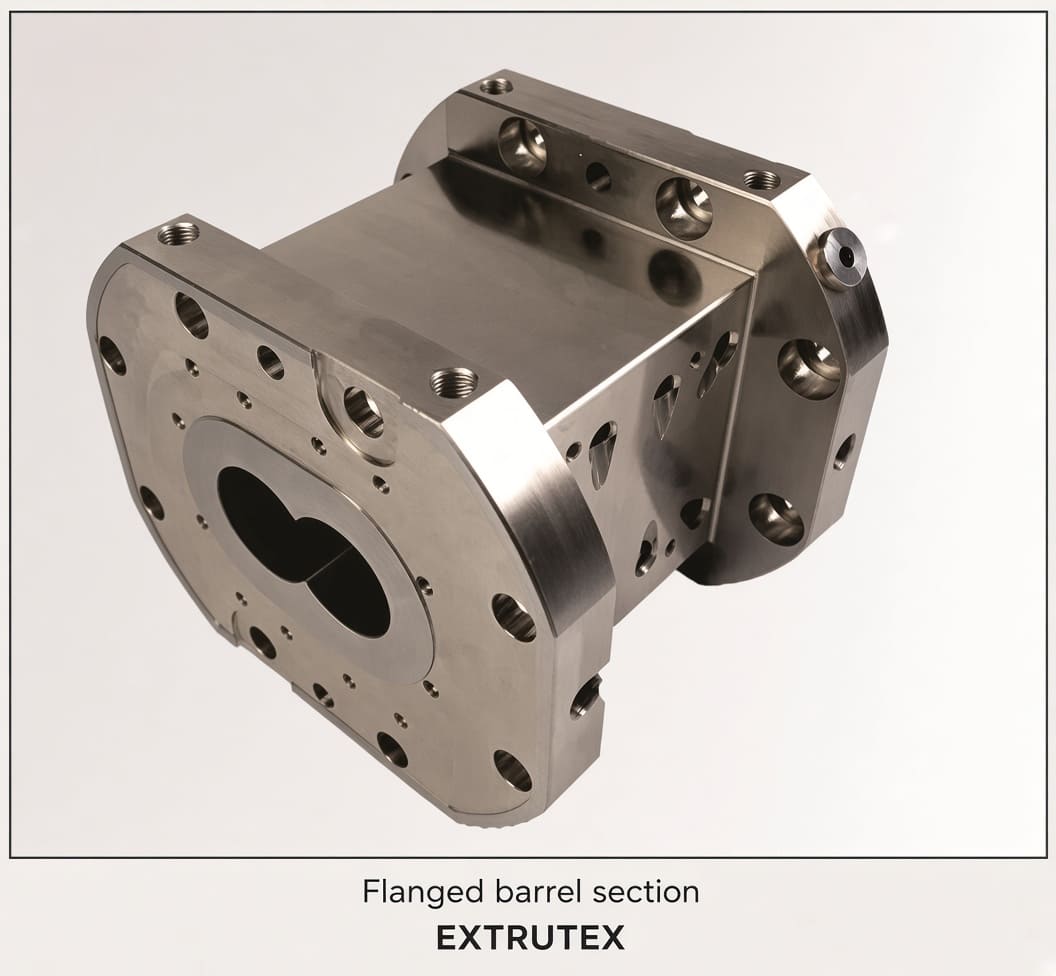
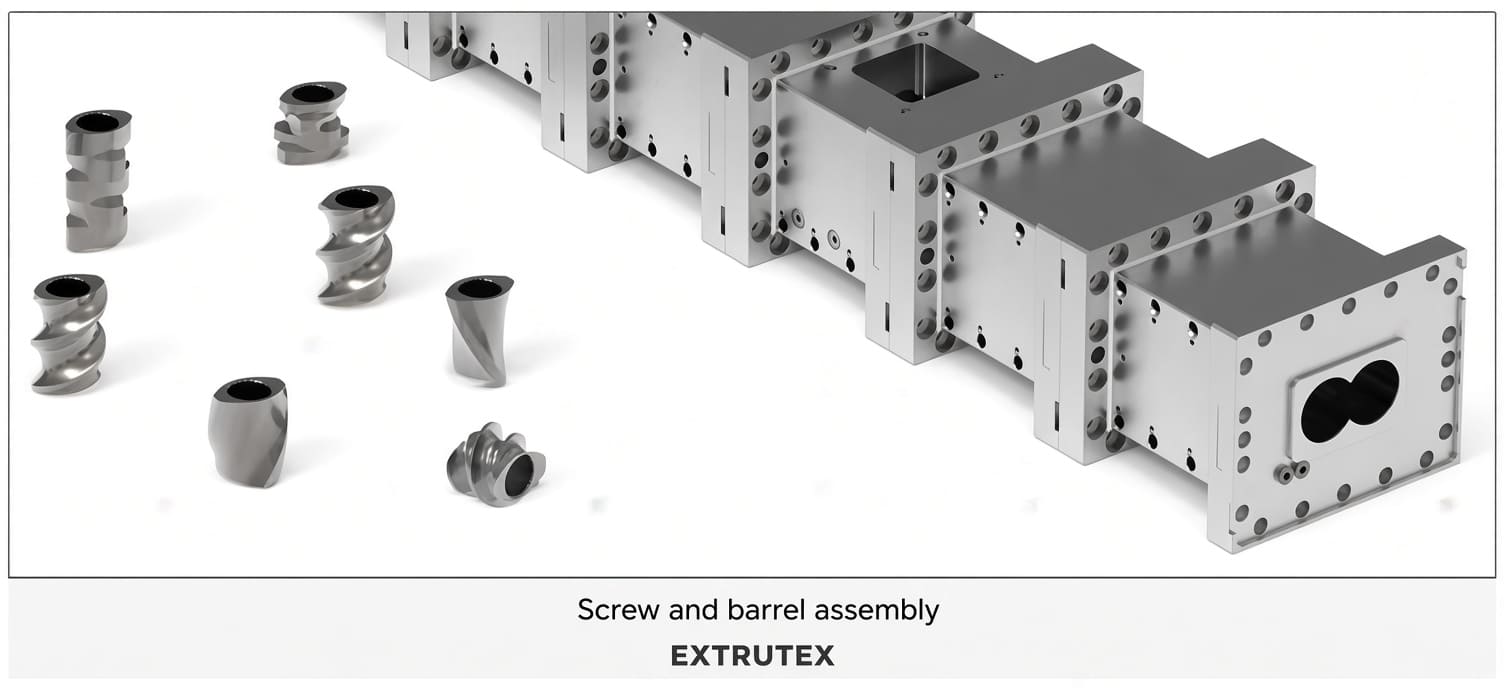
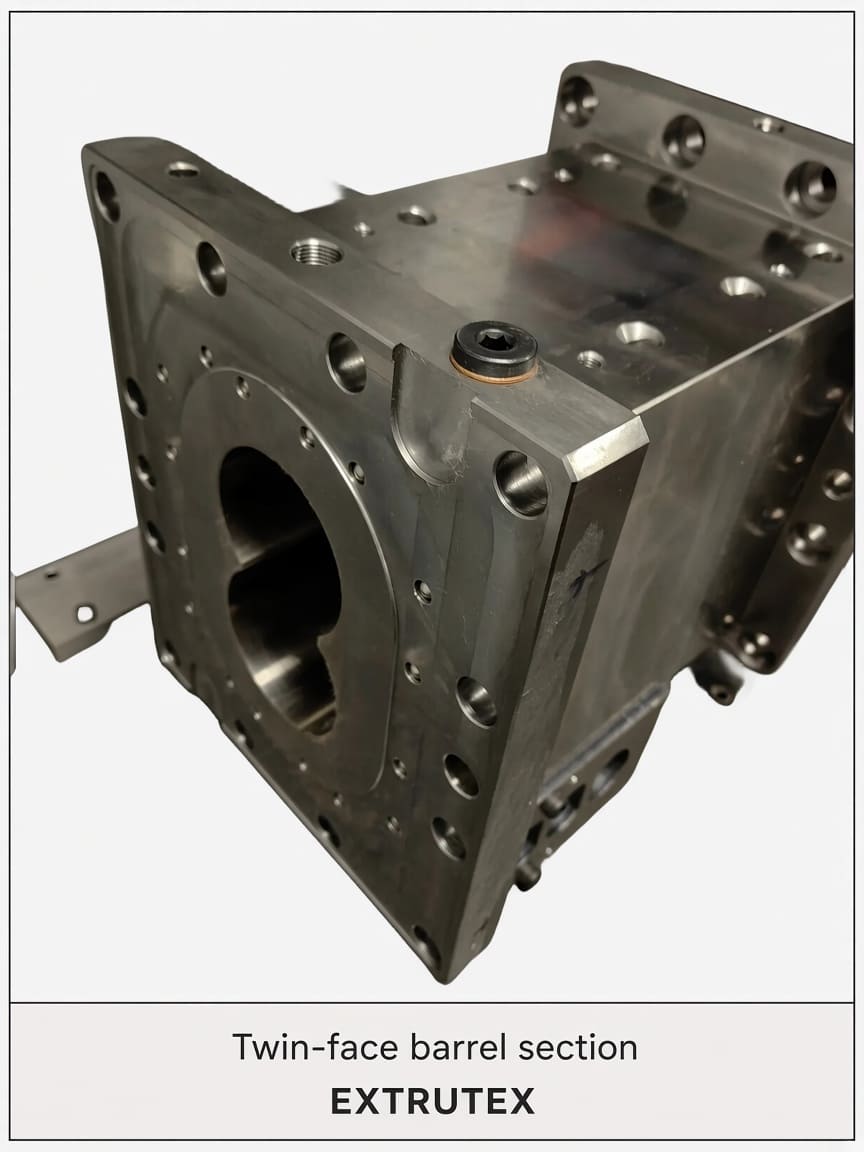
Different twin-screw extrusion applications require different barrel configurations. EXTRUTEX supplies integral steel liners, replaceable liner assemblies, large barrel bodies, flanged barrel sections and specialized sections with side outlets or additional process openings.
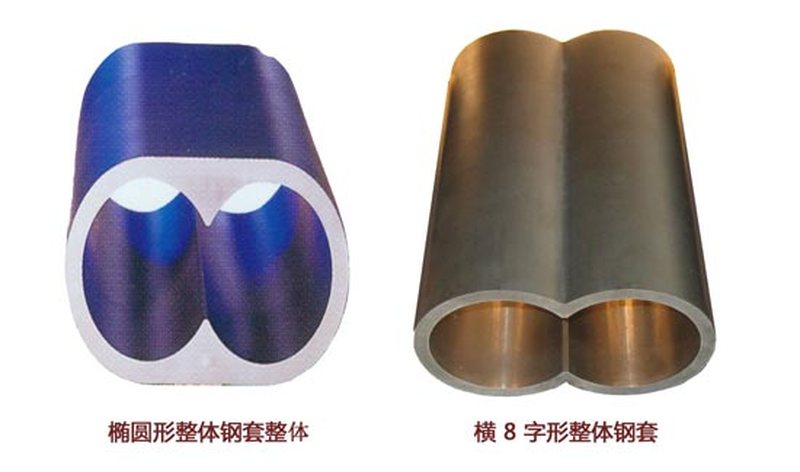
Integral figure-8 steel liners.
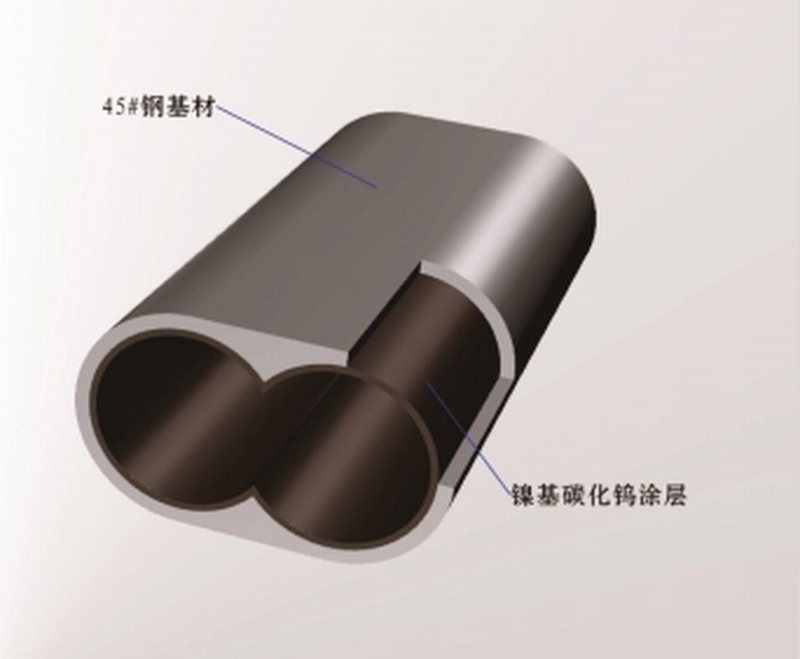
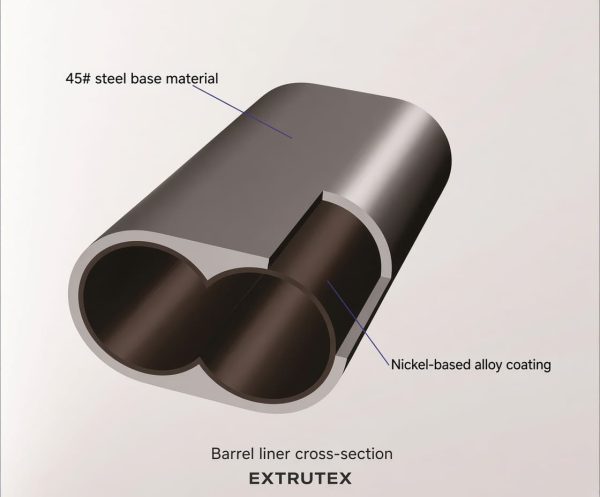
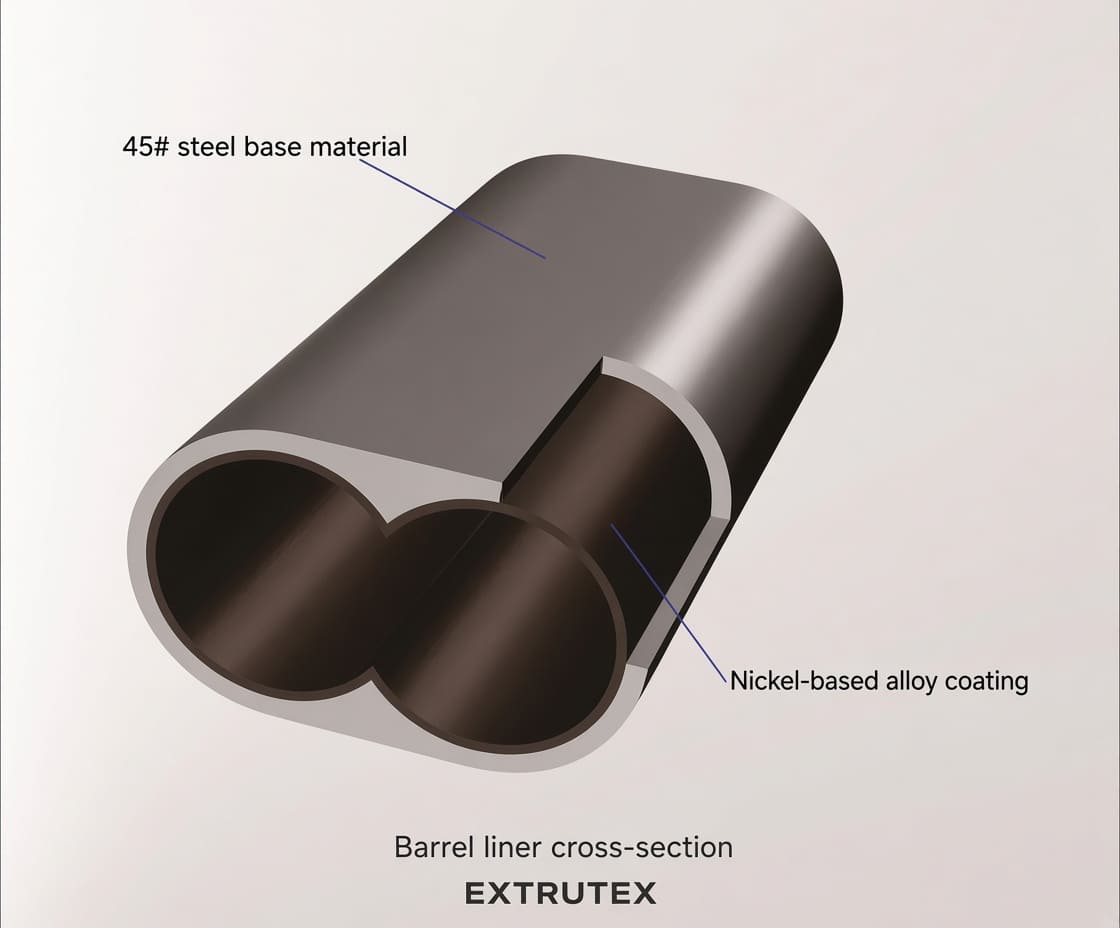
Barrel liner cross-section and internal construction.
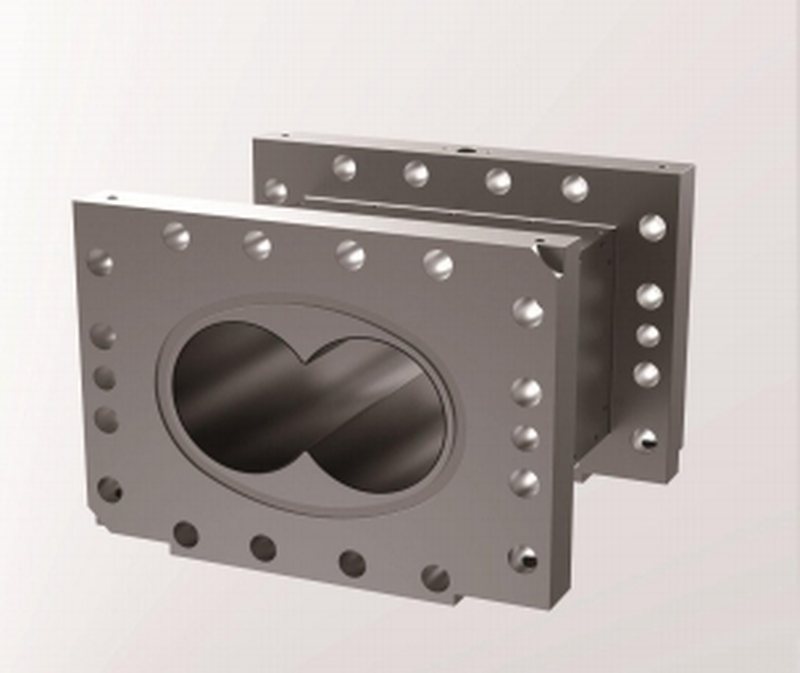
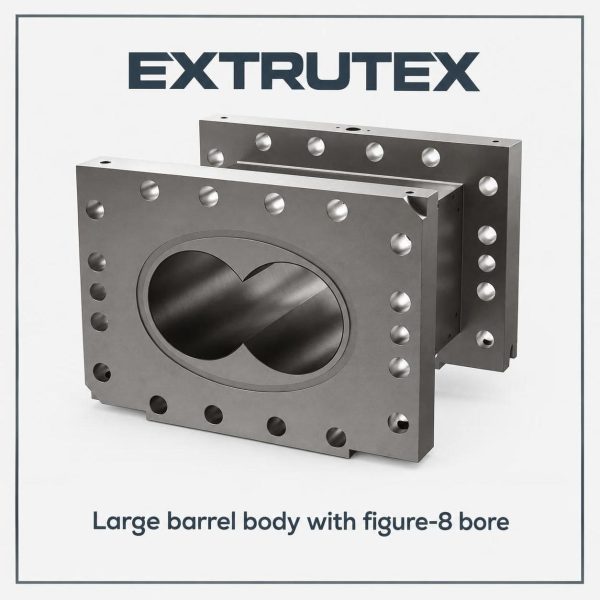
Large-diameter barrel body with figure-8 bore.
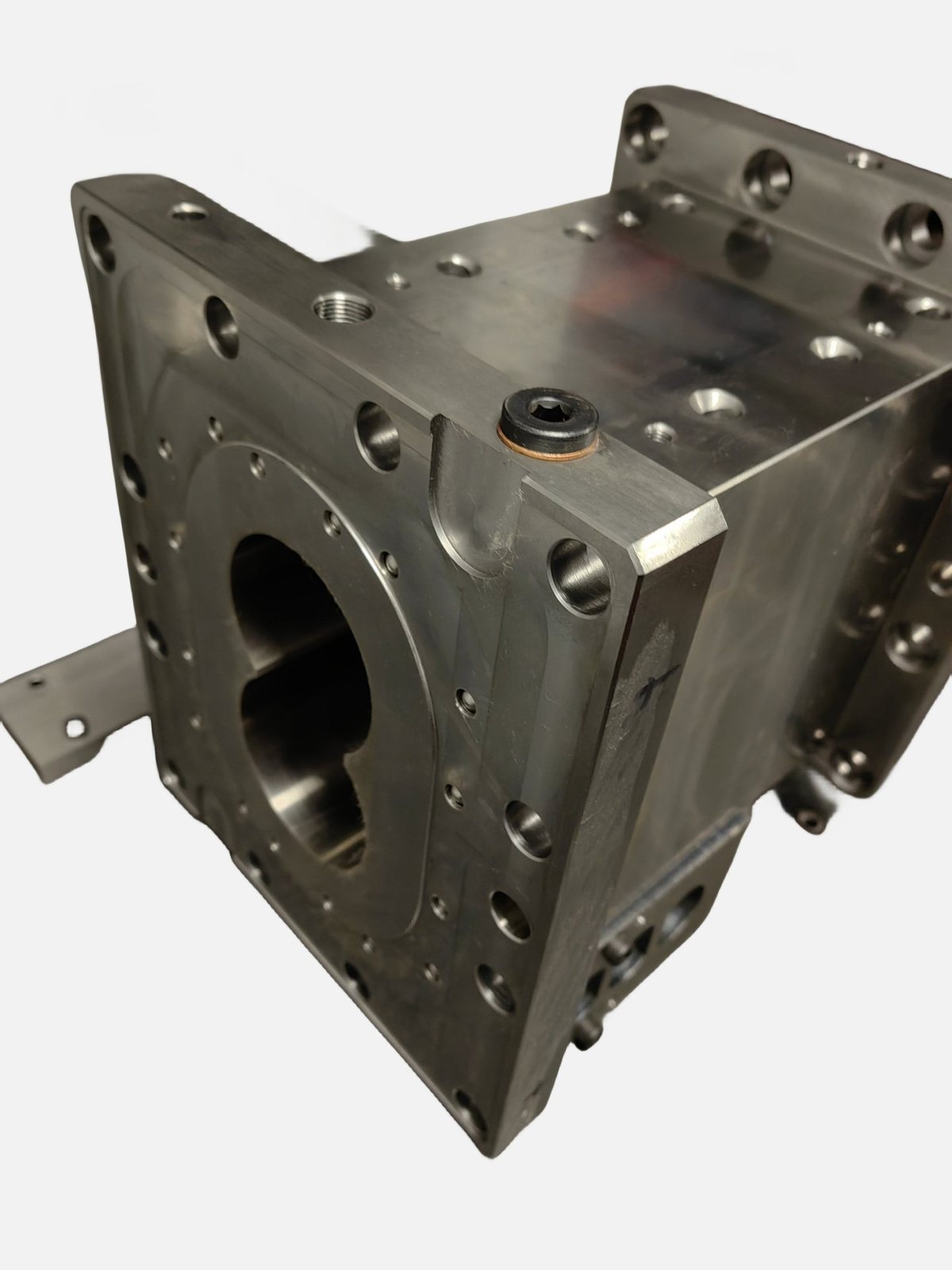
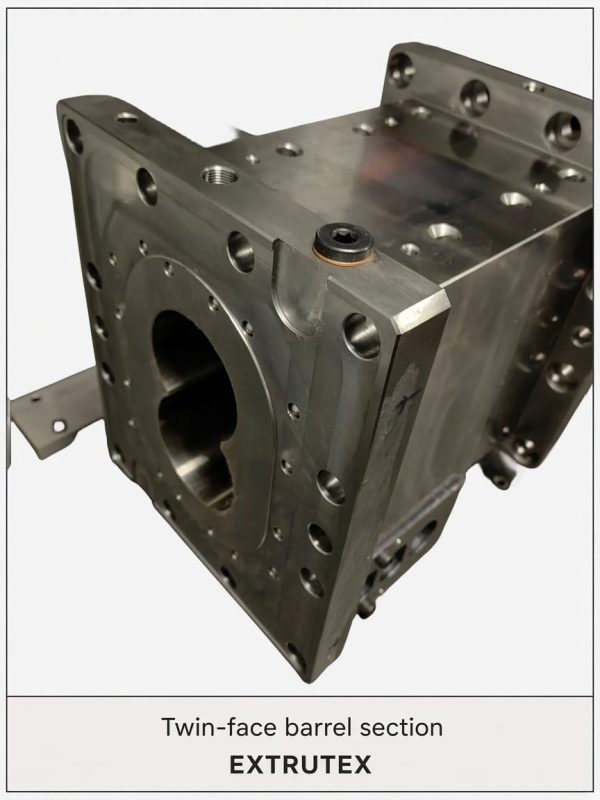
Twin-face barrel section.
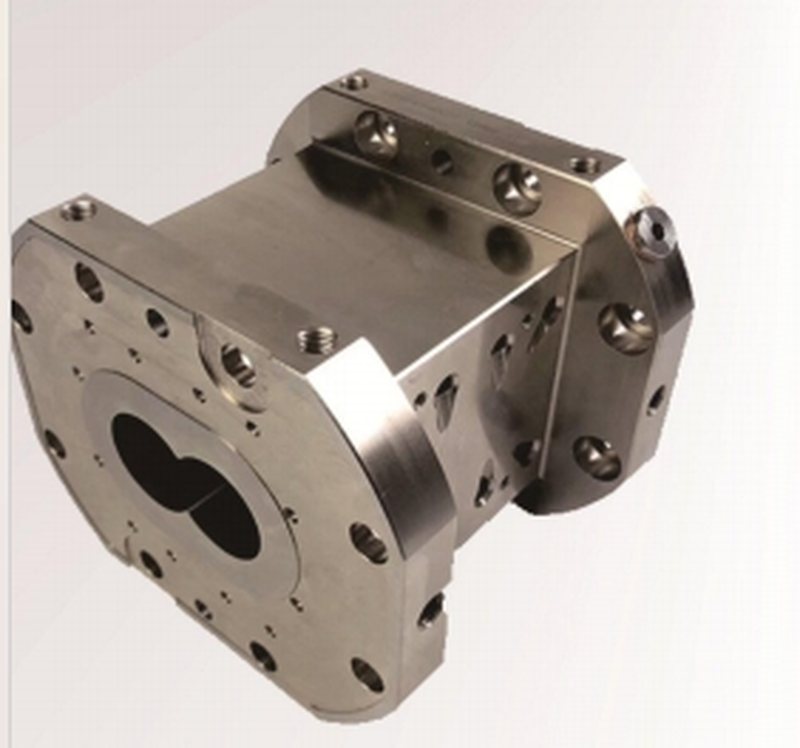
Flanged barrel section.
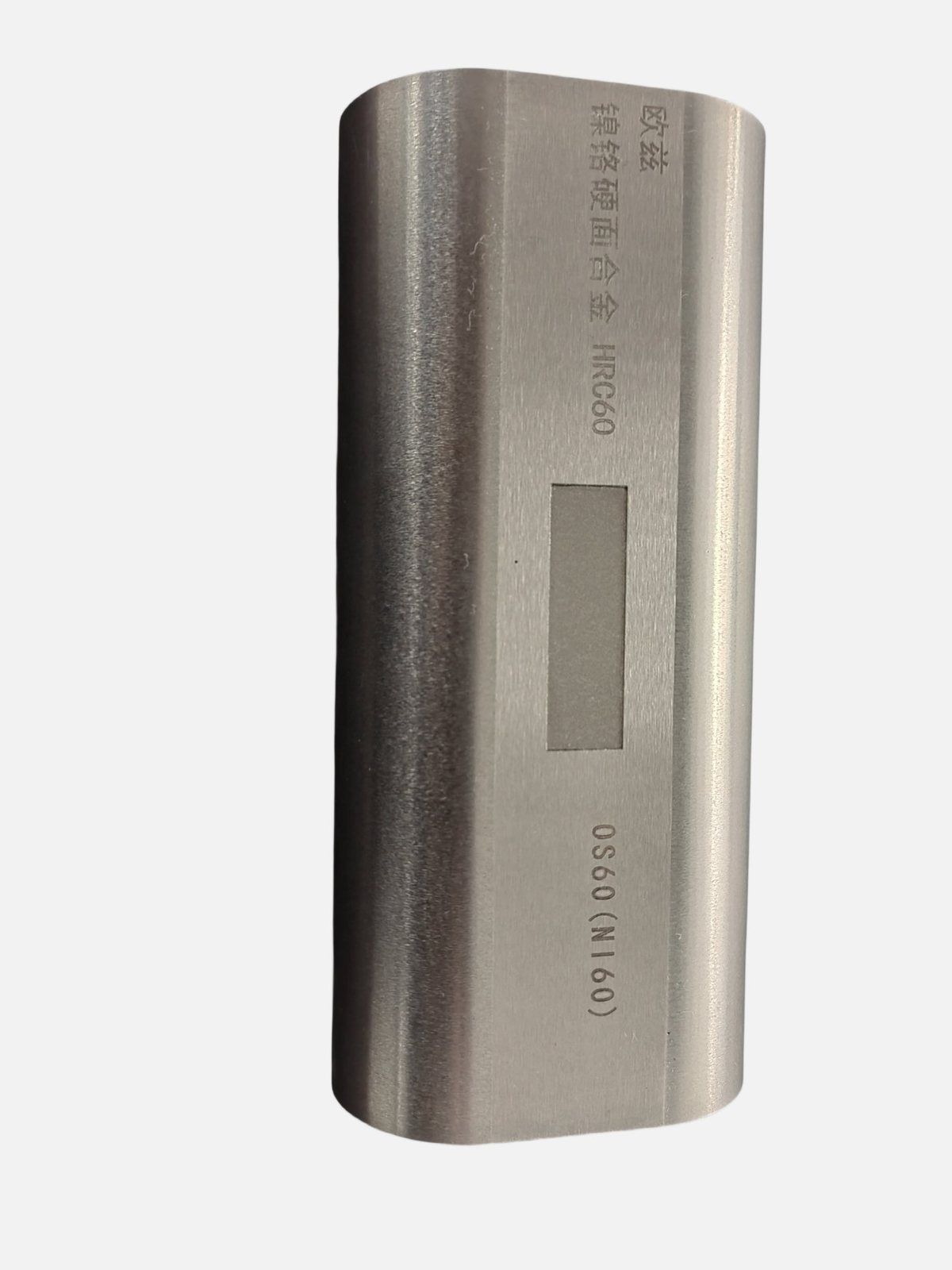
Barrel section with side outlet.
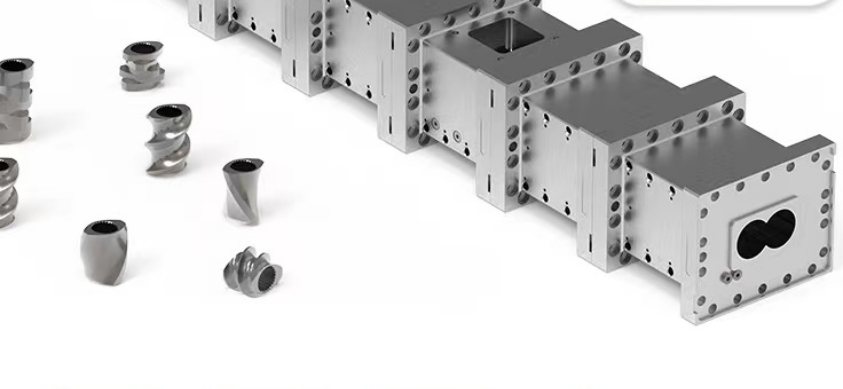
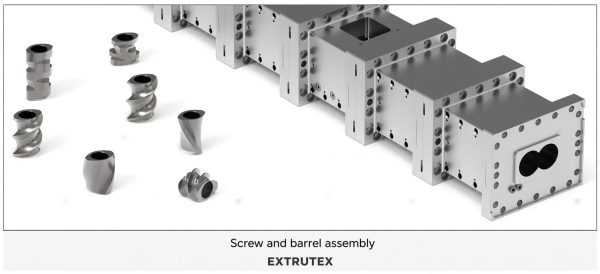
Twin-screw and barrel assembly.
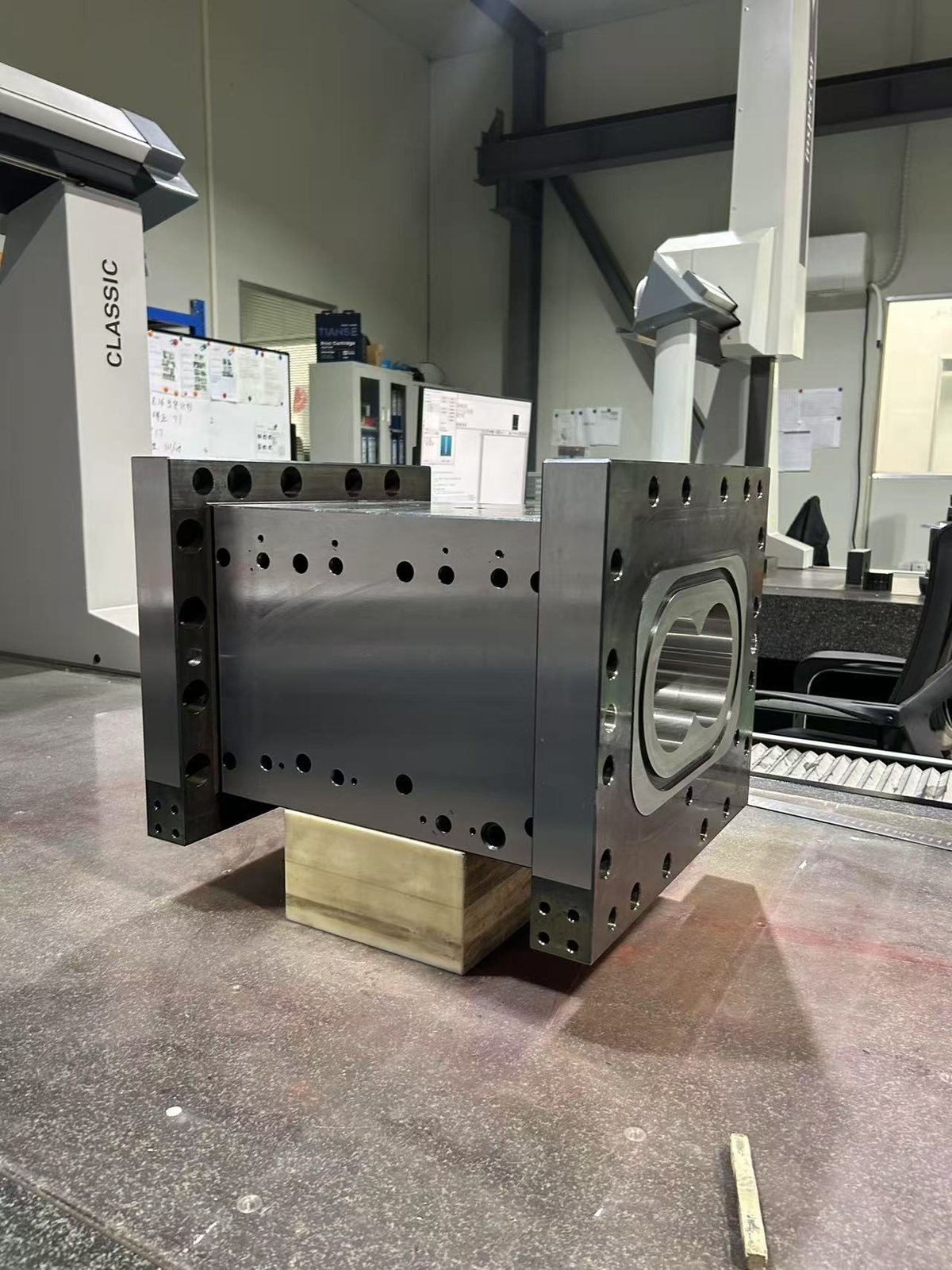
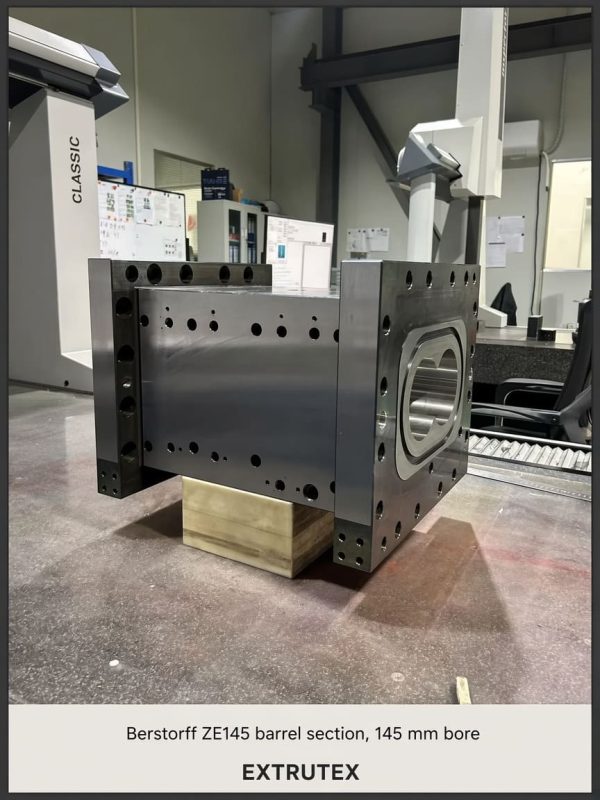
EXTRUTEX replacement barrel section for a 145 mm bore application.
The barrel body establishes the mechanical foundation of the extrusion system. Its internal bore must maintain precise dimensions throughout the working length, while its external surfaces must provide accurate mounting, heating and connection points.
EXTRUTEX machines barrel sections from solid steel billets. CNC boring equipment is used to produce the figure-8 internal geometry, followed by precision honing to achieve the required dimensional accuracy and surface finish. The centre distance between the two bores is particularly important because it determines the relationship between the screw flights and barrel walls.
During manufacturing, the following characteristics are considered:
Correct barrel geometry helps maintain the designed clearance between the screw flights and the barrel wall. This is essential for effective self-wiping action, material conveying, mixing and consistent processing.
The selection of barrel liner material depends on the processing application, filler content, chemical properties and expected operating conditions. Standard nitrided steel can be suitable for general compounding, while highly abrasive or corrosive materials require more advanced wear-resistant solutions.
EXTRUTEX offers four principal liner material options to cover different processing requirements.
| Liner Material | Manufacturing Process | Typical Hardness | Recommended Applications |
|---|---|---|---|
| Nitrided Steel | Nitrogen is diffused into the steel surface through a nitriding treatment. A typical steel grade is 38CrMoAlA. | 950–1100 HV | Unfilled and lightly filled polymers, general plastics compounding and standard extrusion applications. |
| α101 | High-alloy, wear-resistant liner grade supplied as a fitted liner insert. | According to the ordered material grade. | Filled polymer compounds and applications where conventional nitrided surfaces have insufficient service life. |
| HIP Powder Metallurgy | Gas-atomized tool-steel powder is consolidated using hot isostatic pressing to produce a dense, uniform liner. | 900–1100 HV | Glass-fibre compounds, mineral-filled materials and long production campaigns involving abrasive polymers. |
| Nickel-Based Tungsten-Carbide Laser Cladding | Tungsten-carbide particles are fused onto a nickel-based matrix and applied to the bore through laser cladding. | 1100–1400 HV | Highly abrasive and corrosive processing conditions, including demanding large-diameter barrel applications. |
Note: Hardness figures are typical indicative values. Actual material properties depend on the selected grade, manufacturing process and material certificate. EXTRUTEX confirms the applicable specification during order and drawing review.
Nitrided steel is commonly used in standard twin-screw extruders. The nitriding process improves surface hardness and provides a wear-resistant working layer while retaining the mechanical properties of the underlying steel. It is suitable for many unfilled and lightly filled polymer materials.
α101 is an alternative high-alloy wear-resistant liner option for applications that demand improved resistance compared with conventional nitrided steel. It is installed as a separate liner component and can be selected according to the processing material and required service conditions.
Hot isostatic pressing produces a dense powder-metallurgy structure by applying high temperature and pressure. This manufacturing approach provides a suitable material option for demanding applications involving glass fibres, calcium carbonate, talc and other abrasive fillers.
Nickel-based tungsten-carbide laser cladding provides a hard wear-resistant surface directly on the barrel bore. The coating combines a nickel-based matrix with tungsten-carbide particles. This option is particularly useful for large-diameter barrel sections and applications requiring resistance to severe abrasion and corrosion.
In addition to selecting the wear-resistant material, customers must decide how the wear layer is incorporated into the barrel assembly. EXTRUTEX provides two principal construction methods: replaceable liners and linerless barrels.
| Construction Type | Structure | Maintenance Method | Main Characteristics |
|---|---|---|---|
| Barrel with Replaceable Liner | A separate wear-resistant sleeve or insert is installed inside the main barrel body. | The worn liner can be removed and replaced while retaining a suitable barrel body. | Allows replacement of the wear component without replacing the entire barrel assembly. |
| Linerless Barrel | The wear-resistant layer is applied directly to the internal bore of the barrel body, commonly through laser cladding. | The bore can be restored through an appropriate surface restoration process when technically feasible. | Eliminates the separate liner interface and can accommodate a thicker wear-resistant layer on large sections. |
In a lined barrel, the main barrel body supports a separate internal liner. The liner provides the working surface and takes the majority of the abrasive wear generated during extrusion. Depending on the design, the main body can use a different steel grade from the liner.
When the liner reaches its allowable wear limit, it can be replaced without manufacturing an entirely new barrel body, provided the surrounding structure remains suitable for continued use. This construction offers a practical maintenance solution for many compounding applications.
A linerless barrel does not contain a separate internal sleeve. Instead, the wear-resistant layer is applied directly to the internal bore. Laser cladding can be used to create the working surface, reducing the need for a separate liner-to-body interface.
This construction is commonly considered for large-diameter and petrochemical applications where a thicker wear layer and the elimination of a separate thermal interface may be beneficial. The appropriate construction depends on barrel size, processing conditions and maintenance requirements.
A worn twin-screw extruder barrel does not always need to be replaced. Depending on the extent of wear, the condition of the barrel body and the integrity of the figure-8 bore intersection, refurbishment may restore the component to its required working dimensions.
EXTRUTEX provides barrel refurbishment services involving re-boring, honing, new liner installation and suitable bore restoration processes. The objective is to recover the required internal geometry and surface condition while maintaining compatibility with the existing screw assembly.
Approximately 0.5 mm of diametrical wear is often used as a practical reference for evaluating whether re-boring may be possible. However, this is not a universal acceptance limit. The actual decision depends on the original dimensions, maximum allowable oversize, screw clearance and remaining material condition. If the nitrided case has worn through to the base metal, the surface condition must also be assessed.
| Refurbishment Process | Description |
|---|---|
| Re-boring | The figure-8 bore is machined to an appropriate oversize dimension where sufficient material remains. |
| Precision Honing | The internal bore is finished to improve dimensional accuracy and surface quality. |
| Liner Replacement | New wear-resistant liners are installed in suitable lined barrel constructions. |
| Bore Restoration | An appropriate weld overlay or laser-cladding restoration process can be considered according to the barrel design and material. |
| CMM Verification | Dimensional inspection verifies the finished barrel against the agreed drawing and tolerance requirements. |
Before refurbishment, EXTRUTEX recommends inspecting the entire barrel section, including the bore intersection, flange areas, heating channels and mounting surfaces. A barrel with structural cracks or damaged critical mounting areas may not be suitable for refurbishment.
Food and feed extrusion applications have additional requirements beyond ordinary plastics compounding. Barrel surfaces must be suitable for the processed materials and cleaning procedures. Surface finish, material selection and internal geometry are important considerations because product accumulation and difficult-to-clean areas can affect hygiene and production management.
EXTRUTEX manufactures customized barrel sections for food and feed extrusion platforms according to customer specifications and equipment drawings.
For food and feed processing equipment, barrel selection should be considered together with the other extrusion components, including screw elements, kneading blocks, shafts and liners. The complete material-contact system must be appropriate for the processing requirements.
Large-scale petrochemical polymerization and compounding plants use heavy-duty twin-screw extrusion equipment with substantially larger screw diameters than standard compounding machines. EXTRUTEX provides large-diameter barrel sections and refurbishment solutions for applications starting at approximately 300 mm screw diameter and above.
These installations require specialized mechanical construction because of their size, operating loads and process configurations. Barrel bodies may incorporate heavy flanges, multiple process ports, side outlets and specialized internal wear-resistant surfaces.
Depending on the polymer, filler system and operating environment, HIP powder-metallurgy liners or nickel-based tungsten-carbide laser cladding can be considered.
| Parameter | Large-Diameter Barrel Solutions |
|---|---|
| Application range | Large-scale petrochemical polymerization and compounding lines |
| Screw diameter | Approximately 300 mm and above |
| Wear-resistant options | HIP powder-metallurgy liners or laser-clad tungsten carbide |
| Barrel configuration | Heavy flanges, multi-port sections and side outlets |
| Manufacturing | Customized according to drawings and technical specifications |
| Service | New manufacturing, inspection and refurbishment where technically feasible |
Plastics compounding is one of the most demanding applications for twin-screw extruder barrels. During operation, the barrel is exposed to continuous mechanical loading, friction, heat and different chemical environments. The addition of glass fibres, mineral fillers, pigments and other additives can significantly increase the abrasive conditions inside the extrusion system.
For these applications, the correct combination of liner material, barrel construction, bore geometry and heating configuration is essential. EXTRUTEX supplies different wear-resistant barrel solutions to match the material being processed and the required production conditions.
| Processing Material | Barrel Considerations | Potential Liner Selection |
|---|---|---|
| Unfilled polymers | General wear resistance and stable bore geometry. | Nitrided steel |
| Calcium carbonate-filled compounds | Increased resistance to abrasive mineral particles. | HIP PM or α101 according to conditions |
| Glass-fibre-reinforced polymers | High resistance to continuous abrasive wear. | HIP PM |
| Highly abrasive compounds | Advanced wear-resistant working surfaces. | HIP PM or tungsten-carbide laser cladding |
| Corrosive formulations | Material compatibility and resistance to chemical attack. | Selected high-alloy or laser-clad solutions |
| Masterbatch production | Wear resistance appropriate to the pigment and filler formulation. | Selected according to compound composition |
EXTRUTEX can manufacture replacement barrels according to the original machine drawings and inspect worn components to determine whether re-boring, re-lining or complete replacement is the most suitable option.
Barrel wear develops gradually during normal production. However, excessive wear can change the designed clearance between the screw flights and the barrel wall. When this happens, the screws may no longer operate with their intended self-wiping geometry.
Common causes of barrel wear include:
Regular inspection of the screw and barrel assembly helps identify wear before it develops into a more serious mechanical problem.
Accurate measurement is essential when deciding whether a barrel can be refurbished. EXTRUTEX recommends using an internal micrometer or suitable bore gauge with the barrel at room temperature.
Measurements should be taken at several positions along each barrel section. Both circular areas of the figure-8 bore should be checked, using consistent measuring positions and recording the results against the original nominal dimensions.
| Inspection Position | Measurement Requirement | Purpose |
|---|---|---|
| Front section | Measure both bores along horizontal and vertical axes. | Identify wear near the barrel entrance. |
| Middle section | Measure both bores along horizontal and vertical axes. | Evaluate wear through the central working area. |
| Rear section | Measure both bores along horizontal and vertical axes. | Identify wear near the barrel outlet. |
| Bore intersection | Inspect the connecting region between the two circles. | Check for cracks and abnormal surface damage. |
| External structure | Inspect flanges, heating channels and mounting areas. | Evaluate structural condition and refurbishment suitability. |
The wear pattern is as important as the measured diameter. Concentrated wear at the bottom of a bore may indicate unsuitable operating or purging conditions, while wear concentrated on one side can suggest possible alignment problems between the screw shaft and barrel.
Not every worn barrel requires the same repair process. The correct solution depends on the amount of material loss, the condition of the barrel body, the original construction and the maximum allowable bore dimensions.
| Condition | Recommended Approach | Reason |
|---|---|---|
| Moderate bore wear with sound barrel body and intersection | Re-boring and honing | Can restore the working geometry if the required oversize remains acceptable. |
| Worn replaceable liner with a suitable barrel body | Replace the liner | Restores the wear surface while retaining the existing barrel body. |
| Suitable linerless barrel with restorable bore surface | Evaluate bore restoration | Laser cladding or another suitable restoration method may be considered. |
| Cracked figure-8 bore intersection | Replace the barrel section | Structural cracking cannot be resolved through ordinary re-boring or liner replacement. |
| Damaged flanges or heating channels | Technical assessment or replacement | Structural and functional integrity must be maintained. |
| Wear exceeds the maximum allowable oversize | Replace the barrel section | Further machining may make the barrel incompatible with the screw assembly. |
The barrel houses the twin screws and establishes the working clearance between the screw flights and internal bore. It provides the controlled processing space required for conveying, mixing, melting and compounding polymer materials. Its geometry and wear condition directly influence the extrusion process.
A figure-8 bore consists of two connected circular bores arranged around the centre distance of the twin screws. This configuration allows the screws to intermesh and operate with a self-wiping action. Accurate machining of both bores is necessary to maintain the intended screw clearance.
Approximately 0.5 mm of diametrical wear is often used as an initial reference when evaluating refurbishment. However, the actual allowable wear depends on the original bore dimensions, screw clearance, barrel design and maximum permitted oversize. EXTRUTEX recommends inspecting the barrel before deciding on a repair.
Yes. Customers can provide an existing barrel, a worn section or a dimensional sketch. EXTRUTEX can evaluate the component and establish the necessary dimensions, including bore diameter, centre distance, section length, flange dimensions and bolt pattern. Additional measurements may be required before manufacturing.
The available material options include nitrided steel, α101, HIP powder-metallurgy liners and nickel-based tungsten-carbide laser cladding. The appropriate selection depends on the polymer formulation, abrasive filler content, corrosive conditions and expected operating requirements.
Nitrided steel uses a surface-hardening process in which nitrogen is diffused into the steel surface. HIP powder metallurgy uses hot isostatic pressing to consolidate metal powder into a dense liner. HIP PM is generally considered for more demanding abrasive applications, including glass-fibre and mineral-filled compounds.
Neither construction is universally better. A replaceable liner allows the worn component to be changed while retaining a suitable barrel body. A linerless design applies the wear-resistant layer directly to the bore and removes the separate liner interface. Selection depends on barrel dimensions, material requirements and maintenance strategy.
Yes, provided the barrel structure and bore intersection remain suitable. Possible procedures include re-boring, honing, liner replacement and appropriate bore restoration. A barrel with serious structural cracking or damage to critical mounting areas may require complete replacement.
Inspect both the screw elements and the barrel bore. Worn screw flights can change the designed clearance and create abnormal rubbing conditions. Uneven barrel wear may also indicate misalignment or other mechanical problems. Both components should be evaluated together before installing replacement parts.
Use an internal micrometer or bore gauge at room temperature. Measure both circular bores at the front, middle and rear positions of each barrel section. Record horizontal and vertical measurements and compare them with the nominal dimensions on the original drawing. Also inspect the bore intersection for cracks and surface damage.
The intersection is a geometrically important and highly stressed region of the barrel. Thermal cycling, mechanical stress and material fatigue can contribute to cracking. The condition should be inspected carefully because a structural crack at the intersection is a serious reason to consider replacing the barrel section.
Yes. Glass fibres can cause significant abrasive wear during compounding. EXTRUTEX offers wear-resistant solutions including HIP powder-metallurgy liners and other suitable materials selected according to the processing conditions and required service life.
Yes. EXTRUTEX provides customized large-diameter barrel solutions for industrial compounding and petrochemical extrusion applications, including screw diameters from approximately 300 mm upward. Construction can include heavy flanges, multiple process ports and specialized wear-resistant surfaces.
Yes. Customized barrel sections can be manufactured according to the equipment drawings and application requirements. Options include polished or plated bores, suitable steel and liner grades, and customized section lengths and connection dimensions.
For Chinese standard-machine replacement parts, ex-stock availability may allow immediate dispatch. For imported-machine replacement components, approximately 30–45 days should be allowed after material availability and drawing confirmation. Actual delivery depends on the component design, material selection and manufacturing requirements, in addition to transit time.
Provide the extruder model, screw diameter, original barrel drawing or sample, bore dimensions, centre distance, section length, flange dimensions, bolt pattern and heating configuration. Photographs of the existing barrel can also help with the initial evaluation.
Use a barrel liner appropriate for the processed formulation, inspect screw elements regularly, monitor bore wear and maintain correct screw-to-barrel alignment. Avoid operating with severely worn screw elements because they can cause additional damage to the barrel. Regular inspection helps identify problems before they develop into major component failures.
EXTRUTEX provides complete barrel bodies, barrel sections, replaceable liners and specialized wear-resistant internal surfaces. The supply scope can be customized according to the customer's equipment requirements.
Yes. Barrel sections can be designed with cartridge heater openings or oil heating channels. Cooling bores can also be considered according to the original machine configuration and customer requirements.
Critical dimensions are checked against the agreed technical drawing. Inspection can include bore diameter, centre distance, section length, flange dimensions and other specified features. CMM verification is used for dimensional inspection before shipment.
EXTRUTEX provides twin-screw extruder barrels, replacement liners and refurbishment solutions for industrial polymer processing and compounding equipment. Our product range covers standard and customized barrel sections, different wear-resistant material grades and both lined and linerless constructions.
Whether you need a complete replacement barrel, an individual liner, a large-diameter barrel section or refurbishment of an existing component, our technical team can evaluate your requirements and prepare a suitable manufacturing proposal.
There are no reviews yet.

-
(0 customer reviews)