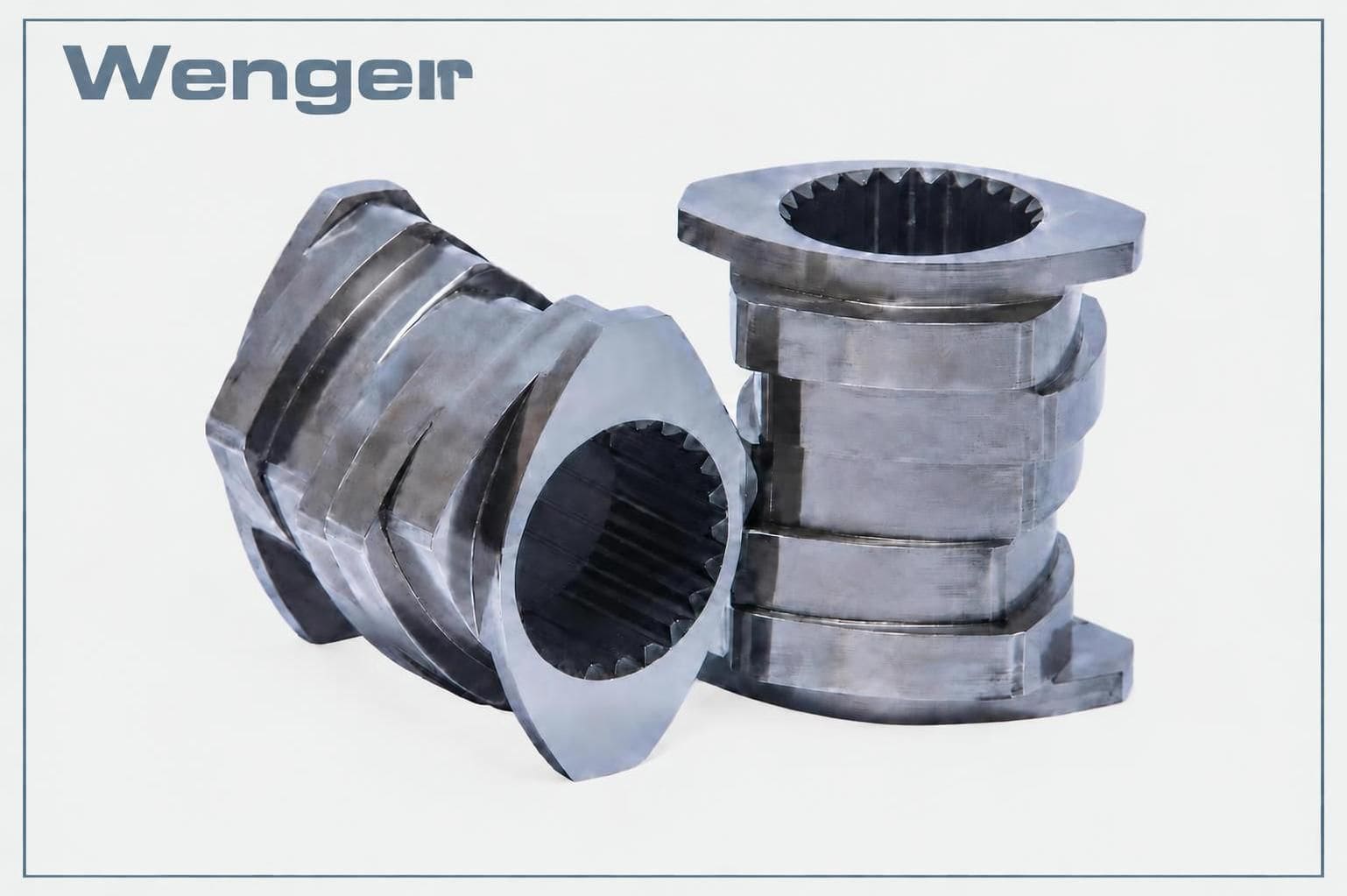
Wenger Extruder Parts: Screw Elements and Wear Liners for TX and Magnum Extruders
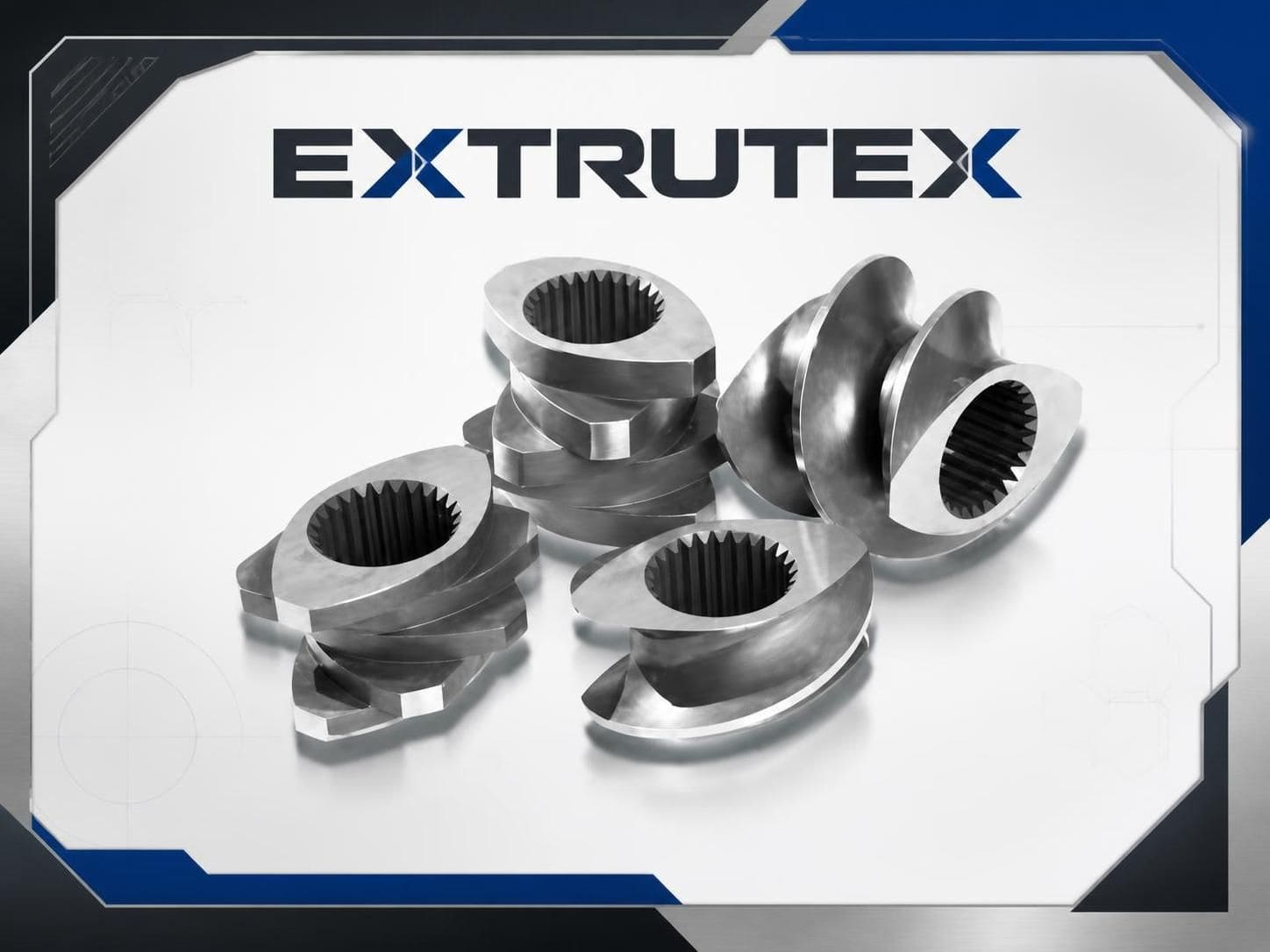
EXTRUTEX manufactures replacement screw elements, kneading blocks, wear liners, barrel sections and screw shafts for Wenger TX and Magnum series extruders. Our replacement components are intended for pet food, aquafeed and food extrusion applications, including abrasive recipes, high-moisture processing and demanding continuous production.
For larger extruders, barrel liner condition can determine when the machine needs to be opened for maintenance. Replacing screw elements without checking the barrel bore can leave the new components operating with excessive clearance. This can accelerate wear and reduce the service life of the replacement screw set.
EXTRUTEX manufactures components according to confirmed technical drawings or measured reference samples. We check the relevant dimensions and interfaces to establish compatibility with the specific Wenger machine configuration.
Important maintenance consideration: Check both screw flight wear and barrel liner condition before ordering replacement components. A new screw set installed in an oversized barrel bore may not restore the intended operating clearance.
Technical Specifications
| Technical Data |
Specification |
| Models covered |
Wenger TX and Magnum series extruders |
| Applications |
Pet food, aquafeed and food extrusion |
| Available components |
Screw elements, kneading blocks, wear liners, barrel sections and screw shafts |
| Interchangeability |
Manufactured to confirmed OEM dimensions or measured reference samples |
| Product-contact materials |
300-series stainless steel and suitable corrosion-resistant grades |
| Abrasive-duty material |
Suitable corrosion-resistant grade, with 58–62 HRC specified where the material and heat treatment permit |
| Dimensional verification |
CMM inspection report per batch |
| Minimum order |
1 piece |
| Documentation |
EN 10204 3.1 material certificate on request |
| Typical lead time |
30–45 days after material availability and geometry confirmation, plus transit |
Wenger TX and Magnum: Capacity Changes the Wear Pattern
The TX and Magnum series cover different machine capacities and production requirements. The resulting differences are not limited to machine size or component part numbers. Throughput, barrel dimensions, operating pressure, recipe composition and production conditions influence how wear develops across the screw and barrel assembly.
On larger machines, the screw elements are not necessarily the first components to reach their replacement limit. The barrel wear liner can become the controlling maintenance item, particularly in applications involving abrasive ingredients and extended production campaigns.
Why barrel liners matter on larger machines
A large barrel contains a substantial internal working surface. During operation, abrasive material moves through the barrel under mechanical loading, temperature and pressure. Over time, the liner can experience wear across a broad section of its internal surface.
The liner is a replaceable wear component. Its purpose is to provide the specified working surface and protect the barrel structure, while allowing maintenance to restore the internal bore when the liner reaches its service limit.
The important maintenance decision is not simply whether the screw elements look worn. The barrel bore must also be measured. If the bore has become oversized, fitting new screw elements alone may not restore the original clearance.
Avoid this replacement mistake: Do not install a new screw set into a barrel with an excessively worn bore without checking the resulting clearance. New elements operating inside an oversized liner may experience accelerated wear from the beginning of the production run.
Pet Food and Aquafeed: Wear from Two Directions
Pet food and aquafeed extrusion can expose screw elements and barrel liners to a combination of mechanical abrasion and chemical corrosion. The exact wear pattern depends on the recipe, raw materials, operating conditions and cleaning procedures.
1. Abrasion from recipe ingredients
Grain, mineral premixes, bone meal and other abrasive ingredients can wear the working surfaces of screw elements and barrel liners. As the flight crest gradually loses material, the original screw profile changes. At the same time, the barrel bore may become larger.
When both surfaces wear together, the operating clearance increases. This can influence material movement, process performance and the mechanical efficiency of the extrusion system.
2. Corrosion from salts and recipe chemistry
Marine aquafeed and selected pet food formulations may contain salt, acidic ingredients or other components that create corrosive conditions. Corrosion can produce pitting and surface deterioration before dimensional wear becomes obvious.
Material selection should therefore consider both corrosion resistance and abrasion resistance. A grade selected only for hardness may not provide the required corrosion performance in a particular recipe.
3. Cleaning and surface condition
Fat, meat slurry and other food ingredients influence cleaning requirements. Although these materials are not necessarily abrasive to steel, the cleaning process can affect polished surfaces, joints and crevices.
Cleaning chemicals, concentration, temperature, contact time and cleaning procedures should be considered when specifying product-contact materials and surface finishes.
Why Downstream Cleaning Does Not Reveal Barrel Wear
The coating and drying sections are downstream processes. They do not directly measure the internal condition of the extruder barrel or screw assembly.
A finished product may appear clean and consistent at the bagging end while the extruder is already operating with excessive internal clearance. For this reason, maintenance decisions should be based on inspection and measurement of the screw and barrel components rather than relying only on the appearance of the finished product.
Watch the Product: Early Signs of Screw and Liner Wear
Changes in pet food and aquafeed quality can provide useful indications that the extrusion process is changing. Product-side symptoms may appear before a mechanical failure or a major reduction in throughput.
Pet food indicators
- Falling pellet durability index at unchanged operating settings.
- Changes in bulk density.
- Variation in pellet dimensions or surface condition.
- Changes in expansion and product structure.
- Increasing variation between production batches.
Aquafeed indicators
- Changes in pellet density.
- Variation in sinking or floating behaviour.
- Changes in sink rate or water stability.
- Reduced consistency between production runs.
- Changes in pressure or material flow through the die.
These symptoms are not proof of component wear by themselves. Recipe composition, moisture, raw material variation, temperature, die condition and operating settings can also affect finished product characteristics. A dimensional inspection is required to determine whether screw or barrel wear is contributing to the change.
Measure Flight Crest and Barrel Bore at Planned Shutdowns
A useful maintenance programme records the condition of the screw elements and barrel bore at planned shutdowns. Measuring the flight crest and comparing it with the corresponding bore dimensions provides a more reliable indication of wear than visual inspection alone.
The measurement history can be used to monitor changes over successive production campaigns. A consistent trend helps maintenance teams estimate when replacement components should be ordered and when a planned shutdown should be scheduled.
Recommended inspection records
- Record the screw element identification and position.
- Measure the screw flight crest at specified inspection locations.
- Measure the corresponding barrel bore diameter.
- Check bore roundness where required.
- Record the location and extent of visible pitting or surface damage.
- Compare readings with previous maintenance records and the applicable machine tolerances.
- Keep the measurements with the machine maintenance history.
Plan against a shutdown, not a breakdown. A recorded wear trend gives the maintenance team time to confirm materials, drawings and replacement scope. A single measurement taken after a breakdown only confirms that the machine has already reached an unacceptable condition.
EXTRUTEX Replacement Parts for Wenger TX and Magnum
| Component |
Manufacturing Scope |
Replacement Considerations |
| Conveying screw elements |
Individual conveying elements and screw segments |
Match shaft interface, outer diameter, pitch and element length. |
| Kneading blocks |
Single-piece and assembled configurations |
Match stagger angle, profile and position in the screw arrangement. |
| Wear liners |
Replacement barrel liners and wear surfaces |
Confirm bore dimensions, liner construction, material and surface requirements. |
| Barrel sections |
Replacement barrel sections and associated components |
Verify internal dimensions and machine connection features. |
| Screw shafts |
Individual shafts and shaft assemblies |
Check spline or keyway, shaft geometry and mechanical requirements. |
Replacement Screw Elements and Kneading Blocks
Screw elements and kneading blocks determine how material is conveyed, mixed and processed through the extruder. Their dimensions and configuration must match the intended position on the shaft.
Conveying screw elements
Conveying elements move the recipe through the barrel and contribute to material transport, filling and pressure development. Element pitch, outside diameter, length and position all influence the screw configuration.
EXTRUTEX manufactures replacement conveying elements according to confirmed technical drawings or measured samples. Individual positions can be supplied when wear is localised.
Kneading blocks
Kneading blocks create mixing and mechanical working sections within the screw arrangement. Their stagger angles and geometry influence the way material moves through the processing zone.
We manufacture single-piece and assembled kneading blocks to the agreed dimensional specification. The replacement configuration must be checked against the machine generation and the intended screw position.
Wear Liners and Barrel Sections: The Critical Replacement Components
For larger Wenger machines, the wear liner can determine when the barrel must be opened for maintenance. The liner provides a replaceable internal working surface, and its condition should be assessed together with the screw elements.
When should a wear liner be replaced?
The decision depends on the measured bore dimensions, wear distribution, roundness, surface condition and the machine's applicable maintenance limits. A liner should not be replaced solely because it has reached a particular operating time.
Similarly, a liner should not be kept in service simply because it has no visible crack or mechanical failure. Excessive bore enlargement or localised wear can affect operating clearance even when the component remains physically intact.
Why replacing the screw set alone may not be enough
Screw elements and barrel liners work together. If the liner bore is oversized, a new screw set may operate with excessive clearance. This can affect material processing and may accelerate wear on the replacement elements.
Before ordering, EXTRUTEX recommends checking the screw flight crest and barrel bore as a pair. Where both components are outside the required limits, replacing the liner and affected screw elements together may be the more appropriate maintenance solution.
What Interchangeable Actually Means
Interchangeability means that the replacement component reproduces the critical dimensions and geometry required for the specified machine position. It must fit the shaft correctly, match the screw arrangement and provide the intended conveying or mixing geometry.
EXTRUTEX works from original technical drawings where available and from measured reference samples where drawings are unavailable.
Critical dimensions and features
- Same spline and keyway configuration.
- Same screw element outer diameter.
- Matching pitch and conveying geometry.
- Matching element length and axial dimensions.
- Matching stagger angles for kneading blocks.
- Correct centre distance and screw arrangement.
- Suitable mating dimensions and operating clearances.
Replacement components can be mixed with original parts on the same shaft when the relevant dimensions and geometry have been confirmed. Compatibility should never be assumed from the machine brand or the apparent similarity of two components.
Material Selection for Pet Food and Aquafeed Duty
The material grade should follow the recipe and operating environment, not simply the machine brand. A poultry feed application and a marine aquafeed application may require different material properties even when they use the same machine platform.
| Material Selection |
Typical Application |
Important Considerations |
| 300-series stainless steel |
General product-contact food applications |
Grade selection depends on corrosion conditions, cleaning procedures and process chemistry. |
| Corrosion-resistant hardened grade |
Abrasive recipes and selected demanding feed applications |
A suitable grade may be specified at 58–62 HRC where material composition and heat treatment permit. |
| Nitrided steel |
Suitable non-contact positions and specified components |
Used where the component design and application permit nitriding. |
| Tool steel |
Selected non-product-contact components |
Grade and heat treatment depend on mechanical and wear requirements. |
| Polished or plated bore |
Barrel internal surface |
Surface finish and treatment must match the original design and operating requirements. |
| Nitrided, alpha-101 or HIP PM liner |
Selected barrel liner applications |
Material and liner construction depend on the required wear and corrosion performance. |
| Laser-clad liner |
Selected high-wear barrel applications |
Cladding specification and suitability require confirmation against the barrel design. |
Balancing abrasion and corrosion resistance
Abrasive ingredients such as grain, mineral premix and bone meal can increase mechanical wear. Salt and acidic inclusions can contribute to corrosion. In marine aquafeed applications, these conditions may occur together.
Material selection should therefore consider hardness, corrosion resistance, wear resistance, process chemistry and cleaning requirements as a complete specification.
Material and food-contact qualification: A hardened or corrosion-resistant material is not automatically suitable for every product-contact application. Food-contact suitability must be confirmed for the actual grade, manufacturing condition and surface treatment. The 58–62 HRC range applies only to suitable corrosion-resistant grades with verified heat treatment, not to all stainless steels.
Manufacturing Without Original Drawings
EXTRUTEX can assess replacement components using measured reference samples when original technical drawings are unavailable. This is particularly useful for older machines or equipment with incomplete spare-parts documentation.
The reconstruction process begins with machine identification and component position. We then assess the reference part, identify unworn surfaces and use the available geometry to establish the manufacturing dimensions.
Sample-based manufacturing process
- Machine identification: Confirm the Wenger TX or Magnum model and machine size.
- Component identification: Identify the screw element, kneading block, liner or shaft position.
- Reference inspection: Measure the worn component and identify usable reference surfaces.
- Geometry reconstruction: Compare the sample with available drawings and assembly information.
- Technical confirmation: Agree on dimensions, material, surface treatment and inspection requirements.
- Manufacturing: Produce the replacement component to the confirmed specification.
- Final inspection: Check the relevant dimensions before packing.
If the original component is severely worn, one sample may not provide enough information to reproduce every feature accurately. An unworn reference element, technical drawing, additional component or assembly measurement may be required.
Dimensional Verification and Quality Documentation
Each shipment includes a dimensional inspection report. Additional inspection and material documentation can be supplied according to the order requirements.
| Inspection or Document |
Purpose |
| CMM dimensional report |
Records critical measured dimensions and geometry. |
| EN 10204 3.1 certificate |
Material documentation available on request. |
| Hardness results |
Records hardness against the specified material and treatment. |
| Case-depth records |
Available where applicable to the specified surface-hardening process. |
| Pre-shipment photographs |
Provides a visual record of the components before packing. |
Individual Components or Complete Replacement Sets
EXTRUTEX can supply individual replacement components, selected screw sections or complete matched sets. The appropriate scope depends on the inspection results and the condition of the existing screw and barrel assembly.
- Individual screw elements: Suitable when wear is limited to specific positions.
- Kneading block replacement: Suitable for localised wear in mixing and cooking sections.
- Wear liner replacement: Suitable when the barrel bore has reached its applicable wear limit.
- Combined screw and liner replacement: Appropriate when both components have excessive wear or clearance.
- Complete screw set: Suitable when wear is distributed across multiple sections or a full replacement is planned.
A complete set is not automatically the faster or more economical solution. Measuring the existing components first helps establish the correct replacement scope.
Lead Time and Shutdown Planning
The minimum order quantity is one piece. EXTRUTEX can manufacture individual screw elements, kneading blocks, wear liners, barrel sections and screw shafts.
The typical lead time is 30–45 days once the required material is available and the component geometry has been confirmed, plus transit time.
Wear liner grades that are not held in stock may require additional material procurement time. Special dimensions, surface finishes and material specifications can also extend the schedule.
For planned maintenance, the best approach is to begin the technical assessment before the machine reaches its replacement limit. This allows time to confirm the liner construction, material grade, drawings and inspection requirements.
Maintenance planning advice: Confirm the replacement liner and screw element requirements before the scheduled shutdown. Do not rely on breakdown maintenance when the material grade or liner dimensions require special procurement.
What to Send EXTRUTEX for a Quotation
The following information helps us identify the correct machine configuration and assess the replacement scope.
- Machine nameplate photograph: Confirm whether the equipment is a Wenger TX or Magnum series machine and identify the size.
- Worn element position: Identify the position on the shaft, if known.
- Whole screw photograph: Show the complete screw assembly where possible.
- Worn component photograph: Include a ruler or measuring reference.
- OEM part number: Provide the original number if it is available and legible.
- Barrel bore measurement: If the liner is suspected of wear, provide the measured bore diameter and roundness.
- Application information: Describe the recipe and whether the machine processes pet food, aquafeed or another food product.
- Material requirements: Include any specified corrosion resistance, hardness, surface finish or documentation requirements.
After reviewing the information, EXTRUTEX confirms the machine configuration, component dimensions and manufacturing requirements before preparing a quotation.
Why Choose EXTRUTEX for Wenger Extruder Parts?
- TX and Magnum replacement components: Screw elements, kneading blocks, wear liners, barrel sections and screw shafts.
- Wear liner manufacturing: Replacement liners for demanding pet food and aquafeed applications.
- Drawing-based production: Manufacturing against confirmed technical drawings and specifications.
- Sample-based reverse engineering: Replacement components can be assessed when original drawings are unavailable.
- Material selection: Options are evaluated against abrasive ingredients, corrosion conditions and product-contact requirements.
- Flexible order quantity: Individual components available from one piece.
- Dimensional verification: CMM inspection reports and supporting documentation available.
- Maintenance-focused replacement: Individual parts, matched sections or complete sets can be quoted according to actual wear.
EXTRUTEX combines Austrian design, laboratory and R&D capabilities with manufacturing in China. We focus on replacement components for industrial extrusion and compounding equipment, with technical assessment based on the actual machine and application.
Frequently Asked Questions
Do you supply wear liners for Wenger TX and Magnum extruders?
Yes. EXTRUTEX manufactures replacement wear liners and barrel sections alongside screw elements, kneading blocks and screw shafts. On abrasive pet food and aquafeed applications, the liner can reach its replacement limit before the screw elements. The bore should be measured before deciding on the replacement scope.
Should I replace the screw set and the wear liner at the same time?
Not automatically. Measure the screw flight crest and barrel bore before making the decision. If the bore remains within the applicable tolerance, replacing the worn screw elements alone may be appropriate. If the bore is oversized, new screw elements may operate with excessive clearance and wear faster. The correct solution depends on the measured condition of both components.
Which Wenger parts wear first on aquafeed applications?
Wear depends on the recipe and operating conditions. Cook-zone kneading blocks and barrel wear liners can experience demanding service. Mineral loading and abrasive ingredients contribute to mechanical wear, while salt and other recipe components may contribute to corrosion. Both conditions should be considered when selecting replacement materials.
Can you supply a Wenger screw element without an original drawing?
Yes. EXTRUTEX can manufacture from a measured reference sample. We assess the unworn sections and available assembly information to reconstruct the original profile. If the component is severely worn, additional reference information may be required.
Can you manufacture replacement parts for both TX and Magnum machines?
Yes. We can assess replacement components for Wenger TX and Magnum series extruders. The exact model, machine size, shaft interface and component geometry must be confirmed before production. Compatibility is not assumed across different machine configurations.
What measurements should I provide if the barrel liner is worn?
Provide the measured bore diameter and roundness, together with the machine nameplate photograph and available liner or barrel drawings. If possible, include measurements at multiple axial and circumferential positions so that localised wear and bore enlargement can be assessed.
Can replacement screw elements be mixed with original Wenger components?
Yes, where the relevant dimensions and geometry have been verified. The spline or keyway, outside diameter, pitch, element length, stagger angle and other mating features must match the intended position. Compatibility should be confirmed before installation.
What material do you recommend for abrasive pet food and aquafeed?
The material depends on the recipe, corrosion conditions and cleaning requirements. Suitable corrosion-resistant grades may be selected for demanding abrasive applications. The specified hardness, including a 58–62 HRC range where appropriate, must be supported by the selected material and heat-treatment process.
What inspection documents are available?
Each shipment includes a dimensional inspection report. CMM reports, EN 10204 3.1 material certificates, hardness results, applicable case-depth records and pre-shipment photographs are available according to the order requirements.
What lead time should I plan for?
Allow approximately 30–45 days once material is available and the geometry is confirmed, plus transit. A liner grade that is not held in stock or a special surface finish may require additional time. For planned maintenance, start the technical assessment before the scheduled shutdown.
What is the minimum order quantity?
The minimum order quantity is one piece. You can order an individual screw element, kneading block, wear liner, barrel section or screw shaft.
Request a Quotation for Wenger TX and Magnum Extruder Parts
Send EXTRUTEX a photograph of your machine nameplate, the worn screw element or liner, and the relevant component position. If the barrel bore is suspected of wear, include the measured bore diameter and roundness.
Our team will review the machine configuration, component geometry, material requirements and replacement scope before confirming compatibility and preparing a quotation.
EXTRUTEX – Replacement Screw Elements, Kneading Blocks, Wear Liners, Barrel Sections and Screw Shafts for Wenger Extruders.
Wenger is referenced solely to identify the equipment platform for which replacement components may be manufactured. EXTRUTEX is an independent replacement-parts manufacturer and is not affiliated with, authorised by or endorsed by Wenger. Compatibility is subject to machine identification and dimensional verification.





-
(0 customer reviews)