No products in the cart.



All rights of this website are reserved for EXTRUTEX Austria and its partner companies, © 2026


Multiple Payment Methods

Discount for advance payments over 50%

Free Shipping Coordination Services
Payment methods:


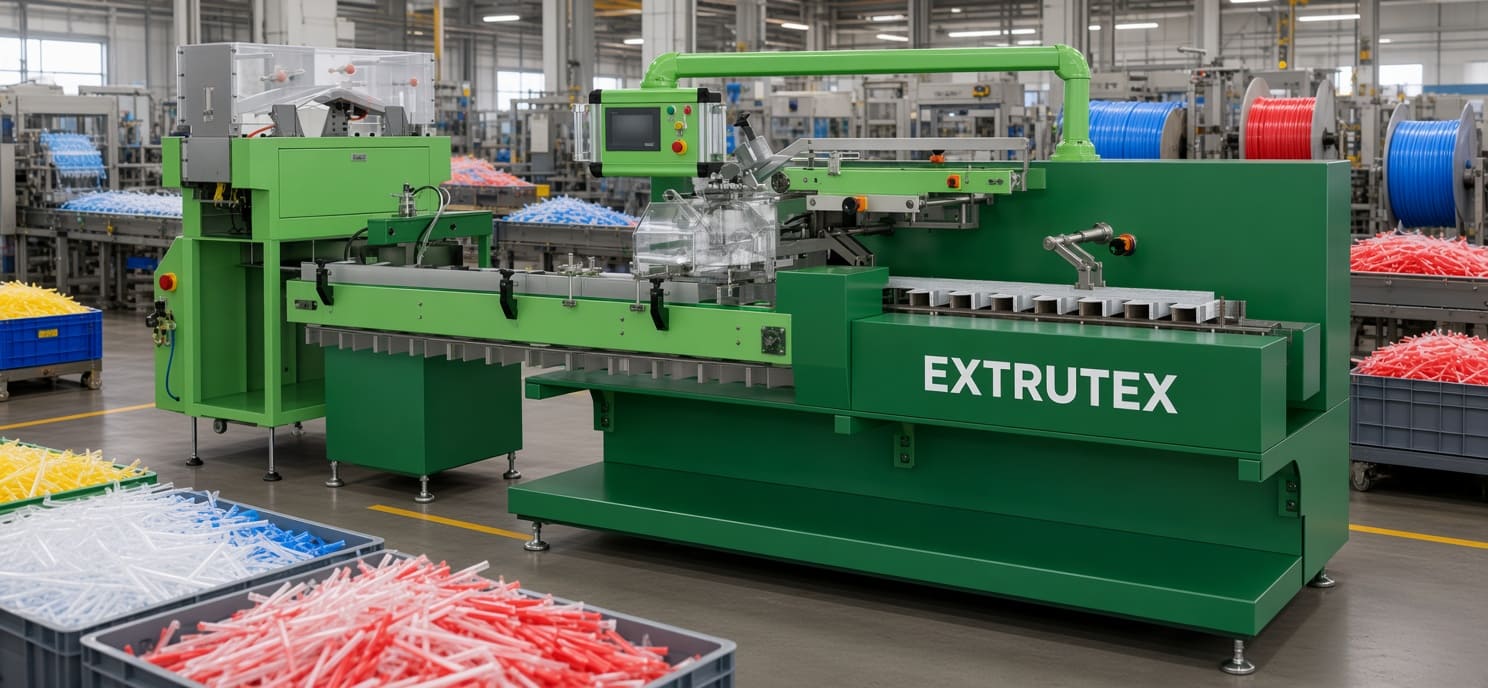
The EXTRUTEX EX-500 Automatic Straw Cartoning Machine is designed for automatic packaging of drinking straws, counted straw groups and pre-packed straw bundles into paper cartons. With a production speed of approximately 5–30 boxes per minute, PLC control, touchscreen operation, batch-number printing and fault detection functions, the EX-500 provides a practical cartoning solution for industrial straw manufacturers and packaging facilities.
Designed for packaging operations that require consistent carton presentation and repeatable production, the EX-500 integrates carton opening, product insertion, paper folding where required, carton handling and finished-box discharge into a coordinated process. Its adjustable carton format supports a range of small and medium-sized packages, making it suitable for different straw lengths, bundle formats and retail packaging requirements within the machine's specified operating range.
The EX-500 is an automatic cartoning machine developed for placing drinking straws or prepared straw packs into paper cartons. It is suitable for production environments where straws must be presented in a neat, protected and organized package for distribution, retail sale, food-service supply or wholesale delivery.
The machine can be configured around loose straws, counted straw groups or pre-packed straw bundles, depending on the feeding arrangement and the product format. The final feeding system should be confirmed before ordering to ensure that the straw dimensions, bundle structure and carton design are compatible with the selected machine configuration.
By automating carton handling and product insertion, the EX-500 helps reduce repetitive manual work and supports more consistent packaging output. Its operating speed can be adjusted according to product flow, carton dimensions, feeding stability and the required production rhythm.
The EX-500 is intended for manufacturers seeking a dedicated straw-cartoning solution rather than a general-purpose machine that must be extensively adapted for every production run. Where different products or carton formats are required, the machine configuration and changeover procedure should be evaluated according to the actual production plan.
The EX-500 is designed to coordinate carton handling with the insertion of straws or prepared straw packs. Flat cartons are supplied from the magazine, opened and positioned for loading. The feeding section then introduces the product into the carton according to the selected configuration.
Automating these repetitive stages can help improve packaging consistency, reduce manual handling and establish a more organized production workflow. Correct carton preparation and stable product feeding are important for reducing interruptions and maintaining the intended operating speed.
The machine uses PLC-based control and a touchscreen interface to manage the cartoning sequence and operating settings. Operators can use the interface to monitor machine status and manage production according to the configured process.
Control functions include process monitoring and fault indications. Depending on the machine configuration, detection functions may monitor product feeding, material availability and carton-handling conditions. Alarms and automatic stopping functions can help operators identify problems before they result in prolonged production interruptions.
The EX-500 has a stated cartoning speed of approximately 5–30 boxes per minute. Actual output depends on carton dimensions, straw format, feeding arrangement, paper-folding requirements, operator setup and the stability of the incoming product supply.
For reliable production planning, the maximum stated speed should not be treated as a guaranteed continuous output for every carton or product type. Production trials using the intended straws, cartons and inserts are recommended to establish realistic operating rates.
The EX-500 can be equipped or configured for batch-number printing on cartons. Batch identification supports production organization and can help manufacturers associate finished packages with internal manufacturing records.
Printing requirements should be confirmed before ordering, including the intended print location, character format, carton surface and required coding content. The precise printer arrangement and printing capabilities depend on the supplied configuration.
Detection and alarm functions help identify abnormal operating conditions, such as missing materials or problems during the cartoning sequence. Where supported by the selected configuration, the machine can reject abnormal cartons or prevent defective packaging from continuing through the process.
These functions help improve process control, although they do not eliminate the need for routine inspection, correct machine adjustment and quality checks. The exact sensors, rejection mechanism and monitored conditions should be confirmed in the final technical specification.
The following table summarizes the available technical parameters for the EXTRUTEX EX-500. Values are based on the supplied ZH-500 specification and should be confirmed against the final EXTRUTEX quotation and machine configuration before ordering.
| Parameter | EX-500 Specification |
|---|---|
| Machine Model | EX-500 |
| Machine Type | Automatic straw cartoning machine |
| Primary Application | Cartoning of drinking straws, counted straw groups and prepared straw packs, subject to feeding configuration |
| Cartoning Speed | Approximately 5–30 boxes/min |
| Paper Folding Speed | Approximately 5–30 sheets/min |
| Minimum Carton Size (L × W × H) | 70 × 45 × 12 mm |
| Maximum Carton Size (L × W × H) | 230 × 135 × 50 mm |
| Paper Size Before Folding (L × W) | 100–250 × 100–150 mm, within the stated ranges |
| Folded Paper Size (L × W) | 100–150 × 20–40 mm, within the stated ranges |
| Recommended Carton Paper Weight | 250–350 g/m² |
| Power Supply | 380 V AC, 50 Hz |
| Main Motor Power | 1.5 kW |
| Listed Energy Consumption | 1.5 kW |
| Compressed Air Working Pressure | ≥ 0.5 MPa |
| Air Consumption | Approximately 0.3 m³/min |
| Overall Dimensions (L × W × H) | Approximately 4,500 × 1,500 × 1,650 mm |
| Machine Weight | Approximately 1,200 kg |
| Noise Level | ≤ 75 dB(A), as specified |
| Control System | PLC control with touchscreen operation |
| Batch Coding | Available according to selected configuration |
| Fault Detection | Detection, alarm and stopping functions according to configuration |
| Carton Rejection | Subject to the supplied detection and rejection arrangement |
| Manufacturer Brand | EXTRUTEX |
| Design and Manufacturing | Austrian design; manufacturing in Nanjing and Shanghai, China |
Technical note: The stated carton and folded-paper dimensions represent supported ranges, not every possible combination of length, width and height. Carton construction, paper stiffness, insert design and straw arrangement must be evaluated together. Confirm the electrical connection, air requirements, printing equipment and rejection functions for the actual order.
The EX-500 supports cartons ranging from approximately 70 × 45 × 12 mm to 230 × 135 × 50 mm. This range allows the machine to be considered for different small-package formats used for drinking straws and straw bundles.
Carton selection should account for the number of straws per box, straw diameter, straw length, product orientation and any additional paper insert. A carton that falls within the machine's nominal dimensional range may still require format-specific tooling or adjustments to achieve stable feeding and reliable closure.
The recommended carton paper weight is 250–350 g/m². Suitable board stiffness is important because cartons must be separated from the magazine, opened into the correct shape and held in position during product loading.
Paper that is too flexible, excessively curled or inconsistent in thickness may cause feeding difficulties. Conversely, board that is too stiff or poorly scored may resist opening or folding. Carton samples should therefore be tested before mass production, particularly when using printed cartons, coated board or custom die-cut packaging.
The specified paper size before folding is approximately 100–250 mm in length and 100–150 mm in width. The stated folded size is approximately 100–150 mm in length and 20–40 mm in width.
These parameters can be relevant when a folded paper component or insert is required as part of the packaging process. Confirm whether the required paper component is an insert, wrap or other folded element, and ensure that its finished dimensions are compatible with the carton and straw arrangement.
Stable performance depends on synchronization between carton handling and product feeding. Cartons must be correctly loaded, straw groups must arrive in the expected format, and all materials must meet the requirements established during setup. The precise sequence of carton closure, insert handling, coding and rejection should be verified for the final machine configuration.
For manufacturers that need to count straws before carton loading, the EX-500 can be planned together with the EXTRUTEX EX-250DS Straw Counting Machine. The EX-250DS is designed to count and group drinking straws, making it a potential upstream component for a coordinated counting and cartoning workflow.
The integration method depends on the number of straws per carton, the required group dimensions, the transfer distance and the product feeding mechanism. A direct automated connection should not be assumed without engineering confirmation. Depending on the required layout, the production system may use an intermediate collection or transfer arrangement between counting and cartoning.
For factories seeking a more complete packaging process, the EX-500 can also be evaluated alongside upstream straw production equipment and downstream carton collection or secondary packaging equipment. The final arrangement should be designed around the actual production capacity and the required level of automation.
The EXTRUTEX EX-500 is intended for businesses that manufacture, package or distribute drinking straws and related disposable food-service products. Typical applications include:
Product compatibility depends on the actual straw material, length, diameter, flexibility, bundle size and feeding layout. Different product formats should be tested before the machine is approved for production.
Automatic carton handling and product insertion can reduce repetitive manual tasks compared with fully manual cartoning. This can help manufacturers organize labor more efficiently and establish a more consistent workflow.
Controlled carton opening, positioning and loading support more uniform finished packages. Consistent presentation is particularly valuable for branded retail products and standardized food-service packaging.
PLC control and touchscreen operation provide a centralized interface for managing the machine's configured functions. Fault indications help operators identify conditions that require inspection or corrective action.
The supported carton size range allows the EX-500 to be evaluated for multiple packaging formats. Format changes may require adjustments, change parts or specific setup procedures. The permitted range and changeover requirements should be confirmed for each intended carton design.
Batch-number printing can help identify production batches and support internal packaging records. For applications with formal traceability requirements, manufacturers should define the coding method and recordkeeping process before commissioning.
The EX-500 has a stated electrical supply of 380 V AC, 50 Hz, a main motor rating of 1.5 kW and a compressed-air working pressure of at least 0.5 MPa. The listed air consumption is approximately 0.3 m³/min.
Before installation, the factory should confirm the available electrical supply, protection devices, grounding, air compressor capacity and air quality requirements. The compressed-air system should be sized for the actual machine demand and any other equipment connected to the same supply.
The stated overall dimensions are approximately 4,500 × 1,500 × 1,650 mm, with a machine weight of about 1,200 kg. Allow additional space for carton loading, maintenance access, operator movement and the transfer of finished products. The installation floor must be suitable for the machine's weight and operating conditions.
Final installation instructions, connection details, foundation requirements and safety provisions should follow the supplied technical documentation and the applicable regulations at the installation site.
Routine inspection helps maintain consistent cartoning performance. Before starting production, operators should verify carton loading, product feeding, paper-folding settings where applicable, coding requirements and the status of safety devices.
During operation, monitor carton opening, product insertion, finished carton quality and any fault indications. If cartons become damaged or products are not loaded correctly, stop the machine according to the operating procedure and investigate the cause before restarting.
Regular maintenance should include cleaning paper dust and packaging debris from accessible areas, checking moving parts, inspecting wear components and verifying sensors and pneumatic connections. Lubrication and component replacement should follow the manufacturer's maintenance schedule.
Operators should receive training in machine controls, safe stopping, fault recovery and lockout procedures for maintenance. Guards and safety devices must remain in place during operation. Never reach into moving mechanisms while the machine is running or attempt to clear a jam without following the required safe isolation procedure.
When selecting a straw cartoning machine, manufacturers should evaluate the complete packaging requirement rather than machine speed alone. Important considerations include:
The EXTRUTEX EX-500 is a dedicated option for compatible straw-cartoning applications. For factories requiring a broader horizontal cartoning platform for different product categories, the EXTRUTEX EX-120 can be evaluated as an alternative, subject to confirmation of its product range and configuration. The two models should be compared using actual product samples, carton drawings and output targets.
EXTRUTEX develops industrial extrusion, processing and packaging solutions for manufacturers seeking practical equipment and production-line integration. The company follows an Austrian design approach, with manufacturing in Nanjing and Shanghai, China.
For straw cartoning projects, the focus is on matching machine configuration to the customer's products, carton specifications and production requirements. Correctly defined feeding arrangements, realistic output targets and clear technical acceptance criteria are important for achieving a reliable installation.
EXTRUTEX can help customers evaluate the EX-500 against their intended straw formats and packaging layouts. Before confirming an order, customers should provide carton drawings, paper specifications, product samples, target output and details of any required upstream or downstream equipment. This information helps establish the appropriate configuration and identify any format-specific requirements.
The EX-500 is designed for drinking straws, counted straw groups and prepared straw packs. Compatibility depends on the feeding layout, product dimensions and carton design.
The stated cartoning speed is approximately 5–30 boxes per minute. Actual output varies according to carton size, product feeding, paper-folding requirements and operating conditions.
The specified carton size range is approximately 70 × 45 × 12 mm to 230 × 135 × 50 mm. The compatibility of a specific carton design should be confirmed before production.
Batch-number printing is available according to the selected configuration. Confirm the required printing position, code format and carton surface before ordering.
Yes, the two machines can be evaluated as components of a counting and cartoning line. The transfer method and degree of automation require engineering confirmation based on the straw group and carton format.
The supplied specifications list 380 V AC, 50 Hz power, a 1.5 kW main motor, compressed air at a minimum of 0.5 MPa and air consumption of approximately 0.3 m³/min. Confirm the final utility requirements before installation.
Provide straw dimensions and material, the quantity per carton, carton drawings, paper specifications, required output, batch-printing details and the preferred level of automation. Samples may be required to verify feeding and cartoning performance.
The EXTRUTEX EX-500 Automatic Straw Cartoning Machine is designed to help drinking straw manufacturers automate carton loading and improve packaging consistency. With PLC control, touchscreen operation, adjustable production speed, optional batch-number printing and configurable fault-handling functions, it offers a practical basis for a dedicated straw-cartoning system.
Contact EXTRUTEX with your product dimensions, carton drawings, required output and packaging-line layout to discuss machine suitability and configuration. Confirm all technical parameters, included functions and acceptance criteria in the final quotation before placing an order.
EXTRUTEX — Austrian Design | Manufacturing in Nanjing and Shanghai, China
There are no reviews yet.
By submitting your email, you agree to our company’s terms and conditions.
We are not looking to sell; we are here to provide you with the best support and service.
Contact available 24/7
Please do not contact us for advertising or sales inquiries
All rights of this website are reserved for EXTRUTEX Austria and its partner companies, © 2026
-
(0 customer reviews)