

No products in the cart.



All rights of this website are reserved for EXTRUTEX Austria and its partner companies, © 2026



Multiple Payment Methods

Discount for advance payments over 50%

Free Shipping Coordination Services
Payment methods:


Automatic Straw Alignment, Group Wrapping, Sealing and Cutting
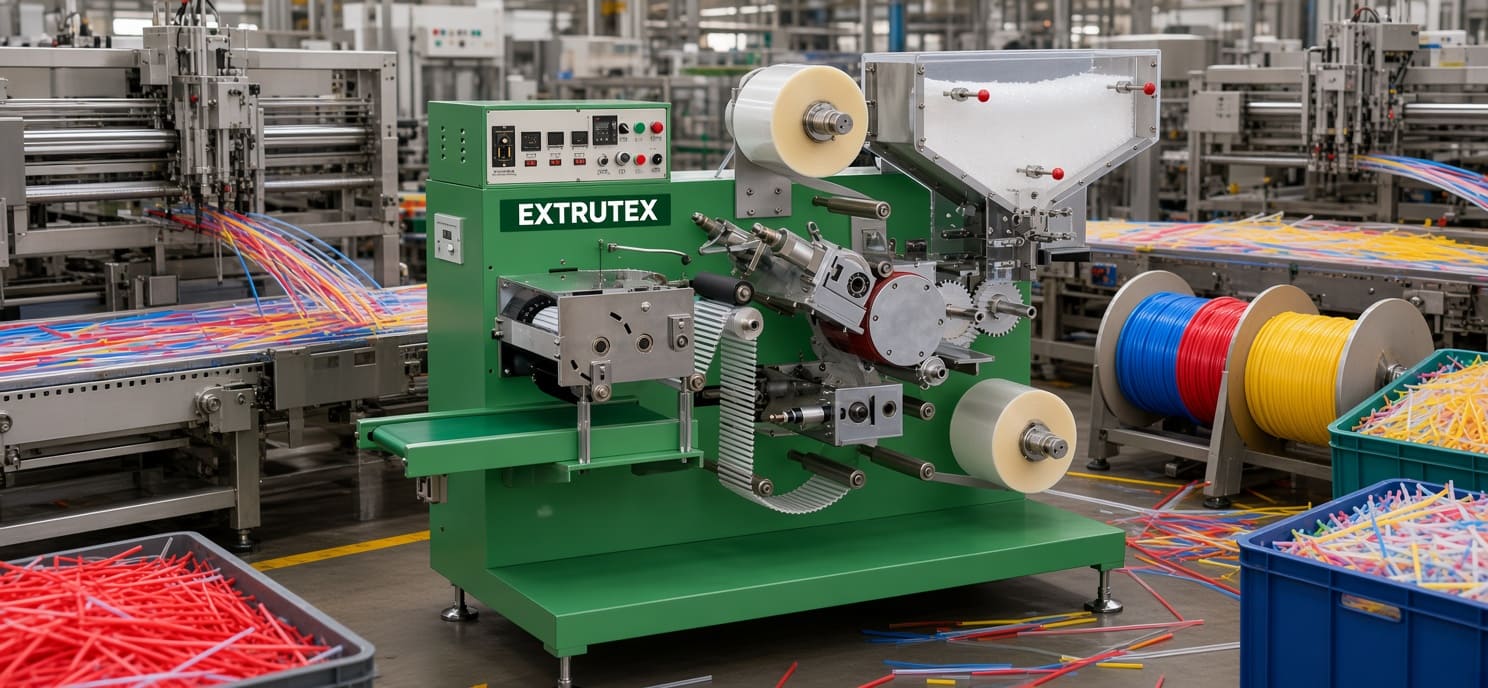
The EXTRUTEX I-Shape Drinking Straw Packing Machine is designed for the automatic alignment and packaging of short and medium-length drinking straws in compact, parallel arrangements. Available in two configurations, the EX-200LP and EX-300LP, the series accommodates straw lengths from 60 to 300 mm, depending on the selected model. It is suitable for manufacturers requiring consistent group packaging, reliable product handling and flexible pack formats for food-service, beverage, hospitality and related packaging applications.
The machine automatically feeds, aligns, groups and wraps straws using compatible OPP or PE packaging film. Integrated sealing and cutting operations produce individual packs or connected strips according to the selected configuration. Typical group formats include 5, 6 or 10 straws per section, subject to the machine setup and product requirements.
EXTRUTEX combines Austrian design expertise with manufacturing in Nanjing and Shanghai, China. The objective is to provide practical industrial packaging solutions that support production efficiency, straightforward operation and adaptation to different straw dimensions and customer packaging requirements.
I-shape straw packing is a packaging method in which several drinking straws are arranged parallel to one another and enclosed together within a narrow film section. The resulting package has an elongated, compact appearance that is convenient for handling, distribution and storage.
Instead of wrapping every straw separately, the machine groups a preset number of straws into one section. Common formats include 5, 6 or 10 straws per pack, depending on the intended application. The finished sections can be separated into individual packs or retained as a connected strip when supported by the selected setup.
This packaging format is particularly useful when customers require several straws in a small, organized package rather than a loose bundle. It can support commercial straw production, institutional supply, food-service distribution and other applications where consistent group quantities are required.
The EX-200LP is intended for straw lengths from 60 to 200 mm. Its working range makes it a candidate for short drinking straws, compact beverage straws and other compatible short tubular products. The machine supports diameters from 3 to 12 mm and uses OPP or PE film, subject to material and machine compatibility.
Automatic feeding and alignment help arrange the straws into the selected group format before the packaging material is formed around them. Integrated sealing and cutting operations complete the packaging cycle. The model is suitable for manufacturers whose product range mainly falls within the shorter length category.
The EX-300LP is designed for straw lengths from 200 to 300 mm. It accommodates the same stated diameter range of 3–12 mm and is intended for products that require a longer packaging section.
The machine uses an enlarged listed footprint compared with the EX-200LP to accommodate its longer product format. Its operating sequence includes straw feeding, parallel alignment, grouping, film positioning, sealing and cutting. The exact finished-pack dimensions depend on the straw length, selected group quantity and packaging setup.
Consistent feeding is essential when multiple straws must be placed together in one package. The machine integrates a feeding and alignment process to organize the straws before wrapping. Correct alignment helps produce orderly packs and reduces the need for manual arrangement.
Product dimensions, straightness, surface condition and material properties can affect feeding stability. The machine should therefore be tested using the actual straw type before production settings are finalized.
The I-shape series supports group packaging formats such as 5, 6 or 10 straws per section. This allows manufacturers to tailor their package quantity to the customer, product presentation and downstream packing requirements.
Final group quantities and pack formats should be confirmed during configuration because the available settings may depend on the supplied machine version and intended straw dimensions.
Depending on the selected operating arrangement, finished sections can be cut into separate packs or retained as a connected strip. Individual packs are convenient for handling and distribution, while connected-strip output may be useful for applications that need several sections kept together for subsequent handling.
Confirm the required cutting pattern, separation method and final package format before ordering to ensure that the machine configuration meets the intended production process.
The EX-200LP and EX-300LP are specified for OPP or PE packaging film. The material should have suitable thickness, width, sealing characteristics and mechanical properties for the intended package design.
Different films behave differently during feeding, forming, sealing and cutting. A packaging-material trial is recommended to verify the selected film, seal integrity, appearance and production stability. Printed material may require additional registration or positioning checks, depending on the supplied configuration.
The integrated packaging sequence brings together film positioning, package forming, sealing and cutting in a coordinated process. This reduces the need to move product manually between separate basic operations and supports a more organized production workflow.
Correct setup of the sealing and cutting systems is important for consistent package quality. Operators should follow the machine manual and use approved settings for each film type and product format.
The stated processing speed is approximately 400–800 straws per minute. Actual output depends on straw length and diameter, group quantity, feeding stability, film properties, cut configuration and operating conditions.
Piece-per-minute output should not be confused with completed-pack output. For example, a format containing more straws per section produces fewer completed sections than a smaller group format at the same individual-straw throughput. Actual finished-pack output should be confirmed using the intended production recipe.
The supplied product information describes automatic fault-stop and preset-count notification functions. These functions can help operators respond to selected operating problems and recognize when a specified count has been reached. The exact fault conditions, alarms and stop logic depend on the installed control system and supplied machine configuration.
Before routine production, operators should verify the selected group count, film tracking, sealing quality, cutting position and discharge operation. A trial run using actual straws and packaging film is recommended whenever the product size or packaging material changes.
| Parameter | EX-200LP | EX-300LP |
|---|---|---|
| Machine model | EX-200LP | EX-300LP |
| Packaging type | I-shape group straw packing | I-shape group straw packing |
| Straw length | 60–200 mm | 200–300 mm |
| Straw diameter | 3–12 mm | 3–12 mm |
| Stated packing speed | Approximately 400–800 pcs/min | Approximately 400–800 pcs/min |
| Packaging film | OPP / PE | OPP / PE |
| Typical group quantities | 5, 6 or 10 straws per section, subject to configuration | 5, 6 or 10 straws per section, subject to configuration |
| Output format | Individual packs or connected strip, according to setup | Individual packs or connected strip, according to setup |
| Rated power | 3 kW | 3 kW |
| Machine dimensions (L × W × H) | 2300 × 900 × 1600 mm | 2300 × 1100 × 1600 mm |
| Application | Short drinking straws and compatible products | Longer drinking straws and compatible products |
Specification note: Values are based on the supplied product information. Confirm the final machine configuration, electrical supply, group-count settings, packaging-film compatibility and guaranteed production output with EXTRUTEX before ordering. The stated speed is a nominal reference and is not a guarantee of finished packs per minute under all conditions.
The EX-200LP is suitable for compatible straws in the 60–200 mm length range. Depending on product dimensions and feeding characteristics, it can be considered for compact drinking-straw formats used in beverage service and other relevant applications.
The EX-300LP is intended for straws measuring 200–300 mm in length. It is a potential choice for manufacturers that need longer group packs while maintaining an organized parallel arrangement.
Group-packed straws can be supplied to beverage outlets, cafes, restaurants, catering operators, hospitality businesses and distributors. The exact suitability of the final package depends on the intended market, the packaging material and any applicable product-contact or packaging regulations.
The machines can be considered as packaging equipment at the end of a compatible straw manufacturing process. Integration with upstream straw production, collection or other downstream equipment should be assessed based on the required product flow, available floor space and production target.
Manufacturers supplying multiple customers may require different group quantities, package lengths or printed film. The selected machine configuration should be reviewed against these requirements to determine which formats can be handled without additional equipment or modifications.
The stated packaging materials are OPP and PE film. Before production, confirm that the selected film is compatible with the wrapping and sealing system. Important considerations include material thickness, film width, tensile properties, surface friction, seal performance and the intended storage and transport conditions.
Straw compatibility should also be verified. Diameter alone does not determine feeding performance; length, straightness, rigidity, weight, surface finish and dimensional consistency may affect alignment and group formation. Materials such as PP, PLA, paper or other straw types should be tested against the intended machine setup rather than assumed to be interchangeable.
Where printed film is required, discuss print positioning and any registration requirements with EXTRUTEX. The final packaging appearance should be checked during a production trial, including seal consistency, cutting accuracy and package integrity.
The stated speed of 400–800 straws per minute provides a reference for initial production planning. However, the effective rate depends on the selected straw length, group count, product feed quality and required cut pattern. Longer straws may require different handling adjustments, and film characteristics can influence the stable operating speed.
To estimate completed sections per minute, the number of straws per section must be considered alongside the actual individual-straw throughput. For example, the same straw throughput produces fewer sections when each section contains 10 straws rather than 5. Production planning should therefore use a verified trial rate for the exact packaging format.
Manufacturers should also account for material changes, setup time, operator handling, quality checks, cleaning and planned maintenance. These factors affect daily production output even when the machine's instantaneous operating speed remains unchanged.
Before starting the machine, verify that the correct straw size and packaging film have been installed. Confirm the selected group count, alignment settings, film path, sealing parameters and cutting arrangement. Run an initial sample batch and inspect it before proceeding to full production.
Regular inspection and correct operating procedures help maintain consistent package quality and reduce avoidable downtime. Follow the supplied machine documentation for lubrication, replacement intervals, adjustment methods and other model-specific maintenance tasks.
| Requirement | Recommended Model |
|---|---|
| Straw length from 60 to 200 mm | EX-200LP |
| Straw length from 200 to 300 mm | EX-300LP |
| Straw diameter from 3 to 12 mm | Both models, subject to product testing |
| OPP or PE film packaging | Both models, subject to material compatibility |
| Group formats of 5, 6 or 10 straws | Confirm the required setup with EXTRUTEX |
| Individual cut packs or connected strip | Confirm the available output arrangement before ordering |
| Non-standard straw dimensions | Request an engineering review and compatibility trial |
The most important selection criterion is the actual straw length. Once the model has been selected, the packaging format, group quantity, material type and required production output should be confirmed together to ensure that the equipment suits the complete application.
EXTRUTEX combines Austrian design expertise with manufacturing operations in Nanjing and Shanghai, China. Our equipment development approach focuses on practical engineering, industrial usability and packaging solutions tailored to defined production requirements.
For the I-Shape Drinking Straw Packing Machine series, customers can discuss straw dimensions, film type, group quantity, individual or connected-strip output, production objectives and factory installation requirements. These details help establish the correct machine configuration and identify any special engineering needs before manufacture.
Contact EXTRUTEX to discuss your I-shape straw packaging application and obtain a proposal based on your production requirements. To support an accurate technical review, please provide:
EXTRUTEX can then review the requirements, confirm the applicable model and discuss the available configuration for your production line.
There are no reviews yet.
By submitting your email, you agree to our company’s terms and conditions.
We are not looking to sell; we are here to provide you with the best support and service.
Contact available 24/7
Please do not contact us for advertising or sales inquiries
All rights of this website are reserved for EXTRUTEX Austria and its partner companies, © 2026
-
(0 customer reviews)