THERMOPLASTIC ELASTOMER RAW MATERIALS
SEBS Resin – Styrene Ethylene Butylene Styrene
EXTRUTEX supplies SEBS resin from internationally recognised manufacturers and established Chinese producers. We offer different grades of Styrene Ethylene Butylene Styrene (SEBS) for thermoplastic elastomer compounding, plastic modification, adhesives, soft-touch products, automotive components, wire and cable applications, footwear and consumer products.
SEBS is a hydrogenated styrenic block copolymer that combines rubber-like elasticity with thermoplastic processing characteristics. Compared with conventional SBS, its hydrogenated ethylene-butylene soft block provides improved resistance to heat, oxidation, ozone and outdoor weathering.
We can help customers source suitable SEBS grades according to hardness, styrene content, molecular structure, flow characteristics, oil absorption, elasticity, compression set and final processing requirements.
EXTRUTEX SEBS supply range: Kraton, Asahi Kasei, TSRC, LCY and Chinese Baling Petrochemical grades, subject to current availability and grade confirmation. Original manufacturer documentation can be requested for the selected material.
What Is SEBS Resin?
SEBS stands for Styrene-Ethylene/Butylene-Styrene. It is a thermoplastic elastomer made from styrene-based block copolymer chemistry. Its molecular structure contains hard polystyrene end blocks and a soft ethylene-butylene midblock.
The polystyrene blocks create physical crosslinking points that help the material maintain its shape, while the soft midblock provides flexibility, stretch and elastic recovery. Because these physical crosslinks can be softened during heating, SEBS can be processed using conventional thermoplastic equipment without the same permanent chemical vulcanisation required by many traditional rubber materials.
Hydrogenation is a key difference between SEBS and SBS. The hydrogenated soft block has fewer carbon-carbon double bonds, improving resistance to oxidation, ozone, UV exposure and heat aging.
Main Characteristics
- Excellent elasticity and flexibility.
- Improved heat and oxidation resistance compared with conventional SBS.
- Good resistance to ozone and outdoor weathering.
- Good compatibility with many polyolefins, including polypropylene and polyethylene.
- Good oil absorption and formulation flexibility.
- Useful impact modification and toughness improvement.
- Suitable for soft-touch and flexible thermoplastic elastomer compounds.
- Can be processed by injection moulding, extrusion and other thermoplastic processing methods, depending on grade and formulation.
- Can be blended with suitable oils, fillers, polypropylene, polyethylene and other additives.
- Available in different molecular structures, styrene contents and molecular-weight ranges.
SEBS Resin Grades from International Brands
EXTRUTEX can source SEBS from major international manufacturers. The available grades cover general-purpose compounding, high-flow processing, resin modification, adhesive formulations, elastic films and specialised applications.
Kraton – USA
Kraton is an internationally recognised supplier of hydrogenated styrenic block copolymers. Its Kraton G product family includes SEBS and other hydrogenated block copolymer chemistries.
Representative SEBS grades:
- Kraton G1650
- Kraton G1651
- Kraton G1652
- Kraton G1654
- Kraton G1657
- Kraton G1660
- Kraton G1726
- Kraton G4609
- Kraton G4610
The Kraton G family contains more than one hydrogenated polymer chemistry. Confirm the exact SEBS grade and current TDS before ordering.
Asahi Kasei – Japan
Asahi Kasei supplies SEBS under the TUFTEC and S.O.E. brands. Its product portfolio includes standard hydrogenated grades and specialised grades for modification, compatibilisation, adhesion and functional applications.
Product families:
- TUFTEC H Series – fully hydrogenated SEBS.
- TUFTEC M Series – modified SEBS grades, including functionalised materials.
- TUFTEC P Series – selectively hydrogenated grades.
- S.O.E. Series – specialised elastomer grades with distinctive damping and abrasion characteristics.
Individual grades must be selected according to their specific polymer structure and technical documentation.
TSRC – Taiwan
TSRC supplies SEBS under the TAIPOL and VECTOR brands. Its range includes grades for compounding, plastic modification, adhesives, elastic films and specialised applications.
Representative grades:
- TAIPOL 6150
- TAIPOL 6152
- TAIPOL 6153
- TAIPOL 6153L
- TAIPOL 6014
- VECTOR 8103
- VECTOR 8245D
TAIPOL 6-series grades include high-flow and conventional SEBS options. Some VECTOR grades are designed for specialised applications.
LCY – Taiwan
LCY supplies SEBS under the GLOBALPRENE brand. The product family covers polymer modification, compounding, adhesives and asphalt modification.
Representative grades listed in LCY product safety documentation:
- GLOBALPRENE 9550
- GLOBALPRENE 9551
- GLOBALPRENE 9552
- GLOBALPRENE 9550U
- GLOBALPRENE 9551U
- GLOBALPRENE 9552U
- GLOBALPRENE 7533
- GLOBALPRENE 7550
- GLOBALPRENE 7551
- GLOBALPRENE 7554
Additional suffix grades and product availability should be confirmed against the manufacturer's latest documentation.
Chinese SEBS Resin Manufacturers and Grades
China is an important source of SEBS raw materials for domestic and international thermoplastic elastomer compounders. Chinese grades are widely used in soft-touch materials, plastic modification, footwear, cable compounds, automotive components, toys, seals and general-purpose TPE formulations.
Baling Petrochemical – China
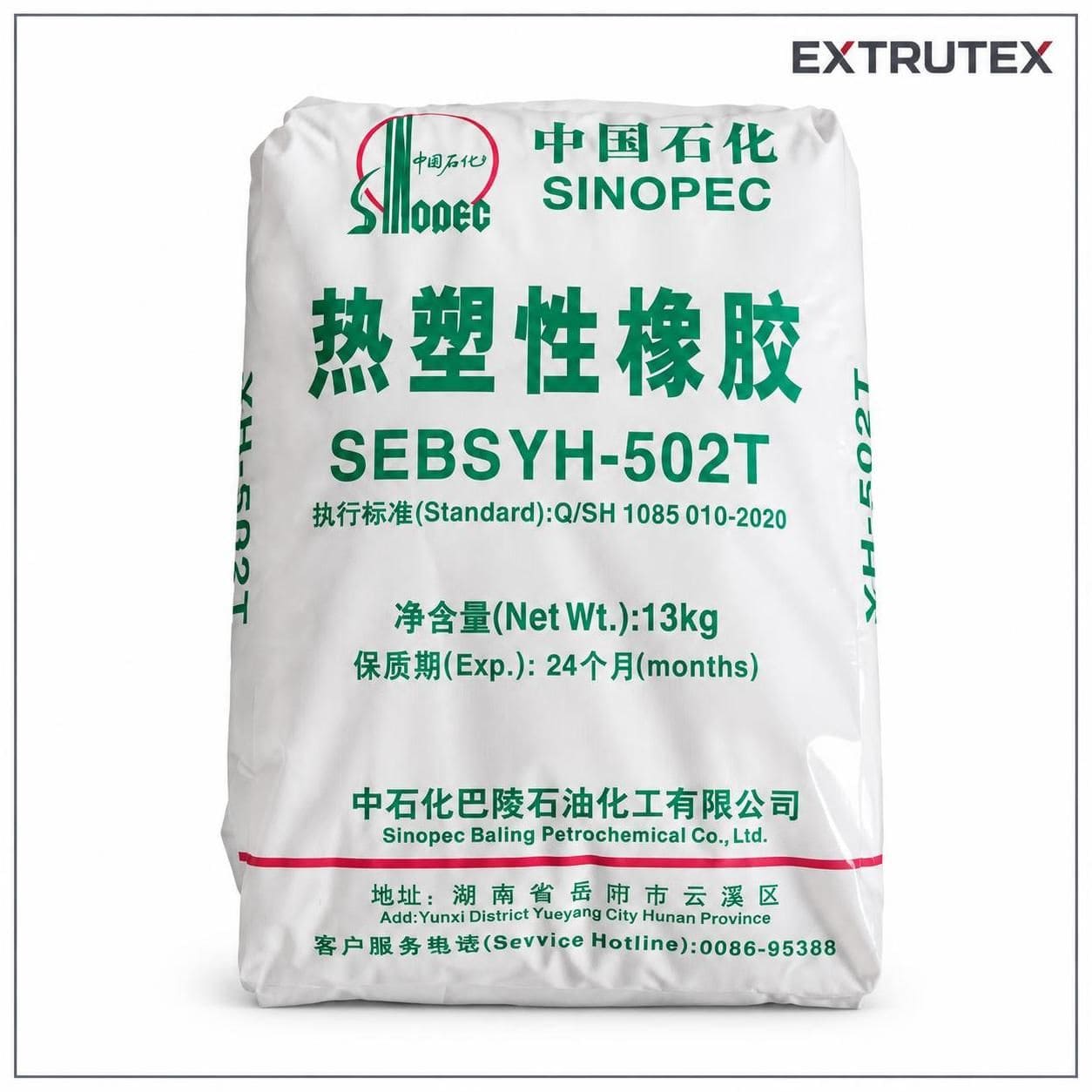
Baling Petrochemical, based in Yueyang, Hunan Province, is a recognised Chinese producer of styrenic block copolymers. Its YH-series SEBS products include linear, star-shaped and other polymer structures.
| Grade | Reported polymer structure | Typical application areas |
|---|
| YH-501 / YH-501T | Linear | Soft-touch products, toys, plastic modification and oil-extended compounds. |
| YH-502 / YH-502T | Linear | Plastic modification, wire and cable compounds, soft-touch products. |
| YH-503 / YH-503T | Linear | TPE compounding, overmoulding, plastic modification and cable applications. |
| YH-504 / YH-504T | Linear | Soft-touch products, cable compounds and flexible materials. |
| YH-506 / YH-506T | Linear, low-styrene type in published grade information | Specialised soft compounds and selected flame-retardant formulations. |
| YH-561 / YH-561T | Mixed structure | Soft-touch materials, overmoulding and selected sealing compounds. |
| YH-602 / YH-602T | Star-shaped | Plastic modification, overmoulding and wire and cable compounds. |
| YH-604 / YH-604T | Star-shaped | Overmoulding, cable compounds and sealing applications. |
| YH-688 / YH-688T | Star-shaped, low-styrene type in published grade information | Soft compounds, selected flame-retardant formulations and sealing materials. |
Other YH-series designations reported in the Chinese market include YH-507, YH-511, YH-515, YH-522, YH-530, YH-533 and YH-610. Availability and current production status must be confirmed individually.
Other Chinese SEBS Supply Options
EXTRUTEX can also assist with sourcing Chinese-market SEBS materials through qualified supply channels. The actual manufacturer, grade designation, production origin and documentation are confirmed before a quotation is issued.
For customers evaluating domestic Chinese alternatives, we can compare available grades according to styrene content, polymer structure, tensile strength, elongation, hardness, solution viscosity, oil absorption and processing behaviour.
Important grade-selection note: Similar grade numbers or market cross-reference tables do not establish technical equivalence. A Chinese grade should not be treated as a direct replacement for a Kraton, Asahi Kasei, TSRC or LCY grade without reviewing the relevant technical data sheets and testing the formulation.
SEBS Grade Selection by Application
The correct SEBS grade depends on the finished product and the formulation. Hardness alone is not enough to determine suitability. Molecular structure, styrene content, molecular weight, melt flow, oil absorption and compatibility with the other polymers in the compound all influence performance.
| Application | Important selection factors | Typical formulation considerations |
|---|
| TPE compounds | Elasticity, hardness, tensile strength and processing stability | SEBS, PP, process oil, fillers and stabilisers. |
| Soft-touch injection moulding | Surface feel, adhesion, flexibility and mouldability | SEBS blended with suitable polyolefins and additives. |
| Automotive interior components | Odour, heat aging, compression set and surface quality | Grade selection based on automotive specifications and testing. |
| Wire and cable compounds | Flexibility, electrical properties, flame performance and aging | SEBS with compatible polymers, fillers and flame-retardant systems. |
| Footwear materials | Elastic recovery, softness, abrasion resistance and processability | SEBS with oil, fillers and other elastomer components. |
| Adhesives and sealants | Cohesion, tack, compatibility and heat resistance | SEBS with suitable tackifying resins, oils and additives. |
| Plastic impact modification | Impact strength, dispersion and compatibility | SEBS selected for the target resin and required impact performance. |
| Elastic films | Stretchability, recovery, film processability and durability | Specialised SEBS grades and suitable film formulations. |
| Seals and gaskets | Compression set, flexibility, aging and sealing performance | Grade and formulation selected according to temperature and service conditions. |
| Consumer products | Softness, colourability, surface appearance and durability | SEBS-based TPE compounds for handles, grips and flexible parts. |
SEBS for TPE Compounding
One of the most important applications of SEBS is as the base polymer in thermoplastic elastomer compounds. SEBS can be blended with polypropylene, polyethylene, mineral oil, fillers, pigments and stabilising additives to achieve the required mechanical and processing properties.
Common SEBS Compound Components
- SEBS resin: The principal elastomeric polymer responsible for flexibility, elasticity and recovery.
- Polypropylene (PP): Commonly used to adjust stiffness, dimensional stability and thermoplastic processing behaviour.
- Polyethylene (PE): Used in selected formulations to modify flexibility and polymer compatibility.
- Process oil: Often used to reduce hardness and improve softness and processability. Compatibility and migration resistance must be considered.
- Calcium carbonate: Used as a mineral filler to adjust cost, stiffness and other formulation characteristics.
- Silica and other fillers: Selected according to reinforcement, surface and processing requirements.
- Antioxidants and stabilisers: Used to improve processing stability and long-term aging performance.
- Pigments and colour masterbatch: Used to achieve the required colour and appearance.
The correct ratio depends on the target Shore hardness, tensile strength, elongation, compression set, density, surface feel and final application. There is no single SEBS formulation suitable for every TPE product.
SEBS Compared with SBS
SEBS and SBS are both styrenic block copolymers, but their soft-block chemistry differs. SBS contains an unsaturated polybutadiene midblock, while SEBS is produced by hydrogenating the soft block to create an ethylene-butylene structure.
| Property | SEBS | SBS |
|---|
| Polymer structure | Styrene-ethylene/butylene-styrene | Styrene-butadiene-styrene |
| Hydrogenation | Hydrogenated soft block | Non-hydrogenated soft block |
| Weather resistance | Generally better ozone and UV resistance | More sensitive to oxidation and weathering |
| Heat aging | Generally improved thermal and oxidative stability | Generally lower oxidative stability |
| Elastic properties | Excellent, depending on grade and formulation | Excellent, depending on grade and formulation |
| Typical applications | Outdoor TPE, soft-touch compounds, automotive and consumer products | Footwear, adhesives, asphalt modification and selected TPE applications |
| Material cost | Usually higher due to hydrogenation technology | Often more economical |
SEBS is not automatically the best choice for every application. SBS can be appropriate where its performance profile and cost are suitable. Selection should be based on the required product properties and service conditions.
SEBS Compared with SEPS and Other TPE Materials
SEBS belongs to the broader family of styrenic thermoplastic elastomers. It should not be confused with SEPS, SBS, SIS, TPU or TPV, which have different polymer structures and performance characteristics.
- SEBS: Hydrogenated styrenic block copolymer with an ethylene-butylene midblock.
- SEPS: Hydrogenated styrenic block copolymer with an ethylene-propylene midblock.
- SBS: Non-hydrogenated styrene-butadiene-styrene block copolymer.
- SIS: Styrene-isoprene-styrene block copolymer, commonly used in adhesive formulations.
- TPU: Thermoplastic polyurethane, offering a different combination of abrasion, mechanical and chemical properties.
- TPV: Thermoplastic vulcanizate, generally based on dynamically vulcanised rubber dispersed in a thermoplastic matrix.
SEBS Processing and Storage
Processing Methods
Depending on grade and formulation, SEBS can be used in:
- Twin-screw extrusion and compounding.
- Single-screw extrusion of suitable compounds.
- Injection moulding of SEBS-based TPE compounds.
- Film and sheet extrusion.
- Profile extrusion and selected flexible product manufacturing.
- Adhesive and sealant formulation.
Processing temperature, screw configuration, residence time and drying requirements should follow the manufacturer's recommendations for the specific grade. SEBS grades and finished compounds do not necessarily share the same processing window.
Storage and Handling
- Store in the original sealed packaging in a dry, clean warehouse.
- Protect the material from moisture, contamination and prolonged direct sunlight.
- Follow the manufacturer's recommended storage temperature and shelf-life instructions.
- Keep different grades and production batches identified during storage and compounding.
- Review the Safety Data Sheet before handling and processing.
Technical Data and Quality Documentation
SEBS technical properties vary by manufacturer, grade and production batch. EXTRUTEX can provide available technical documentation for the selected product, subject to the manufacturer's supply and documentation conditions.
| Technical parameter | Why it matters |
|---|
| Styrene content | Influences hardness, strength and the balance between hard and soft segments. |
| Polymer structure | Linear, star-shaped or specialised architecture can influence processing and mechanical behaviour. |
| Melt flow rate or melt viscosity | Helps evaluate processing behaviour under specified test conditions. |
| Tensile strength | Indicates resistance to tensile loading. |
| Elongation at break | Measures the extension a specimen can withstand before breaking. |
| Hardness | Indicates resistance to indentation, commonly measured on the Shore A scale for soft elastomers. |
| Compression set | Evaluates the ability to recover after prolonged compression. |
| Specific gravity | Important for density, weight and formulation calculations. |
| Volatile matter and ash | Useful for material quality control and contamination assessment. |
Test results must be compared using the same test method, specimen preparation, temperature and test conditions. Typical values are not guaranteed product specifications unless the manufacturer explicitly identifies them as such.
EXTRUTEX SEBS Resin Supply
EXTRUTEX supports international customers sourcing thermoplastic elastomer raw materials from established manufacturers and Chinese producers. Our supply service focuses on selecting the appropriate polymer grade, confirming its origin and documentation, and coordinating reliable delivery.
International Brands
Access to selected Kraton, Asahi Kasei, TSRC and LCY SEBS products, depending on grade availability and supply conditions.
Chinese Manufacturers
Supply options including Baling Petrochemical YH-series materials and other qualified Chinese-market products.
Grade Selection
Material matching based on the customer's target hardness, elasticity, melt flow, formulation and processing method.
Documentation
Available TDS, SDS and batch COA documentation can be requested for the selected product.
EXTRUTEX product and material development is supported by design, laboratory and R&D activities in Austria, with manufacturing and supply operations in China.
How to Select the Right SEBS Grade
To recommend a suitable SEBS resin, we suggest providing the following information:
- Application: TPE compound, automotive parts, footwear, wire and cable, adhesive, seal, handle, grip or another product.
- Target hardness: Shore A or Shore D, if already specified.
- Processing method: Injection moulding, extrusion, film production, compounding or another process.
- Existing material: Current manufacturer and grade, if you are replacing an existing material.
- Formulation: Whether you use PP, PE, oil, calcium carbonate or other additives.
- Performance requirements: Tensile strength, elongation, compression set, weather resistance, oil resistance and surface requirements.
- Quantity: Trial quantity, regular monthly consumption or annual demand.
- Destination: Country and delivery port or address.
If you already use a specific Kraton, Asahi Kasei, TSRC, LCY or Baling grade, provide the complete grade designation. EXTRUTEX can help investigate suitable sourcing options or possible alternatives for evaluation.
Frequently Asked Questions About SEBS Resin
1. What does SEBS stand for?
SEBS stands for Styrene-Ethylene/Butylene-Styrene. It is a hydrogenated styrenic block copolymer used in thermoplastic elastomers and polymer modification.
2. Which SEBS brands can EXTRUTEX supply?
We can assist with sourcing selected products from Kraton, Asahi Kasei, TSRC, LCY and Chinese producers such as Baling Petrochemical, depending on grade availability.
3. Can you supply Chinese SEBS grades?
Yes. Chinese-market supply options include Baling Petrochemical YH-series grades such as YH-501, YH-502, YH-503, YH-504, YH-506, YH-561, YH-602, YH-604 and YH-688. Confirm the specific grade and current availability when requesting a quotation.
4. What is the difference between YH-502 and YH-503?
They are different Baling SEBS grades with different reported solution-viscosity and mechanical-property profiles. The appropriate choice depends on the required compound properties and processing conditions. Compare the current manufacturer TDS before selecting one.
5. Is SEBS better than SBS?
SEBS generally provides better heat, oxidation, ozone and weathering resistance because its soft block is hydrogenated. SBS can still be suitable for applications where its properties and cost are appropriate.
6. Can SEBS be used to produce TPE compounds?
Yes. SEBS is widely used as a base polymer for TPE compounds. It can be combined with polypropylene, process oil, fillers, pigments and other additives according to the target formulation.
7. Can SEBS be used for wire and cable materials?
Yes. Selected SEBS grades can be used in flexible wire and cable compounds. The final compound must be designed and tested against the required electrical, mechanical, flame-retardant and aging specifications.
8. Can you recommend an alternative to Kraton G1650 or G1651?
We can investigate potential alternatives from Chinese and other international manufacturers. A grade cross-reference is only a starting point. Technical data comparison and application testing are necessary before substitution.
9. Do you supply SEBS in pellet or powder form?
Product form depends on the manufacturer and grade. We confirm the actual supplied form, packaging and handling requirements before order confirmation.
10. Can you provide TDS, SDS and COA?
Available manufacturer technical data sheets, safety data sheets and batch certificates of analysis can be requested for the selected material.
Request an SEBS Resin Quotation
Looking for Kraton, Asahi Kasei, TSRC, LCY or Chinese SEBS resin? Contact EXTRUTEX with your required grade, application and quantity.
Our team can help identify suitable supply options for TPE compounding, plastic modification, automotive materials, wire and cable, footwear, adhesives and other elastomer applications.
EXTRUTEX – Polymer Materials, Machinery and Processing Solutions.
Visit EXTRUTEX









-
(0 customer reviews)