

No products in the cart.

All rights of this website are reserved for EXTRUTEX Austria and its partner companies, © 2026

Multiple Payment Methods

Discount for advance payments over 50%

Free Shipping Coordination Services
Payment methods:


Engineering-grade PA6 resin sourcing for automotive components, electrical parts, industrial machinery, consumer products and reinforced plastic applications.
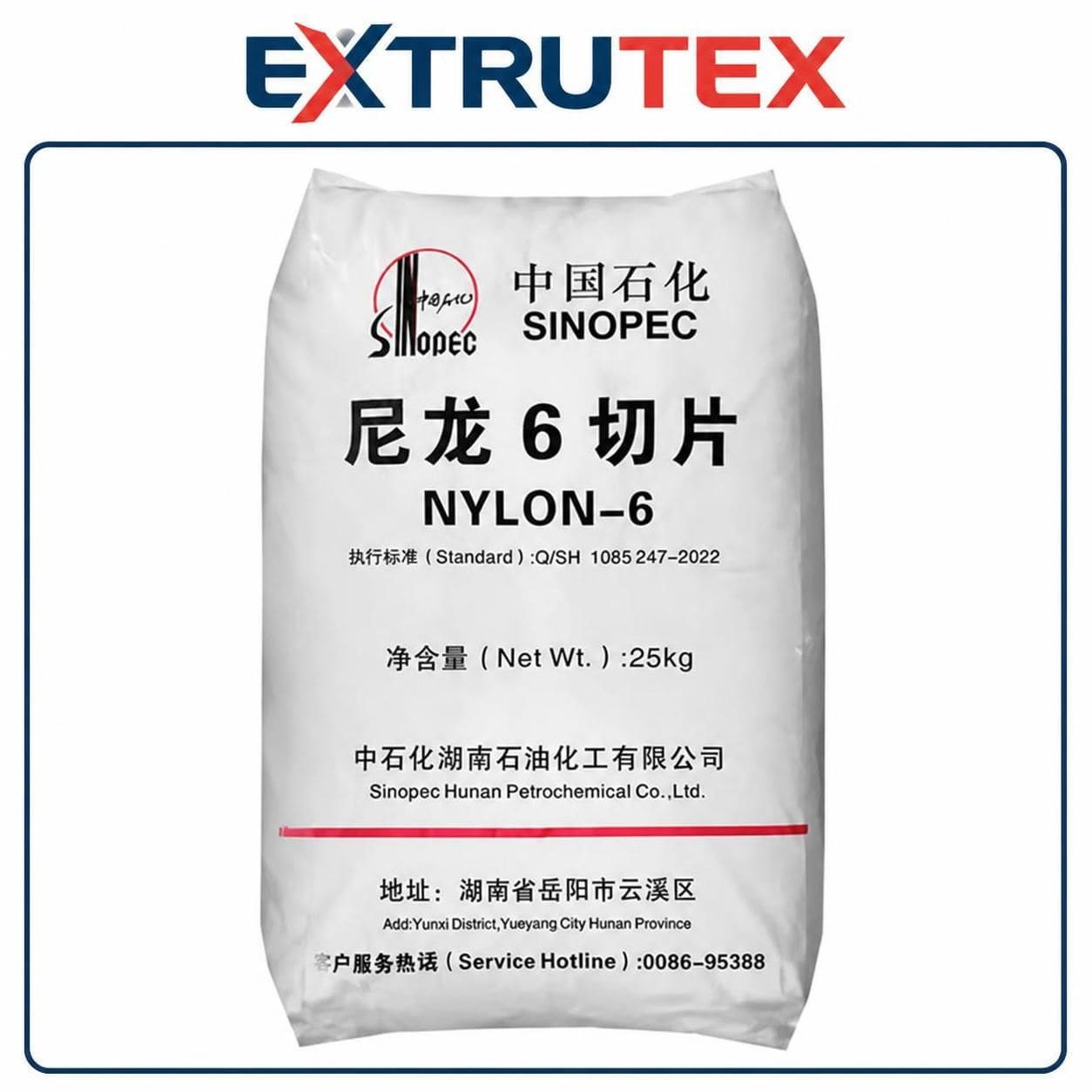
EXTRUTEX supplies and sources PA6 (Polyamide 6), commonly known as Nylon 6, from Chinese petrochemical producers and other potential international suppliers, subject to grade availability and technical requirements. We help buyers compare material options for injection molding, extrusion and selected reinforced engineering-plastic applications.
PA6 is valued for its mechanical strength, toughness, abrasion resistance and broad processing versatility. Depending on the formulation, it can be supplied as an unfilled natural resin, a colored compound, glass-fiber-reinforced material, mineral-filled compound, impact-modified grade or a specially formulated engineering material.
Whether you need general-purpose Nylon 6 pellets or a material designed for higher stiffness, dimensional stability, impact performance or heat resistance, EXTRUTEX can help identify suitable candidate grades and coordinate technical information for evaluation.
PA6 stands for Polyamide 6, a thermoplastic polymer widely known as Nylon 6. It is produced through ring-opening polymerization of caprolactam. PA6 is one of the most widely used engineering polyamides and is available in many formulations for plastic components, fibers, films and industrial products.
PA6 offers a useful balance of strength, toughness, abrasion resistance, fatigue performance and processability. It can be molded into complex shapes and, when appropriately formulated, reinforced with glass fiber or modified for specific performance requirements. It is used in automotive components, electrical equipment, machinery, textile applications, consumer goods, cable management, fasteners and many other products.
One important characteristic of PA6 is its ability to absorb moisture from the surrounding environment. Moisture can affect its dimensions, stiffness, toughness and other mechanical properties. This behavior must be considered during material selection, storage, processing and product design.
PA6 is related to PA66, another important nylon engineering plastic, but the two materials are not interchangeable in every application. Their melting behavior, mechanical performance, moisture response and processing requirements differ by grade. The specific polymer type and technical data sheet should always be checked before selecting a replacement material.
These are general descriptions rather than guaranteed values for every PA6 product. Density, melting behavior, tensile strength, impact resistance, flow and moisture response depend on molecular characteristics, additives, reinforcement, processing and test conditions. Always consult the current manufacturer's technical data sheet for the selected grade.
PA6 is used for components that must withstand mechanical loads while retaining useful toughness. Unfilled grades can provide a balance of strength and flexibility, while reinforced formulations can deliver increased stiffness and strength. The correct material depends on loading direction, part geometry, temperature and moisture conditioning.
PA6 is widely used for sliding parts, rollers, guides, bushings and other components exposed to friction. Its wear behavior depends on the counterface material, pressure, speed, lubrication, temperature and moisture level. For demanding tribological applications, evaluate the actual grade in representative operating conditions.
Selected PA6 grades can perform well under repeated loading. Applications may include clips, brackets, flexible mechanisms and components subjected to repeated movement. Fatigue performance should be assessed using the expected cycle count, load, temperature and conditioning state rather than relying on a general polymer description.
Glass-fiber-reinforced PA6 grades are available for applications requiring higher stiffness, strength and dimensional control. Glass content can influence impact behavior, shrinkage, surface appearance, flow direction and anisotropy. A higher glass-fiber percentage does not automatically mean a better material for every component.
PA6 is used in injection molding, extrusion and fiber manufacturing. Injection-molding grades are selected for their flow, mechanical properties and cycle-time requirements, while extrusion and textile grades may require different viscosity and molecular characteristics. A grade designed for one process should not automatically be assumed suitable for another.
PA6 can resist many oils, greases and selected industrial chemicals, but compatibility depends on the exact chemical, concentration, temperature and exposure duration. Water absorption and chemical exposure can also affect dimensions and mechanical behavior. Check the chemical resistance chart for the exact grade and intended application.
PA6 and PA66 are both important engineering polyamides, but their properties differ. PA6 is often selected for its toughness, processing characteristics and broad availability. PA66 is often selected where a different balance of stiffness, thermal performance and mechanical behavior is required. The best choice depends on the grade and operating conditions.
| Comparison | PA6 (Nylon 6) | PA66 (Nylon 66) |
|---|---|---|
| Polymer formation | Produced from caprolactam through ring-opening polymerization | Produced from hexamethylenediamine and adipic acid |
| Melting behavior | Typically around 220°C for many unfilled grades | Typically around 260°C for many unfilled grades |
| Mechanical performance | Can offer a useful balance of toughness, strength and flexibility | Often provides a different balance of stiffness and high-temperature performance |
| Moisture absorption | Absorbs moisture, affecting dimensions and properties | Also absorbs moisture; response differs by grade and condition |
| Processing | Requires grade-specific drying and temperature control | Requires grade-specific drying and temperature control |
| Applications | Automotive parts, machinery, consumer goods, fibers and molded components | Automotive, electrical, industrial and other engineering applications |
The temperatures and comparisons above are general references. Reinforcement, additives, conditioning and grade design can change performance. Do not substitute PA6 for PA66—or the reverse—without checking the technical requirements and validating the part.
EXTRUTEX can help source PA6 from Chinese petrochemical producers and other suppliers, subject to product availability and technical confirmation. The following manufacturer and brand families are included as starting points for grade comparison. The supplied list may contain PA66 grades, special compounds or designations whose current chemistry must be confirmed.
| Grade supplied | Manufacturer / brand in reference | Charpy notched impact at 23°C (kJ/m²), supplied | Selection notes |
|---|---|---|---|
| B3K | BASF / Ultramid | 5.5 | Confirm polymer type, reinforcement and test conditions |
| B3L | BASF / Ultramid | 10 | Confirm conditioning state and exact grade designation |
| B3S HP | BASF / Ultramid | Not supplied | Check the current grade datasheet |
| B3Z2 | BASF / Ultramid | 56 | Confirm impact test method and material formulation |
| B3Z4 HP | BASF / Ultramid | 87 | Confirm exact grade, test method and conditioning |
| B3EG3 | BASF / Ultramid | 8 | Verify glass-fiber content and mechanical properties |
| B3EG5 | BASF / Ultramid | 12 | Verify reinforcement level and grade specification |
| B3WG5 | BASF / Ultramid | 12 | Verify reinforcement and application suitability |
| B3EG6 | BASF / Ultramid | 15 | Verify filler content and flow characteristics |
| B3WG6 | BASF / Ultramid | 15 | Confirm grade designation and datasheet |
| B3HG7 | BASF / Ultramid | 15 | Confirm exact product specification |
| B3WG7 | BASF / Ultramid | 14 | Confirm reinforcement and test conditions |
| B3G8 | BASF / Ultramid | 14 | Confirm glass-fiber content and processing method |
| B3WG10 LF | BASF / Ultramid | 22 | Verify the LF suffix and current technical data |
| B3WG12 HSP | BASF / Ultramid | 14.6 | Confirm formulation, conditioning and intended use |
| B3ZG3 | BASF / Ultramid | 16 | Confirm grade suffix and impact test method |
| B3ZG6 | BASF / Ultramid | 20 | Confirm formulation and mechanical properties |
| B3ZG8 | BASF / Ultramid | 24 | Confirm exact datasheet before comparison |
| B3GK24 | BASF / Ultramid | 5 | Check reinforcement, filler and processing conditions |
| B3K6 | BASF / Ultramid | 3.5 | Confirm current product designation |
| B3M6 | BASF / Ultramid | 9 | Confirm grade properties and processing guidance |
| B3WGM24 HPX | BASF / Ultramid | 8 | Verify exact product chemistry and reinforcement |
| B3GM35 Q611 | BASF / Ultramid | 8 | Verify current product data and test conditions |
| PA6-LGF50 | Listed under BASF / Ultramid in supplied reference | 30 | Confirm the actual manufacturer, long-glass-fiber formulation and grade name |
| Grade supplied | Manufacturer / brand in reference | Charpy notched impact at 23°C (kJ/m²), supplied | Selection notes |
|---|---|---|---|
| 7335F | DuPont / Zytel | 4 | Verify whether the specific grade is PA6 or another polyamide |
| 7300T | DuPont / Zytel | 15 | Confirm polymer type and current datasheet |
| 7331T | DuPont / Zytel | 16 | Confirm polymer type and test conditions |
| 73G20L | DuPont / Zytel | 15 | Verify glass-fiber content and polyamide family |
| 73G30HSL | DuPont / Zytel | 12 | Confirm polymer type, heat stabilization and impact test |
| 73G45HSL | DuPont / Zytel | 23 | Confirm reinforcement level and polymer type |
| ST7301 | Celanese / Zytel in supplied reference | 125 | Manufacturer and brand attribution requires verification |
| 73G15HSL | Celanese / Zytel in supplied reference | 11 | Manufacturer attribution and polymer type require verification |
| 73G35HSL | Celanese / Zytel in supplied reference | 21 | Manufacturer attribution and polymer type require verification |
| 73G30T | Celanese / Zytel in supplied reference | 12 | Manufacturer attribution and polymer type require verification |
| Grade supplied | Brand / supplier in reference | Application supplied in reference | Verification notes |
|---|---|---|---|
| F130 | Envalior / Akulon | Automotive parts and electrical devices | Confirm exact PA6 grade and current datasheet |
| F130-C | Envalior / Akulon | Consumer goods and machinery parts | Confirm grade suffix and processing requirements |
| F-X9215 | Envalior / Akulon | Industrial tools and electronic casings | Confirm polymer type and intended application |
| K222-D | Envalior / Akulon | Textile components and packaging items | Verify whether the grade is suitable for the intended process |
| F160-Z | Envalior / Akulon | Sporting equipment and household products | Confirm current grade specification |
| F-X9183 | Envalior / Akulon | Medical instruments and office supplies | Medical use requires application-specific qualification and approvals |
| K222-KGMV14 | Envalior / Akulon | Construction materials and automotive interiors | Confirm formulation, reinforcement and regulatory needs |
| K223-TP4 | Envalior / Akulon | Aerospace parts and electrical connectors | Verify exact grade and all applicable industry approvals |
| Grade supplied | Brand / supplier in reference | Application supplied in reference | Verification notes |
|---|---|---|---|
| Renycle S T203K | Radici / Renycle | General injection molding | Confirm recycled content, polymer type and performance specifications |
| Renycle S GF2501 HFO | Radici / Renycle | Flame-retardant electrical and electronic components | Verify flame rating, glass-fiber content and certification |
| Renycle S GF3001K | Radici / Renycle | Automotive and industrial machinery parts | Confirm polymer family and reinforcement content |
| Renycle S GF3004K | Radici / Renycle | Structural appliance and furniture components | Confirm stiffness, impact performance and grade designation |
| Renycle S N101 | Radici / Renycle | Small consumer-product components | Confirm material composition and current availability |
How to use these tables: Treat them as a starting list for sourcing inquiries, not as a verified technical catalogue. Before placing an order, confirm the manufacturer's current name, exact grade code, polymer type, reinforcement level, impact test standard, conditioning state and technical documentation. Some legacy brand names and product families may have changed ownership or market availability.
In addition to international engineering-plastic brands, EXTRUTEX can help source PA6 resin from Chinese petrochemical producers and polymer suppliers. This can be useful for buyers seeking regional supply options, alternative grade selections or materials for larger-volume production. Availability depends on the exact grade, supplier, order quantity and delivery destination.
Chinese PA6 materials may be offered in different viscosity ranges and formulations for injection molding, extrusion, fiber production and compounding. Reinforced and modified compounds may also be available through appropriate producers or compounders. Not every producer offers every grade, and resin suitable for textile fiber production is not necessarily suitable for engineering injection molding.
EXTRUTEX can help coordinate technical comparison and sourcing discussions for Chinese PA6 materials. Final grade selection should be based on the actual datasheet, sample testing and the performance requirements of the finished product.
PA6 is used in selected automotive parts such as brackets, clips, housings, cable-management components, air-management parts and under-hood or interior components. Heat-stabilized and reinforced grades may be considered for more demanding environments. The grade must meet the relevant requirements for temperature, chemical exposure, mechanical loading, aging and vehicle-specific approval.
PA6 compounds are used in electrical housings, connectors, terminal components, cable accessories, switch components and other molded parts. Applications with strict flame-retardancy, tracking, insulation or temperature requirements need grades with the appropriate verified ratings. Do not assume that standard PA6 is flame-retardant or certified for electrical use.
Industrial applications include gears, rollers, sliding parts, housings, fasteners, wear components and machine guards. Glass-fiber-reinforced PA6 can offer increased stiffness where suitable, while unfilled grades may be preferred where toughness, flexibility or surface finish is more important.
PA6 is used for durable housings, handles, clips, fasteners, appliance components, sporting goods and selected household products. Color, texture, impact resistance and dimensional behavior should be considered during product design.
PA6 is an important fiber-forming polymer used in yarns, textiles, carpets, industrial fabrics and technical filament applications. Fiber-grade PA6 has different process and viscosity requirements from many injection-molding grades. Specify the intended spinning or extrusion process when requesting material.
Selected PA6 grades are used in film and extrusion applications, including packaging structures and semi-finished products. Material moisture, viscosity, melt stability and processing equipment all affect quality. Verify that the chosen grade is specifically designed for the intended extrusion process.
Glass-fiber-reinforced PA6 is widely used when unfilled Nylon 6 does not provide sufficient stiffness or dimensional control. Reinforcement can improve tensile strength, flexural modulus and heat performance under appropriate conditions. Commercial grades are available with different glass-fiber percentages and stabilizer packages.
| Material type | Potential advantages | Points to consider |
|---|---|---|
| Unfilled PA6 | Balanced toughness, easier surface finishing and lower reinforcement-related anisotropy | Moisture-related dimensional change and lower stiffness than many reinforced grades |
| PA6 with approximately 15% glass fiber | Moderate stiffness improvement in suitable formulations | Actual performance depends on fiber length, orientation and grade design |
| PA6 with approximately 30% glass fiber | Common option for higher stiffness and structural molded parts | May increase anisotropy, visible fiber appearance and tool wear |
| PA6 with higher glass-fiber content | Potentially higher stiffness and strength in the correct design | Flow, impact, weld-line strength and surface finish need careful evaluation |
| Long-glass-fiber PA6 | Can provide useful structural performance in suitable applications | Processing, fiber retention and component design differ from short-glass-fiber compounds |
Glass-fiber percentage alone is not enough to specify a compound. Confirm the base polymer, fiber length, reinforcement content, moisture conditioning, impact performance, shrinkage and processing recommendations. A reinforced grade may require different mold design and processing parameters from unfilled PA6.
PA6 is hygroscopic, which means it absorbs moisture from its surroundings. Moisture control is essential for consistent processing. Excess moisture in the melt can cause hydrolytic degradation, reduced molecular weight, surface defects and inconsistent mechanical properties.
Keep resin in its original sealed packaging until use and follow the supplier's specified drying procedure. Drying temperature, time and target moisture level depend on the grade, equipment and packaging condition. Use a suitable dehumidifying dryer where required, and verify moisture content according to the supplier's recommendations. Avoid relying on one universal drying recipe for every PA6 grade.
Processing temperatures depend on the polymer type, grade viscosity, reinforcement, additives and equipment. Use the grade-specific processing window rather than selecting a barrel temperature from a generic PA6 description. Excessive heat or residence time can degrade the polymer, while inadequate melt temperature can lead to poor filling, surface defects or weak weld lines.
Mold temperature affects crystallization, surface quality, cycle time, shrinkage and dimensional behavior. The correct setting depends on the resin grade and finished-part requirements. Reinforced grades may show directional shrinkage due to fiber orientation, so mold design and cooling balance should be validated during trials.
Molded PA6 parts can change dimensions and mechanical behavior as they absorb moisture after production. In some applications, conditioning is part of the product specification; in others, dry-state properties are more relevant. Make sure the material data and acceptance criteria refer to the same conditioning state.
Follow the resin manufacturer's safety data sheet and machine supplier's operating instructions. Use appropriate ventilation and avoid overheating the polymer. Maintain traceability between resin batch, drying conditions, machine settings and finished-part inspection results. For critical components, validate performance under realistic temperature, moisture and loading conditions.
| Application requirement | Important properties | Information to provide to EXTRUTEX |
|---|---|---|
| General injection molding | Flow, toughness, strength, shrinkage and surface finish | Part design, machine and annual consumption |
| High stiffness | Flexural modulus, tensile strength, reinforcement and creep | Loads, dimensions and operating temperature |
| Impact resistance | Notched impact, elongation and conditioned properties | Impact conditions, wall thickness and service environment |
| Electrical components | Flammability rating, electrical properties and thermal aging | Required standards, certification and destination market |
| Automotive applications | Heat aging, chemical resistance, emissions and mechanical durability | Vehicle application and customer specifications |
| Textile or fiber production | Viscosity, molecular characteristics, moisture and spinning stability | Spinning process, equipment and target fiber properties |
| Extrusion | Melt stability, viscosity and process-specific performance | Extrusion type, die design and product dimensions |
| Chinese supply alternative | Polymer identity, consistency, documentation and availability | Current grade, required quantity and target cost parameters |
EXTRUTEX helps industrial buyers identify suitable resin options for manufacturing and product development. Our sourcing approach focuses on matching the requested material to the intended process and application rather than selecting a resin by name alone.
EXTRUTEX is presented here as a sourcing supplier. Manufacturer and brand names are included to identify potential material options only. They remain the property of their respective owners, and their appearance on this page does not imply authorization, exclusivity or guaranteed stock.
Tell EXTRUTEX about your application, processing method, preferred grade and required quantity. We can help assess available PA6 options, including Chinese supply sources and suitable international grade families.
For a faster technical review, include: required polymer type, glass-fiber content if applicable, target properties, delivery country and any mandatory approvals.
Contact EXTRUTEX for PA6 ResinPA6 is Polyamide 6, commonly called Nylon 6. It is an engineering thermoplastic produced from caprolactam and used in molded parts, industrial components, fibers, films and other products requiring a balance of strength, toughness and wear resistance.
There is no material-family difference: PA6 and Nylon 6 are two names for the same polymer family. Specific grades can differ in viscosity, additives, reinforcement, color and intended processing method.
No. PA6 and PA66 are different polyamide types with different chemical structures and properties. Their melting behavior, moisture response, mechanical performance and processing conditions differ. Always confirm the polymer type before making a material substitution.
Many unfilled PA6 grades have a melting point around 220°C, but the exact value depends on the grade and formulation. The melting point is not the same as the recommended injection-molding barrel temperature; use the manufacturer's processing guide.
Yes. PA6 absorbs moisture from the environment. Moisture can change dimensions, stiffness, toughness and other properties. Resin should be stored and dried according to the manufacturer's instructions, and product specifications should state the relevant conditioning state.
Yes. Many PA6 grades are specifically designed for injection molding. Select the grade according to flow requirements, mechanical performance, part geometry, moisture behavior and operating conditions.
Yes, selected PA6 grades are used for extrusion, film, profiles and other products. Extrusion and fiber grades may have different viscosity and processing requirements from injection-molding grades. Confirm that the chosen grade is intended for your process.
It is PA6 compounded with glass fibers to improve stiffness and strength in suitable applications. Reinforcement can also affect shrinkage, anisotropy, impact performance, surface appearance and processing. The exact glass content and grade properties should be verified.
GF30 commonly indicates a material containing approximately 30% glass fiber by weight, but the exact meaning should be confirmed for the supplier's grade. It does not by itself specify the base polymer, fiber length, mechanical properties or regulatory status.
Yes. EXTRUTEX can help source PA6 from Chinese petrochemical producers and polymer suppliers, subject to grade availability, quantity, destination and technical requirements. The exact producer, grade, specification and documentation should be confirmed before ordering.
EXTRUTEX can help investigate availability for requested grades and supplier families, subject to sourcing conditions. Each exact grade, manufacturer attribution, polymer type, current datasheet and supply arrangement must be verified. Listing a brand on this page does not guarantee availability or imply authorized-distributor status.
No. The supplied list is a preliminary sourcing reference and may include PA66 grades, other polyamide formulations or product names that need verification. Confirm the exact polymer type and current technical data sheet before specifying a grade as PA6.
Provide the required grade or preferred manufacturer, application, processing method, quantity, destination country, reinforcement level if applicable and any technical or regulatory requirements. If you do not know the grade, provide a drawing or target performance specification.
PA6 is used in both sectors, but suitability depends on the exact grade and application. Automotive parts may require heat-aging, chemical-resistance and durability testing. Electrical components may require specific flame-retardancy and electrical ratings. Confirm all requirements for the target market.
Keep the material in sealed packaging in a clean, dry storage area and follow the supplier's handling instructions. Once opened, minimize exposure to ambient moisture and use the specified drying procedure before processing.
Whether you need unfilled PA6, glass-fiber-reinforced Nylon 6, a specialty compound or a Chinese refinery supply option, EXTRUTEX can help you organize the requirements and identify candidate grades for technical evaluation.
Contact us with your application, required quantity, preferred grade and delivery destination to begin a sourcing discussion.
There are no reviews yet.
By submitting your email, you agree to our company’s terms and conditions.
We are not looking to sell; we are here to provide you with the best support and service.
Contact available 24/7
Please do not contact us for advertising or sales inquiries
All rights of this website are reserved for EXTRUTEX Austria and its partner companies, © 2026
-
(0 customer reviews)