No products in the cart.


All rights of this website are reserved for EXTRUTEX Austria and its partner companies, © 2026
EXTRUTEX SG-20 Small Desktop Parallel Twin-Screw Extrusion Line for PP Recycling and 3D Printing Filament Production

Multiple Payment Methods

Discount for advance payments over 50%

Free Shipping Coordination Services
Payment methods:


A compact parallel twin-screw extrusion solution for polymer experimentation, polypropylene recycling, material development and small-scale 3D printing filament production.
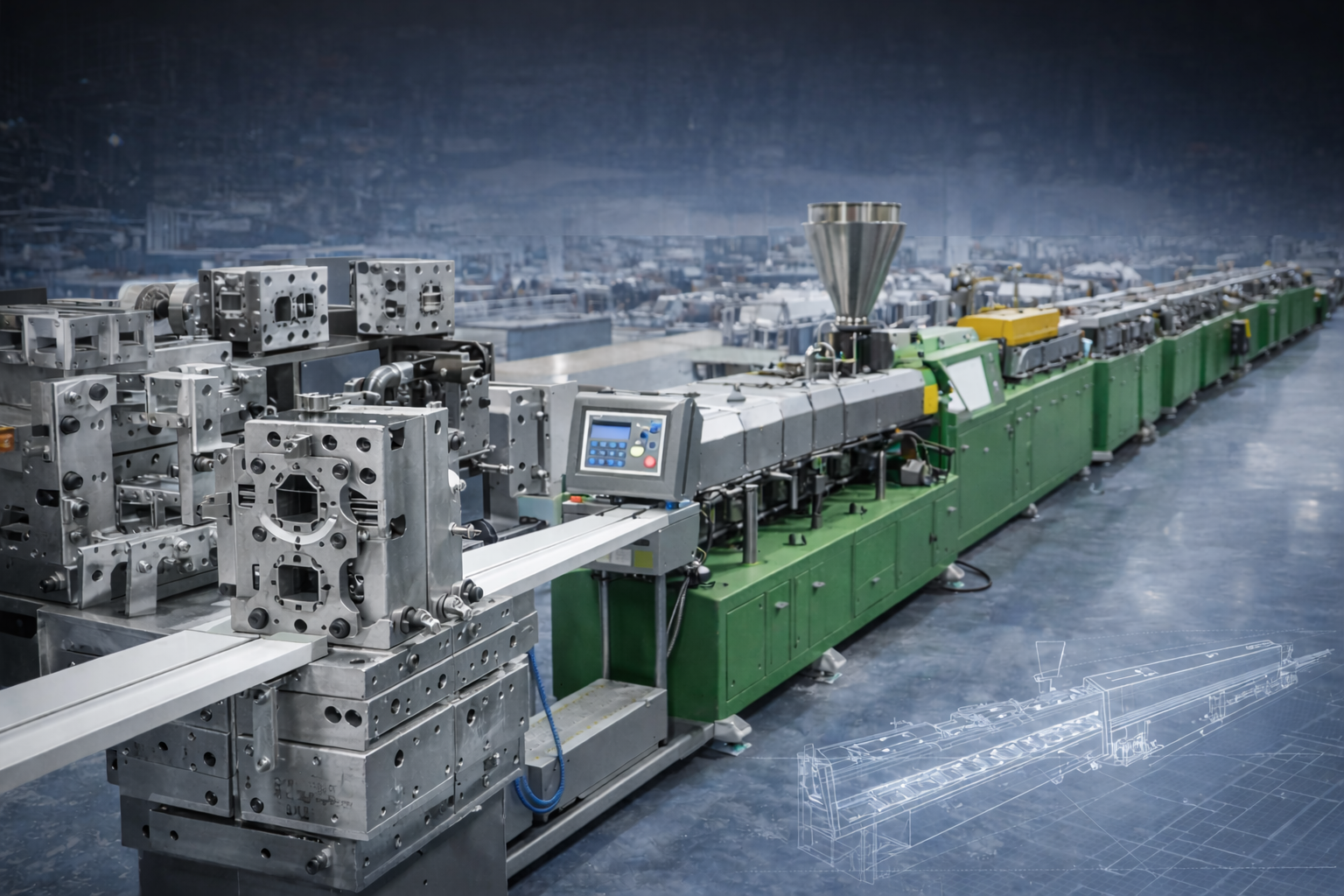
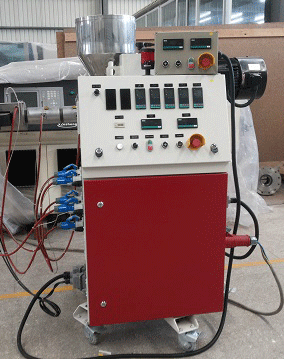
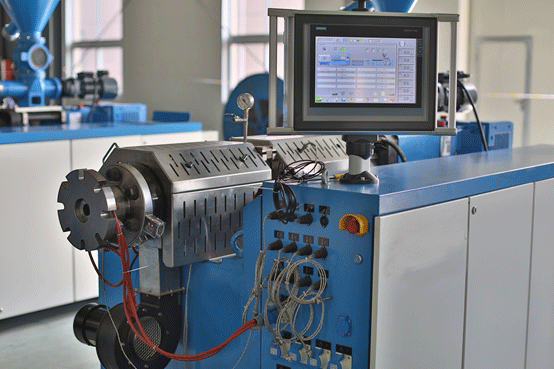
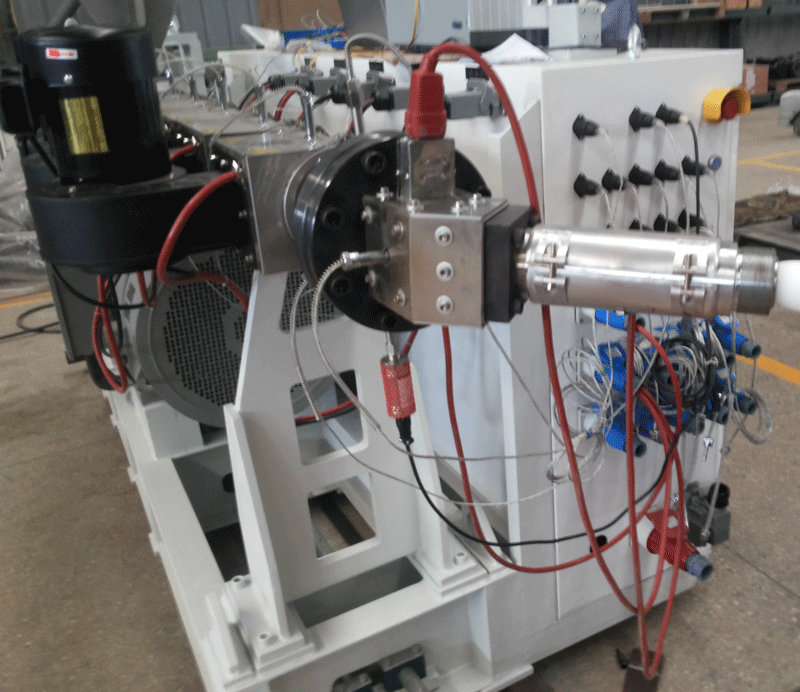
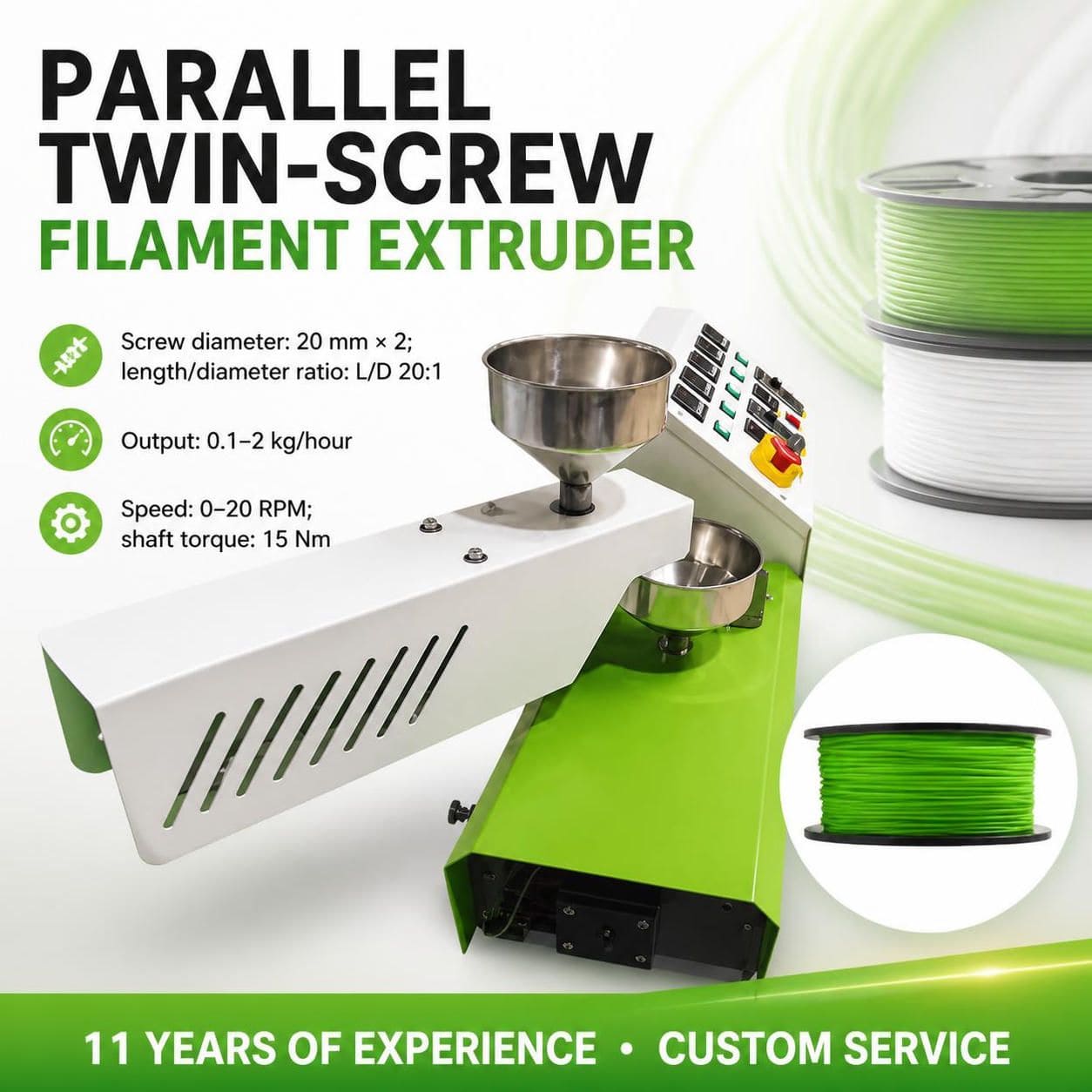
The EXTRUTEX SG-20 is a desktop-scale parallel twin-screw extruder designed for laboratories, universities, technical schools, research facilities, material developers and small workshops. Its compact configuration combines a twin-screw extrusion unit with a water cooling tank, haul-off puller and filament winder to create a continuous small-scale production line.
With two 20 mm screws, a 1,600 W total machine power rating, a 300 W combined main drive and feeding motor rating, and a nominal output range of 0.1–2 kg/h, the SG-20 provides a practical platform for controlled polymer processing and recycling experiments.
Request Technical Information Contact EXTRUTEXSmall-scale polymer processing is important for universities, research laboratories, technical institutions and businesses developing new plastic products. Before a material or formulation is transferred to larger production equipment, engineers and researchers often need to conduct preliminary trials using smaller quantities of polymer.
The EXTRUTEX SG-20 is designed for this type of work. Its parallel twin-screw arrangement provides a compact extrusion platform for processing suitable thermoplastics, evaluating material behavior and investigating recycling methods. It can be used for polypropylene (PP) recycling experiments and the development of small-scale extruded products, including filament for 3D printing trials.
Unlike a single-screw laboratory extruder, a parallel twin-screw configuration uses two screws working inside a common barrel. Twin-screw technology is widely used in polymer compounding, mixing and material development. The actual mixing and conveying behavior depends on screw design, screw arrangement, rotation direction and processing conditions.
The SG-20 features a split barrel construction, four internal heating zones and a temperature monitoring point at the feed inlet. Its compact dimensions make it suitable for installations where laboratory space, material consumption and experimental batch size are important considerations.
Process limited quantities of thermoplastic materials for formulation trials, material comparisons, process development and preliminary product testing.
Investigate the reprocessing of suitable polypropylene scrap, clean production waste and identified PP materials after appropriate sorting and preparation.
Connect the extruder to a cooling tank, haul-off puller and winder to investigate continuous filament production and downstream process control.
Demonstrate polymer melting, screw conveying, temperature control, cooling, pulling and winding in a compact laboratory production environment.
The EXTRUTEX SG-20 is offered as a complete small-scale extrusion line rather than only an individual extruder. The downstream equipment is arranged to support the movement of extruded material through cooling, pulling and collection.
The main extrusion unit contains two parallel screws with a specified diameter of 20 mm each and an L/D ratio of 20:1. The screw system conveys and processes thermoplastic material through the heated barrel.
The split barrel construction provides access to the screw and barrel assembly for inspection, cleaning and maintenance according to the machine's operating procedures.
The cooling tank receives the extruded strand after it leaves the die. Water cooling helps reduce the temperature of the extrudate and supports dimensional stabilization before the material reaches the puller.
Cooling conditions should be adjusted according to the polymer, strand dimensions and line speed. Tank dimensions and cooling capacity are subject to the supplied downstream configuration.
The puller draws the cooled extrudate through the downstream section at a controlled speed. Pulling speed is an important parameter because it influences strand dimensions and continuity.
For filament development, the puller must be coordinated with the extrusion rate and cooling conditions to help maintain a stable strand.
The winder collects the finished strand onto a spool for storage, handling and subsequent testing. Consistent winding is important to avoid tangled filament, crossed loops and unnecessary stretching.
Winding speed and tension should be coordinated with the haul-off system and the required filament dimensions.
The following technical table is based on the supplied SG-20 machine specifications. It covers the extrusion unit, electrical system, screw assembly, heating arrangement, dimensions and complete-line configuration.
| Technical Parameter | Specification |
|---|---|
| Product Model | EXTRUTEX SG-20 |
| Equipment Type | Small desktop parallel twin-screw extruder |
| Main Application | PP recycling, polymer processing, material research and 3D printing filament development |
| Total Machine Power | 1,600 W |
| Power Supply | 220 V, 50–60 Hz |
| Screw Configuration | Parallel twin-screw |
| Screw Diameter | 20 mm × 2 |
| Screw Length-to-Diameter Ratio | L/D 20:1 |
| Screw Material | 38CrMoA, nitrided and electroplated (as supplied; alloy designation to be confirmed) |
| Screw Speed | 0–20 rpm |
| Shaft Torque | 15 Nm |
| Nominal Output Capacity | 0.1–2 kg/h |
| Barrel Construction | Split-type barrel |
| Heating Method | Internal heating tube arrangement |
| Heating Zones | 4 zones |
| Temperature Monitoring Zones | 1 monitoring point at the feed inlet |
| Main Drive Motor | 220 V, 250 W |
| Main Feeding Motor | 220 V, 250 W |
| Motor Load Display | Two-position load display for main and auxiliary motors |
| Safety System | Key-operated machine lock; key activation required before operation |
| Extrusion Direction | Left to right |
| Net Machine Dimensions (L × W × H) | 113 × 35 × 50 cm |
| Net Machine Weight | 64 kg |
| Packed Dimensions (L × W × H) | 130 × 35 × 50 cm |
| Gross Packed Weight | 80 kg |
| Downstream Equipment | Water cooling tank, haul-off puller and filament winder |
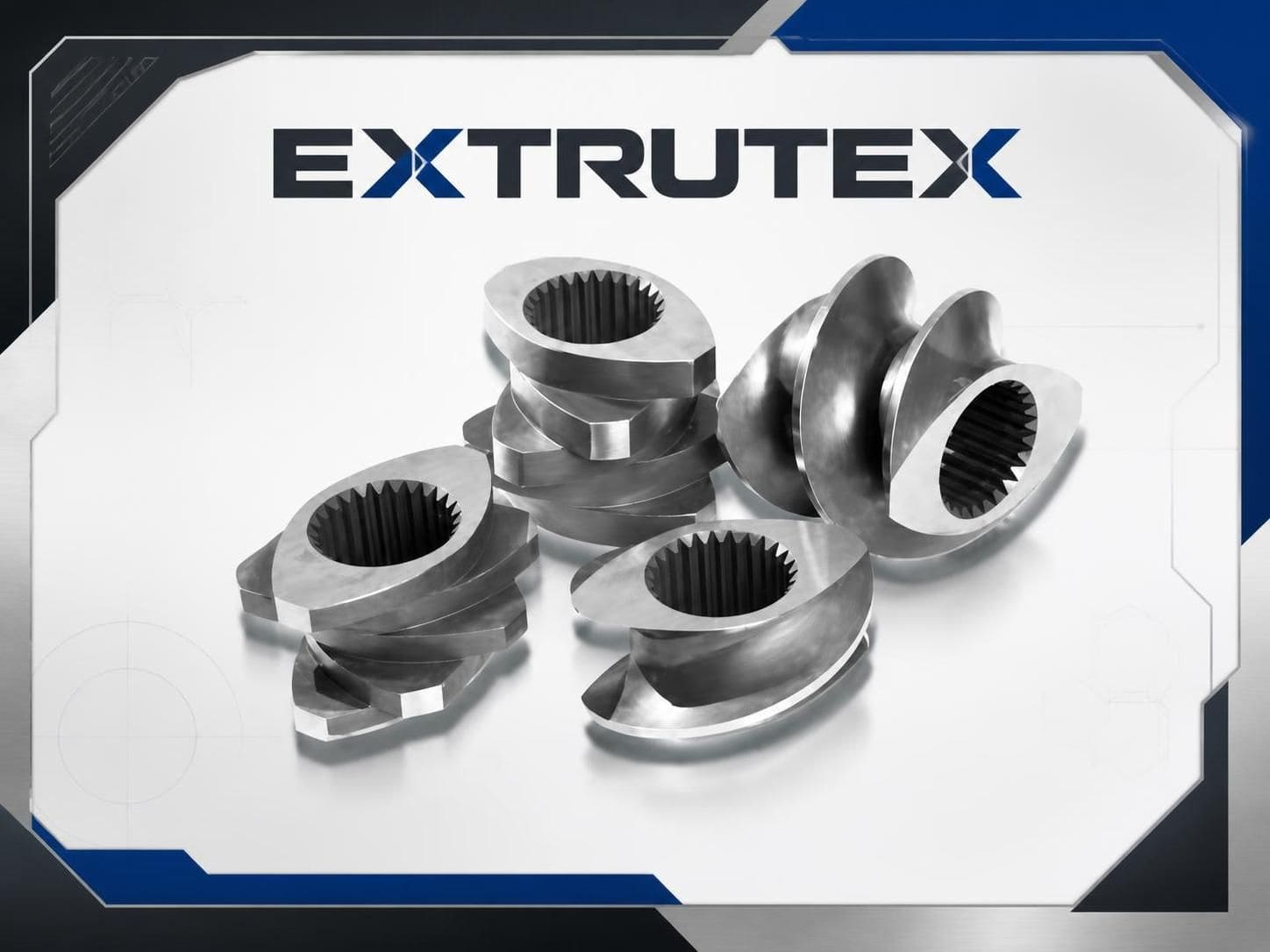
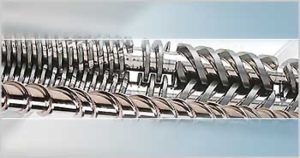
The screw and barrel assembly is the central processing section of the EXTRUTEX SG-20. Two parallel screws, each with a nominal diameter of 20 mm, operate inside the barrel to convey and process the polymer. The specified L/D ratio of 20:1 provides the dimensional basis for the screw processing section.
A twin-screw system can provide conveying and material interaction within a compact processing space. Its performance depends on screw geometry, screw clearance, rotation direction, speed, feed rate and polymer characteristics. These factors are particularly important when working with recycled material, where particle size and feed consistency may vary.
The supplied specification identifies 38CrMoA screw material with nitriding treatment and electroplating. Surface treatment is intended to improve the working surface characteristics and resistance to wear during polymer processing.
The exact alloy designation, plating material, coating thickness and hardness should be confirmed against the manufacturer's final technical documentation. This is especially important when specifying equipment for abrasive or filled polymer formulations.
The SG-20 uses a split-type barrel arrangement. A split barrel can make internal components more accessible for inspection and cleaning compared with a fully enclosed construction. This is useful in laboratory work where users may need to change materials, examine processing residues or conduct repeated formulation trials.
Always follow the manufacturer's shutdown, cooling and disassembly instructions before opening the barrel or carrying out maintenance.
Thermoplastic extrusion requires controlled heating to soften and melt the material as it travels through the barrel. Different polymers and formulations require different processing conditions. The SG-20 is equipped with four heating zones using an internal heating tube arrangement.
The four-zone heating arrangement allows the operator to establish heating conditions along the processing section. The supplied specification also identifies one temperature monitoring point for monitoring the feed-inlet area.
Multiple heating zones support staged thermal management along the barrel. Operators can establish suitable temperature settings according to the polymer and experimental process requirements.
One monitoring point is specified at the feeding inlet. This provides temperature information for the designated area and supports observation of operating conditions.
The correct processing temperature is material-dependent. PP, PLA, ABS, PETG and other thermoplastics do not share identical processing windows. Operators should use appropriate material data and manufacturer guidance rather than applying one temperature profile to every polymer.
The main drive system is specified with a 220 V, 250 W motor. It provides the drive for the twin-screw extrusion mechanism. The screw speed is specified as 0–20 rpm, with a stated shaft torque of 15 Nm.
The feeding system is specified with a separate 220 V, 250 W motor. Controlled feeding is important for maintaining a stable supply of material to the screw assembly and supporting consistent extrusion trials.
A two-position load display is specified for monitoring the main and auxiliary motor loads. Observing motor load can help operators identify changes in processing conditions, such as variations in feed consistency or material resistance.
The machine is equipped with a key-operated lock arrangement. The key must be used to enable the machine before operation. This feature is intended to restrict operation to authorized personnel and help prevent unintended use.
The EXTRUTEX SG-20 is particularly relevant to polypropylene recycling studies and small-scale thermoplastic processing. Suitable material selection and preparation are essential to obtaining stable operation and useful experimental results.
PP is a key target material for recycling and extrusion experiments. Potential feedstock includes identified PP production scrap, clean rejected components and suitable PP regrind.
Different PP grades may have different melt flow characteristics and processing behavior. Keep grades identified and evaluate them separately where necessary.
PLA can be investigated in small-scale filament extrusion and recycling trials when the machine configuration and processing conditions are appropriate. Moisture control is particularly important.
Identified ABS material can be considered for suitable extrusion experiments. Appropriate ventilation and polymer-specific temperature control are important.
PETG and other compatible thermoplastics may be investigated after confirming material suitability, feeding behavior, temperature requirements and downstream performance.
The SG-20 can form the extrusion section of a small-scale filament production line. The extruded polymer strand passes through a water cooling tank, then through the haul-off puller and finally to the winding unit.
This arrangement allows laboratories and material developers to investigate the relationship between extrusion rate, cooling, pulling speed and final strand dimensions. For filament production, the relationship between these process variables is important: pulling too quickly can reduce strand diameter, while insufficient pulling or unstable extrusion can cause irregular dimensions.
Filament diameter is a critical quality parameter for 3D printing. The target diameter must be selected according to the intended printer and application. Common filament formats include 1.75 mm and 2.85 mm, but the actual achievable range depends on the die, cooling arrangement, puller and process settings.
The supplied SG-20 specifications do not state a guaranteed filament diameter range or diameter tolerance. These values should therefore be confirmed for the selected downstream configuration rather than assumed from the extruder screw diameter.
Cooling helps the extruded strand retain its shape before it enters the pulling section. The cooling method and residence time should be appropriate for the polymer. Excessive or insufficient cooling can affect strand stability and the consistency of the final product.
The puller and winder should operate in coordination with the extrusion rate. The puller controls strand movement through the downstream line, while the winder collects the finished material. Proper synchronization helps reduce tension variations and winding defects.
Polypropylene is widely used in packaging, household products, automotive components, laboratory items and industrial applications. Clean PP production waste and rejected parts can be potential feedstock for recycling experiments when the polymer is correctly identified and contamination is controlled.
The EXTRUTEX SG-20 provides a compact platform for studying how prepared PP material behaves during twin-screw extrusion. Researchers can evaluate processing stability, output consistency, material appearance and the properties of extruded samples.
Repeated processing can change polymer properties. Recycled PP should be evaluated for its intended use, especially where mechanical performance, appearance or dimensional requirements are important.
Conduct small-batch extrusion trials, investigate polymer behavior and evaluate material processing parameters.
Demonstrate twin-screw extrusion, polymer melting, heating zones, cooling and downstream handling.
Study the reprocessing of suitable PP scraps, production waste and identified recycled feedstock.
Investigate small-scale filament extrusion with water cooling, pulling and winding equipment.
Evaluate selected polymer formulations and investigate the effects of additives or compatible recycled content.
Support prototyping, material demonstrations and preliminary product development with limited material quantities.
Stable extrusion depends on the interaction between the material, screw system, heating conditions and downstream equipment. The nominal output range of 0.1–2 kg/h should be considered in relation to the material and product being processed.
Uniform particle size and a consistent material supply help reduce fluctuations during feeding. Contamination and inconsistent feed size can influence processing stability and final product appearance.
Moisture can cause bubbles, surface defects and unstable extrusion in moisture-sensitive polymers. Follow material-specific drying recommendations.
The four heating zones provide staged heating control. Suitable settings depend on polymer grade, formulation, feed rate and processing objectives.
The specified screw speed range is 0–20 rpm. Screw speed and feed rate should be adjusted together to maintain stable processing and avoid overloading.
Downstream conditions influence the final strand dimensions and appearance. The water tank, puller and winder should be coordinated with the extrusion process.
The EXTRUTEX SG-20 is a small desktop parallel twin-screw extrusion line designed for polymer research, PP recycling experiments and small-scale filament production.
The machine has two parallel screws, each with a specified diameter of 20 mm.
The specified screw length-to-diameter ratio is 20:1.
The specified output range is 0.1–2 kg/h. Actual production depends on the polymer, feedstock preparation, screw speed and operating conditions.
The specified total machine power is 1,600 W. The main drive motor is 250 W and the main feeding motor is 250 W.
The SG-20 has four heating zones using an internal heating tube arrangement. One temperature monitoring point is specified at the feed inlet.
Yes. The described complete line includes a water cooling tank, haul-off puller and filament winder downstream of the extruder.
It can be configured as the extrusion section of a small-scale filament production line. The final filament diameter and tolerance depend on the die and downstream configuration.
The SG-20 is suitable for investigating the processing of identified and properly prepared PP feedstock. Material should be clean, appropriately sized and suitable for the machine configuration.
The specified power supply is 220 V, 50–60 Hz. Confirm electrical compatibility and installation requirements before ordering.
The net machine dimensions are 113 × 35 × 50 cm and the net weight is 64 kg. The packed dimensions are 130 × 35 × 50 cm and the gross packed weight is 80 kg.
Yes. A key-operated machine lock is specified. The key is required to enable operation. It should be used together with the required guarding and electrical safety procedures.
Whether your project involves PP recycling, polymer research, material development or experimental 3D printing filament production, the EXTRUTEX SG-20 provides a compact extrusion platform with a complete cooling, pulling and winding workflow.
Contact EXTRUTEX to discuss your material, intended application and downstream configuration.
Request a Quotation Email EXTRUTEXThe EXTRUTEX SG-20 small desktop parallel twin-screw extrusion line is designed for laboratory polymer processing, polypropylene recycling and small-scale 3D printing filament development. Equipped with two 20 mm screws and an L/D ratio of 20:1, the machine provides a compact platform for material experiments and controlled extrusion trials.
The SG-20 features a split-type barrel, four heating zones, one feed-inlet temperature monitoring point, a 250 W main drive motor and a 250 W feeding motor. Its total machine power is specified at 1,600 W, with a screw speed range of 0–20 rpm and a nominal output range of 0.1–2 kg/h.
For filament production experiments, the extruder is combined with a water cooling tank, haul-off puller and automatic winder. This complete configuration allows users to investigate the relationship between extrusion conditions, cooling, pulling speed and final strand dimensions.
The machine is intended for universities, technical schools, research laboratories, polymer developers, recycling projects and small workshops that require a compact parallel twin-screw extrusion solution. Its small-scale design makes it suitable for experimental work where limited material quantities and controlled processing are preferred.
Related search terms: EXTRUTEX SG-20, SG-20 twin screw extruder, desktop twin screw extruder, small parallel twin screw extruder, laboratory twin screw extruder, PP recycling extruder, polypropylene recycling machine, desktop PP extruder, small scale plastic extrusion, 20 mm twin screw extruder, 20 mm parallel twin screw, 3D printing filament extrusion line, laboratory filament extruder, small filament production line, PP filament extruder, polymer research extruder, plastic recycling laboratory equipment, twin screw polymer processing, compact plastic extruder, water cooling filament line, filament haul-off puller, automatic filament winder, four zone heating extruder, split barrel twin screw extruder, small batch polymer extrusion, material development extruder, desktop plastic recycling equipment, university polymer extrusion equipment, laboratory PP recycling, EXTRUTEX extrusion equipment.
There are no reviews yet.
By submitting your email, you agree to our company’s terms and conditions.
We are not looking to sell; we are here to provide you with the best support and service.
Contact available 24/7
Please do not contact us for advertising or sales inquiries
All rights of this website are reserved for EXTRUTEX Austria and its partner companies, © 2026
-
(0 customer reviews)