No products in the cart.



All rights of this website are reserved for EXTRUTEX Austria and its partner companies, © 2026



Multiple Payment Methods

Discount for advance payments over 50%

Free Shipping Coordination Services
Payment methods:


Closed-loop raw-material handling for plastics processing plants
The EXTRUTEX Central Conveying System is a fully engineered, closed-loop solution that centralizes the storage, drying, dosing and pneumatic transport of plastic resins and additives. Designed in Austria and manufactured at EXTRUTEX production facilities in Nanjing and Shanghai, the system eliminates workshop dust, noise and hot-air pollution while enabling true multi-site remote control. It is the preferred architecture for modern extrusion, injection-moulding and compounding plants that demand higher product quality, lower energy consumption and a cleaner, safer working environment.
Traditional material handling in plastics factories relies on individual loaders mounted on each machine. Every loader generates its own vacuum, draws ambient air through the material stream and discharges residual dust and warm air directly into the production hall. The result is a noisy, dusty and thermally unstable environment that compromises both product quality and operator comfort. The EXTRUTEX Central Conveying System reverses this paradigm.
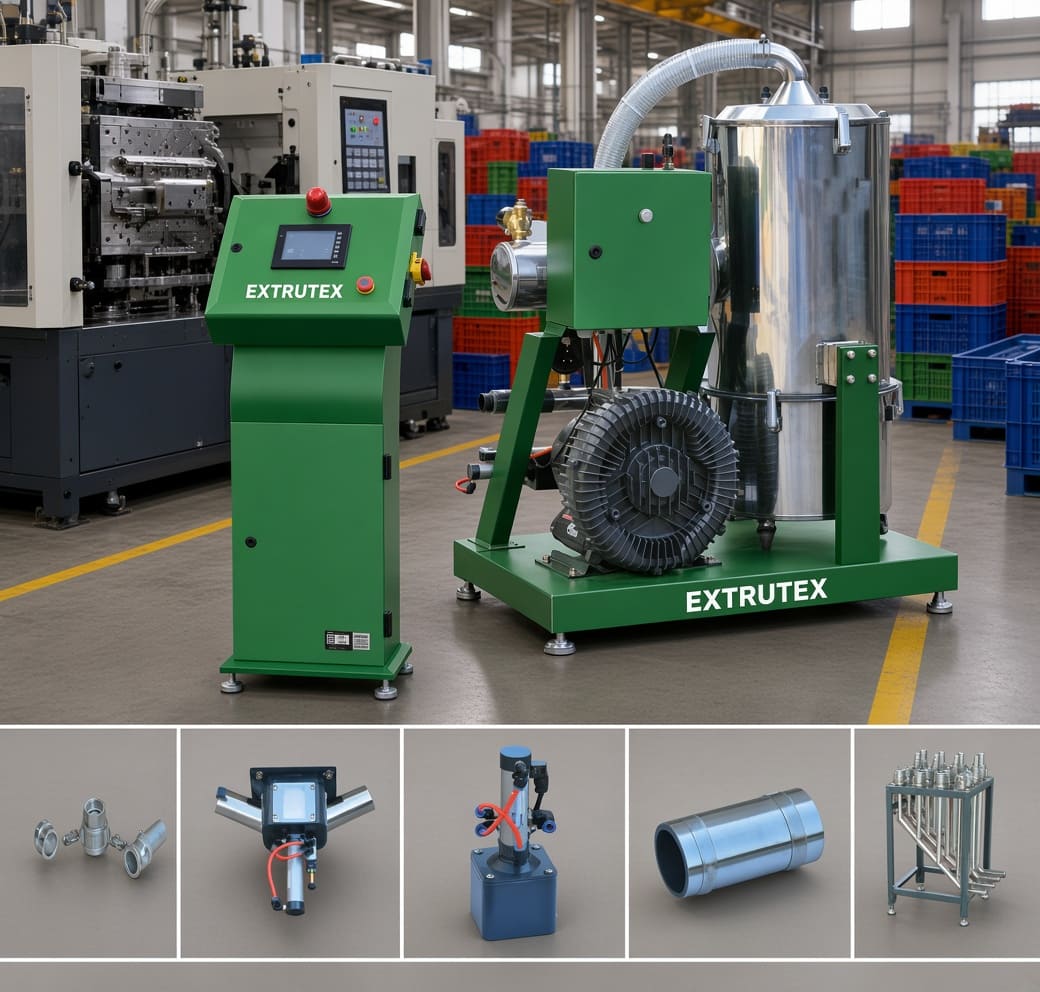
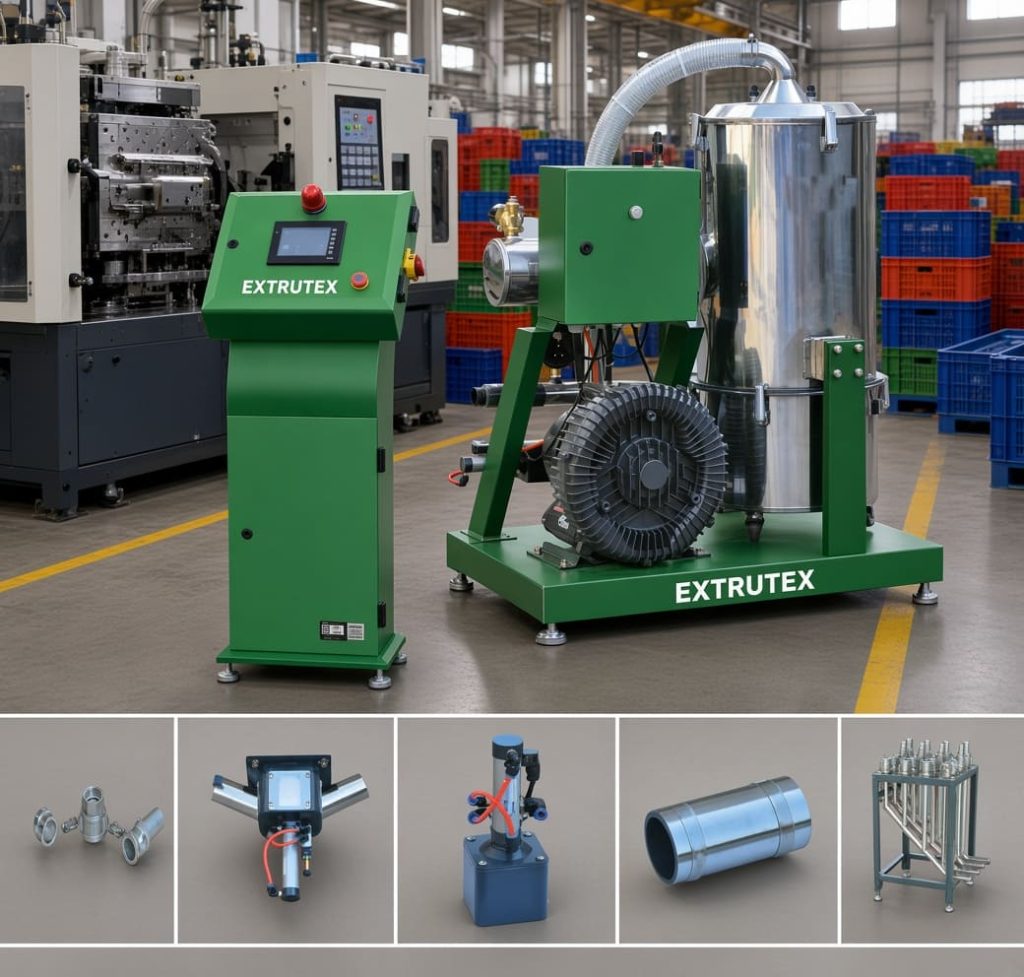
At the heart of the layout is a single, high-capacity central vacuum unit (or a redundant pair of units) that serves every processing machine on the shop floor. Raw materials are stored in a battery of stainless-steel silos or day bins, optionally equipped with drying or crystallizing units. From these central sources, material is conveyed through a network of stainless-steel or aluminium pipes under continuous negative pressure. At each machine a compact, low-noise receiver (hopper loader) receives the material and discharges it into the machine throat on demand. Because the entire circuit is sealed, neither dust nor process heat escapes into the workshop.
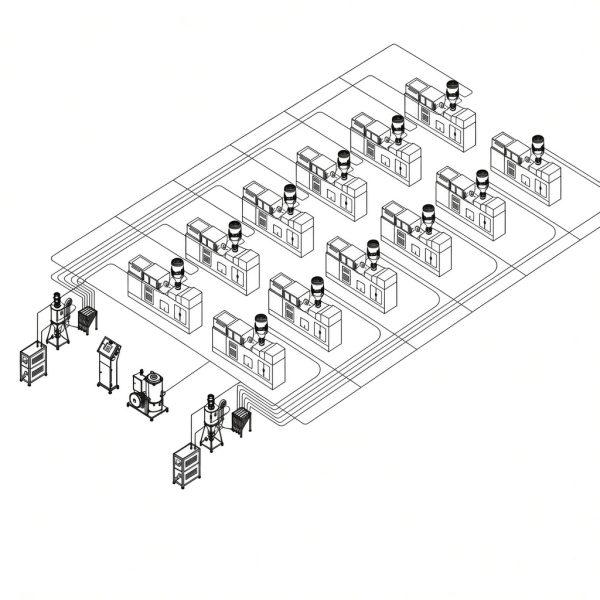
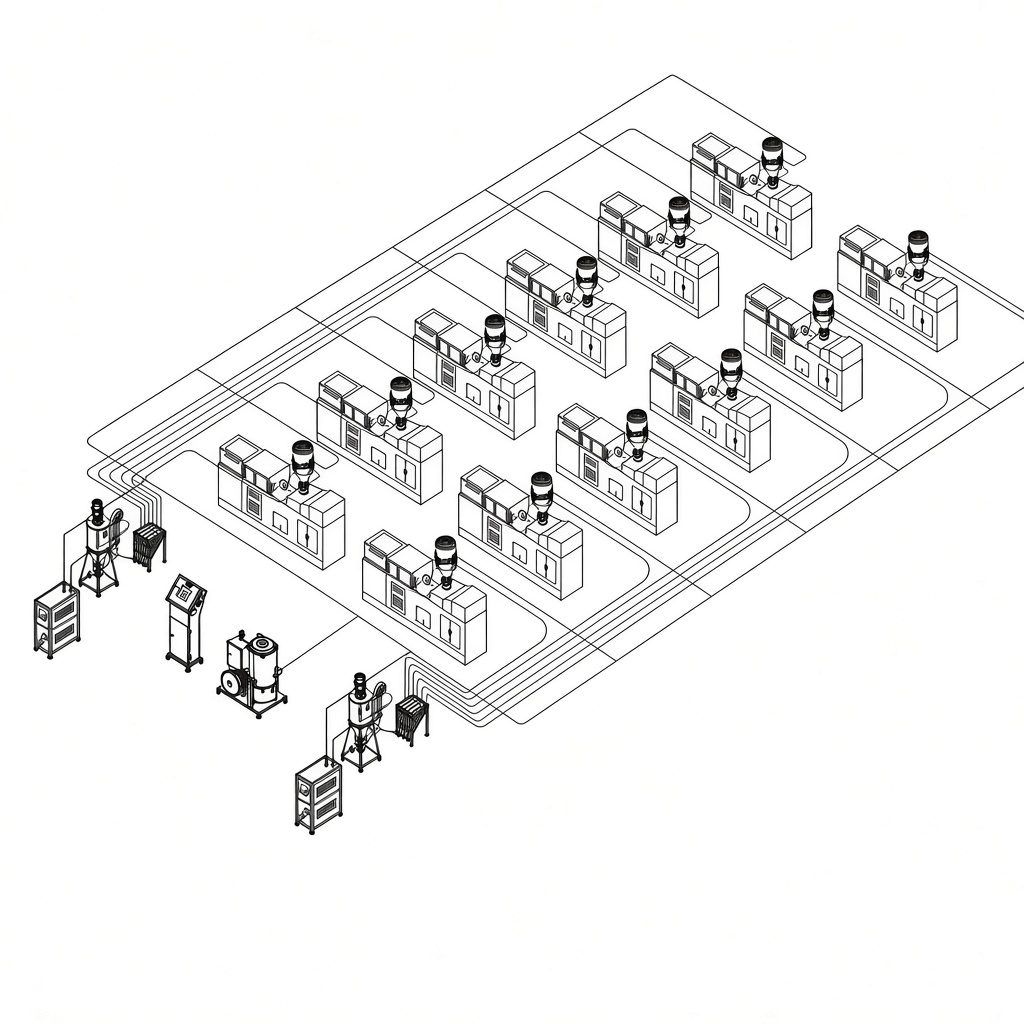
The isometric construction layout typically shows a central control cabinet, a vacuum pump station, a bank of material sources, a multi-branch pipe network and a series of machine-mounted receivers. Pipe routing is carefully calculated for minimum pressure drop and maximum conveying distance—often exceeding 100–150 m for multi-storey or multi-building installations. Automatic pipe-cleaning cycles and line-purging sequences prevent cross-contamination when materials are changed.
The performance advantages of the EXTRUTEX central system are both technical and commercial. They can be grouped into five principal benefits that appear consistently in customer feedback and internal testing data.
All dust is captured at the central filter station and discharged into sealed collection bins. Workshop air quality remains within strict occupational-health limits without the need for additional local exhaust systems.
High-speed blowers and vacuum pumps are housed in an acoustic enclosure, typically located outside the production hall or in a dedicated plant room. Machine-side receivers operate at sound levels well below 70 dB(A).
One correctly sized central vacuum unit consumes significantly less power than a fleet of individual loaders. Frequency-inverter control further matches vacuum demand to real-time material flow, yielding typical energy savings of 30–50 %.
Reduced energy, lower maintenance, fewer spare parts and the elimination of local dust-collection equipment combine to shorten the payback period to 12–24 months in most medium-to-large plants.
A clean, quiet, fully automated material-handling hall is a powerful differentiator during customer audits, ISO certifications and ESG reporting.
EXTRUTEX employs high-efficiency side-channel or claw-type vacuum pumps selected according to total conveying distance, number of simultaneous receivers and material bulk density. Pumps are equipped with frequency inverters that modulate motor speed in real time, maintaining a constant vacuum set-point while minimizing electrical consumption. Redundant pump configurations with automatic change-over are available for 24/7 continuous operation. All pumps are mounted on vibration-damped frames inside sound-attenuating cabinets; residual noise at 1 m is typically ≤ 75 dB(A).
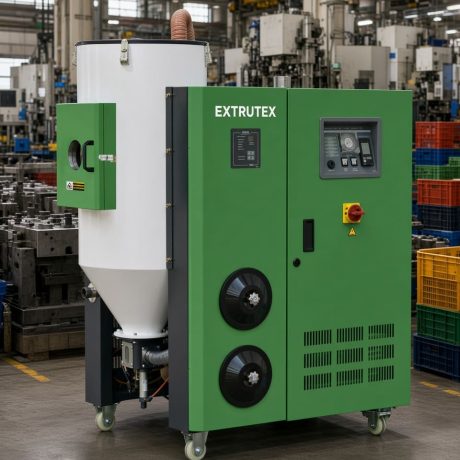
Material can be drawn from a wide variety of sources: outdoor aluminium or stainless-steel silos, indoor day bins, octabins, big-bags or directly from drying/crystallizing hoppers. Each source is fitted with a material probe or level sensor that communicates with the central PLC. Automatic source selection allows the system to switch between virgin resin, regrind and additives without operator intervention. Optional integrated drying systems use dual-bed desiccant dryers or infrared crystallizers to ensure that hygroscopic materials (PET, PA, PC, etc.) enter the conveying circuit at the required residual moisture level.
Conveying lines are fabricated from stainless steel (AISI 304 or 316) or anodized aluminium, with smooth internal surfaces and large-radius bends to minimize abrasion and pressure loss. Pipe diameters range from 40 mm to 100 mm depending on throughput. Multi-branch manifolds are equipped with pneumatically actuated diverter valves that route material to the correct destination. Automatic line-cleaning (pipe-purging) sequences empty residual material after each conveying cycle, preventing colour or type contamination when recipes change.
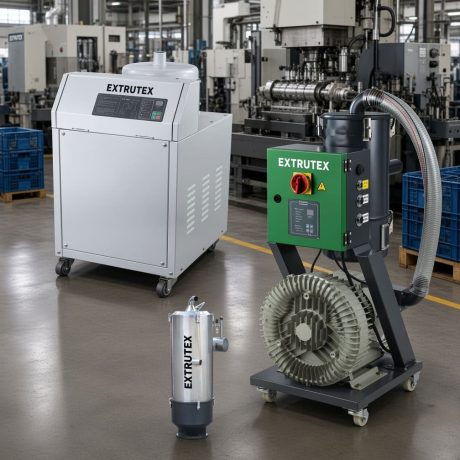
Each processing machine is equipped with a compact receiver whose volume is matched to the machine’s throughput. Receivers are available in stainless steel or food-grade polymer construction and incorporate a high-efficiency filter cartridge that is automatically cleaned by reverse-pulse air. A level sensor (capacitive or optical) triggers the next conveying cycle when the material level falls below a pre-set threshold. Because the receiver is under continuous vacuum only during the short filling phase, energy consumption and filter loading remain minimal.
A critical component highlighted in the original construction layout is the vacuum valve. EXTRUTEX vacuum valves are compact, lightweight units fitted with an internal rubber diaphragm that guarantees absolute airtightness. The valve is installed in the air-suction circuit and is controlled by the central PLC. When a receiver calls for material, the corresponding valve opens, allowing vacuum to be applied only to that specific line. All other lines remain isolated, preventing unnecessary air leakage and maintaining system efficiency. The diaphragm design ensures reliable sealing even after tens of thousands of cycles and is resistant to the abrasive action of glass-filled or mineral-filled resins.
The entire installation is supervised by a programmable logic controller (PLC) of European origin, selected for its robustness and long-term availability of spare parts. The operator interface is a colour touch-screen HMI that displays real-time status of every machine: material loading, machine on/off status, material-shortage alarms, filter-cleaning cycles and vacuum-pump operating parameters. Recipe management allows the operator to assign specific materials and source silos to each machine with a few screen taps. Historical data logging and Ethernet connectivity support integration into plant-wide MES or Industry 4.0 platforms. Remote access via secure VPN is optionally available for factory-floor diagnostics by EXTRUTEX service engineers.
A typical operating sequence proceeds as follows:
Because the vacuum is applied only to the active line, multiple receivers can be served sequentially or in carefully timed parallel groups without loss of conveying velocity.
EXTRUTEX recognises that no two plastics plants are identical. The system is therefore modular and fully customisable:
All custom components are designed in Austria and manufactured under strict quality control at the Nanjing and Shanghai plants, ensuring consistent metallurgy, welding standards and surface finishes.
The following table summarises the principal technical parameters of a typical EXTRUTEX Central Conveying System. Exact values are project-specific and confirmed during engineering design.
| Parameter | Typical Range / Value | Notes |
|---|---|---|
| Conveying distance (horizontal) | Up to 150 m | Longer distances possible with booster stations |
| Conveying height (vertical) | Up to 30 m | Multi-storey installations supported |
| Number of receivers served | 1 – 40+ | Scalable by additional vacuum units |
| Pipe diameter | Ø 40 – 100 mm | Stainless steel or aluminium |
| Vacuum pump power | 5.5 – 45 kW | Inverter-controlled |
| Vacuum level | –200 to –600 mbar | Adjustable via PLC |
| Receiver volume | 3 – 50 litres | Custom sizes available |
| Filter type | Cartridge, automatic reverse-pulse | Optional HEPA secondary stage |
| Control system | European PLC + colour HMI | Ethernet / remote access ready |
| Noise level (pump station) | ≤ 75 dB(A) at 1 m | Acoustic enclosure standard |
| Material compatibility | All free-flowing pellets, flakes, powders | Abrasion-resistant options for filled resins |
| Power supply | 380–480 V / 50–60 Hz / 3-phase | Other voltages on request |
| Compressed-air requirement | 6 bar dry, oil-free | For valves and filter cleaning |
| Operating temperature | –10 °C to +45 °C | Outdoor components weather-protected |
| Compliance | CE, optional ATEX / IECEx | Designed to European machinery directives |
The isometric construction layout provided by EXTRUTEX engineers shows the recommended spatial arrangement. The vacuum pump station is ideally located outside the production hall or in a dedicated plant room to isolate noise and heat. The central control cabinet is placed in a clean, accessible area—often adjacent to the production supervisor’s office—so that operators can monitor the entire system at a glance. Material sources (silos, dryers, day bins) are clustered to minimise pipe runs. Machine receivers are mounted directly on the feed throat of each extruder or injection-moulding machine, with flexible hose connections that accommodate machine vibration and occasional repositioning.
Pipe bridges and overhead trunking keep the floor clear for forklift traffic and maintenance access. All valves, sensors and receivers are accessible from catwalks or portable platforms, facilitating routine filter changes and inspection. The layout also anticipates future expansion: spare pipe branches and electrical conduits are installed during the initial phase so that additional machines can be connected with minimal disruption.
Because the conveying circuit is completely closed, ambient air does not contact the material stream after the material leaves the source silo. This eliminates the risk of moisture pick-up, airborne contamination and thermal degradation. Product quality—particularly critical for optical, medical and food-contact grades—is therefore protected throughout the handling process.
From a safety perspective, the absence of open dust sources reduces the risk of dust explosions and improves occupational hygiene. Centralised dust collection means that operators never handle fine powders directly. All electrical components are selected and wired in accordance with European machinery directives; emergency-stop circuits and interlocks are fully integrated into the PLC safety architecture.
Environmentally, the reduction in energy consumption and the elimination of local exhaust fans translate into a measurable lowering of the plant’s carbon footprint. Captured dust can be recycled or disposed of in a controlled manner rather than being released into the atmosphere.
EXTRUTEX combines Austrian engineering excellence with cost-effective, high-quality manufacturing in China. Design, process engineering and critical component selection are performed in Austria, ensuring that every system meets the rigorous standards expected by European and global customers. Manufacturing takes place in modern facilities located in Nanjing and Shanghai, where skilled technicians produce stainless-steel fabrications, assemble vacuum units and integrate control systems under strict quality-management procedures.
This dual-location model gives customers the best of both worlds: European design integrity and competitive pricing without compromising on reliability or after-sales support. EXTRUTEX maintains a global network of service partners and keeps a comprehensive stock of spare parts, guaranteeing rapid response times wherever the equipment is installed.
Every EXTRUTEX central conveying project follows a structured engineering workflow:
Customers receive a complete documentation package that includes P&IDs, electrical drawings, operating manuals, maintenance schedules and recommended spare-parts lists. Software updates and recipe expansions can be performed remotely when the system is connected to a secure network.
In an increasingly competitive plastics-processing landscape, the ability to deliver consistent product quality while controlling energy costs and improving workplace conditions is a decisive advantage. The EXTRUTEX Central Conveying System addresses all three requirements simultaneously. By centralising vacuum generation, sealing the material path and placing intelligent control in the hands of a single PLC, the system removes dust, noise and thermal pollution from the production hall, reduces power consumption by up to half, and gives operators full visibility and remote control over every material movement.
Whether the plant is a multi-line extrusion facility, a large injection-moulding hall or a compounding operation handling dozens of formulations, the modular architecture of the EXTRUTEX system scales gracefully. Custom stainless-steel hoppers, abrasion-resistant pipework, integrated drying and dosing, and advanced recipe management ensure that the solution fits the process rather than forcing the process to fit the equipment.
Backed by Austrian design expertise and manufactured to exacting standards in Nanjing and Shanghai, EXTRUTEX delivers a reliable, future-proof materials-handling platform that protects product quality, lowers operating costs and elevates the professional image of the entire production facility. For plastics processors seeking a cleaner, quieter and more efficient plant, the Central Conveying System is no longer an option—it is the new standard.
© EXTRUTEX — Austria Design · Manufacturing in Nanjing & Shanghai, China
Technical data subject to confirmation for each project. Specifications may be updated without prior notice.
There are no reviews yet.
By submitting your email, you agree to our company’s terms and conditions.
We are not looking to sell; we are here to provide you with the best support and service.
Contact available 24/7
Please do not contact us for advertising or sales inquiries
All rights of this website are reserved for EXTRUTEX Austria and its partner companies, © 2026
-
(0 customer reviews)