No products in the cart.



All rights of this website are reserved for EXTRUTEX Austria and its partner companies, © 2026


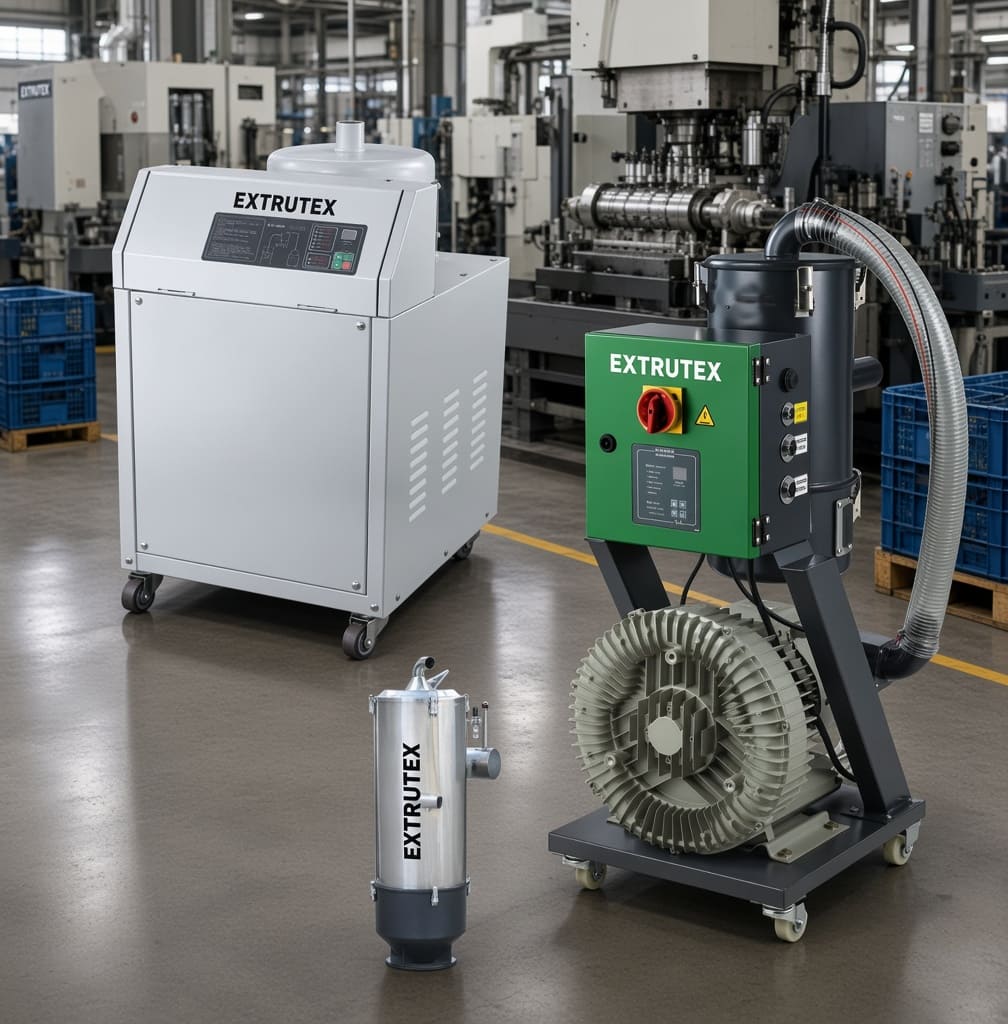
Detachable Type Autoloader

Multiple Payment Methods

Discount for advance payments over 50%

Free Shipping Coordination Services
Payment methods:


EXTRUTEX Detachable Type Autoloaders are high-performance automatic material feeding systems designed for plastic injection moulding machines and related process equipment. Combining Austrian design principles with precision manufacturing in Nanjing and Shanghai, these autoloaders deliver accurate, long-distance conveying of pellets and powders while protecting material quality and extending motor life through advanced control and overload protection.
In modern plastics processing, consistent and contamination-free delivery of raw material to the injection moulding machine is essential for product quality, cycle-time stability, and overall plant efficiency. Manual loading is labour-intensive, prone to spills and moisture pick-up, and difficult to control. The EXTRUTEX Detachable Type Autoloader series solves these problems with a clean, automated, and highly flexible solution.
Designed in Austria and manufactured in advanced facilities in Nanjing and Shanghai, China, every unit reflects a focus on reliability, operator convenience, and process integrity. The signature “detachable” architecture separates the controller from the material hopper. This separation simplifies installation, maintenance, and operation, while allowing the hopper to be positioned optimally above the machine throat or dryer.
The range covers conveying capacities from 400 kg/h to 1 200 kg/h and conveying heights from 4.5 m to 10 m. Models are available for both granule and powder handling, with options for single-machine feeding or multi-machine (one-to-several) distribution. Stainless-steel hoppers protect material purity, high-voltage blowers enable long-distance transport, and microcomputer control with comprehensive alarms keeps the process under precise supervision.
Whether you operate a single injection moulding machine or a multi-machine cell, the EXTRUTEX Detachable Type Autoloader can be configured to match your layout, material type, and production volume—delivering reliable automatic feeding day after day.
Seven core performance pillars define the EXTRUTEX Detachable Type Autoloader series. Each has been engineered to address real production challenges in plastics processing.
The separation of controller and hopper is more than a convenience feature. By locating the control unit away from the process area, heat, vibration, and potential material dust are kept away from sensitive electronics. Operators can access the control panel at a comfortable height and location, while the hopper sits directly where it is needed—above the machine or dryer. This architecture also simplifies cleaning and hopper changeovers.
Microcomputer control delivers accurate timing and sequence management for suction, conveying, and discharge cycles. Multiple alarm points alert operators to filter blockage, motor overload, material shortage, or other abnormal conditions, allowing rapid intervention before product quality or machine safety is compromised.
Motor overload protection is standard across the range. Continuous monitoring prevents the motor from running under excessive load, significantly extending its service life and reducing the risk of sudden failure during production.
High-voltage blower technology provides the static pressure needed to move material through long conveying lines and vertical lifts. This capability is especially valuable in larger plants where material storage or central drying systems are located some distance from the injection machines.
Stainless-steel construction of the material hopper eliminates the risk of contamination that can occur with painted or coated mild-steel hoppers. For food-contact, medical, or high-purity applications, this is an essential quality safeguard.
Flexibility is further enhanced by the ability to feed one or several moulding machines from a single autoloader, and by the choice of electric-eye or vacuum hopper designs. Electric-eye hoppers use photoelectric sensors to detect material level, while vacuum hoppers rely on the vacuum system itself for level control. Both options can be selected according to process preference and material behaviour.
The EXTRUTEX Detachable Type Autoloader operates on the vacuum (negative-pressure) conveying principle. A high-voltage blower creates suction in the conveying line. Material is drawn from a storage bin, bag, or dryer outlet into the suction tube and transported to the material hopper mounted above the injection moulding machine or further process equipment.
Once the hopper reaches the set material level (detected by electric eye or by vacuum logic), the suction cycle stops, the discharge valve opens, and material flows by gravity into the machine throat or dryer. After a short discharge period the cycle repeats automatically. The entire sequence is managed by the microcomputer controller with adjustable timers and alarm functions.
Typical system layouts illustrated in the working-principle diagrams include:
These modular configurations allow the same core technology to serve simple single-machine cells as well as complex multi-machine production lines with central material handling.
The EXTRUTEX Detachable Type Autoloader is widely used in the plastics processing industry and related sectors:
In all of these applications the combination of reliable long-distance conveying, precise level control, material protection, and multi-machine capability delivers measurable improvements in labour efficiency, product consistency, and plant cleanliness.
A complete EXTRUTEX Detachable Type Autoloader system typically includes:
All product-contact surfaces in the hopper are stainless steel. Seals and valves are selected for durability and clean operation. The detachable design means that the hopper can be removed or replaced with minimal tools, simplifying cleaning and changeovers between different materials or colours.
The table below summarises the standard EXTRUTEX Detachable Type Autoloader range. Custom configurations, additional hoppers, and powder-handling options are available on request.
| Model | Motor | Conveying Capacity | Conveying Height | Material Hopper Volume | Conveying Tube Calibre | Controller Dimensions (L×W×H) | Hopper Dimensions (L×W×H) | Controller Weight | Hopper Weight |
|---|---|---|---|---|---|---|---|---|---|
| SAL-700G | 1 kW | 400 kg/h | 4.5 m | 6 L | Ø38 mm | 430×380×600 | 360×260×430 | 30 kg | 6 kg |
| SAL-700GE | 1 kW | 400 kg/h | 4.5 m | 6 L | Ø38 mm | 430×380×600 | 360×260×530 | 30 kg | 6 kg |
| SAL-800G1 | 1.1 kW | 400 kg/h | 4.5 m | 6 L | Ø38 mm | 430×380×600 | 360×260×430 | 45 kg | 6 kg |
| SAL-800G1E | 1.1 kW | 400 kg/h | 4.5 m | 6 L | Ø38 mm | 430×380×600 | 360×260×530 | 45 kg | 6 kg |
| SAL-800G2 | 1.5 kW | 550 kg/h | 5 m | 12 L | Ø38 mm | 430×380×600 | 400×260×430 | 50 kg | 10 kg |
| SAL-800G2E | 1.5 kW | 550 kg/h | 5 m | 12 L | Ø38 mm | 430×380×600 | 400×260×530 | 50 kg | 10 kg |
| SAL-3HP | 2.2 kW | 650 kg/h | 7 m | 20 L | Ø50 mm | 450×380×800 | 400×260×750 | 60 kg | 12 kg |
| SAL-4HP | 3 kW | 700 kg/h | 8 m | 20 L | Ø50 mm | 450×380×800 | 400×260×750 | 65 kg | 12 kg |
| SAL-5HP | 3.7 kW | 750 kg/h | 8 m | 20 L | Ø50 mm | 450×380×800 | 400×350×750 | 75 kg | 20 kg |
| SAL-7.5HP | 5 kW | 900 kg/h | 10 m | 30 L | Ø50 mm | 450×380×800 | 400×350×1000 | 90 kg | 25 kg |
| SAL-10HP | 7.5 kW | 1200 kg/h | 10 m | 30 L | Ø50 mm | 450×380×800 | 400×350×1000 | 90 kg | 25 kg |
Capacities and conveying heights are approximate and depend on material bulk density, particle size, conveying distance, and number of bends in the line. Electrical supply is typically three-phase; local voltage and frequency adaptations are available.
EXTRUTEX combines Austrian design discipline—focused on precision, reliability, and operator safety—with efficient, high-quality manufacturing in Nanjing and Shanghai. The result is a range of autoloaders that perform at a European technical standard while remaining competitively priced for global plastics processors.
Key customer advantages include:
Every machine is functionally tested before shipment. Documentation, wiring diagrams, and operating manuals are supplied as standard.
Installation of an EXTRUTEX Detachable Type Autoloader is straightforward. The controller unit is typically wall-mounted or placed on a stand near the machine, while the material hopper is mounted on the injection machine throat, dryer inlet, or a dedicated support frame. Conveying tubing is routed with the minimum number of sharp bends to preserve conveying efficiency.
Electrical connection is made according to the motor nameplate and local regulations. Once power and tubing are connected, the suction probe is placed in the material source and the system is ready for commissioning.
Typical daily operation is fully automatic:
Routine maintenance includes periodic cleaning or replacement of the filter, inspection of the discharge valve and seals, and verification that the overload protection and alarms function correctly. Because the controller is separated from the hopper, electronic components remain cleaner and last longer.
Operator and equipment safety are built into every EXTRUTEX autoloader:
These features help maintain both process reliability and a safe working environment around the injection moulding cell.
While the standard range covers most common requirements, EXTRUTEX regularly supplies tailored solutions:
Customers are encouraged to provide details of material type, bulk density, required capacity, conveying distance and height, and number of machines to be fed so that the optimal configuration can be recommended.
EXTRUTEX manufacturing facilities operate under rigorous quality-management systems. Critical components are inspected, electrical assemblies are tested, and every finished autoloader undergoes a functional run-test before despatch. This disciplined approach ensures that machines arrive ready for reliable service.
Beyond the initial investment, the EXTRUTEX Detachable Type Autoloader delivers ongoing economic benefits:
When evaluated over several years of continuous production, these factors make the detachable autoloader a highly cost-effective choice for plastics processors.
The EXTRUTEX Detachable Type Autoloader series provides plastics processors with a proven solution for automatic material conveying. From compact 400 kg/h units to high-capacity 1 200 kg/h systems capable of multi-machine feeding and powder handling, every model is designed to Austrian standards and manufactured with care in Nanjing and Shanghai.
Separation of controller and hopper, microcomputer precision, motor protection, stainless-steel material contact, and long-distance conveying capability combine to deliver clean, reliable, and operator-friendly performance.
Contact the EXTRUTEX team with your machine list, material data, and layout requirements. Our engineers will recommend the most suitable model and configuration so that you can start benefiting from automatic, contamination-free material feeding as quickly as possible.
Contact EXTRUTEX today for technical consultation, detailed quotations, or system design support.
Austria Design • Manufactured in Nanjing & Shanghai, China
© EXTRUTEX. All rights reserved. Technical data subject to change without notice. Capacities, heights, and dimensions are approximate and depend on material characteristics, conveying distance, and optional equipment. Always consult the official technical documentation supplied with the machine for installation, operation, and safety instructions.
Central Material Handling Systems (CMHS) — also called Central Feeding Systems or Central Conveying Systems — are automated solutions that store, dry, blend, and distribute plastic raw materials (pellets, regrind, powders) from a central location to multiple processing machines (injection molding, extrusion, blow molding) through a network of pipelines.
They replace the traditional “beside-the-press” approach (individual loaders, dryers, and material bags next to each machine) with a unified, closed-loop system.
| Component | Function |
|---|---|
| Storage silos / bins | Central raw-material inventory |
| Central vacuum pumps | Generate suction for long-distance conveying |
| Stainless-steel pipelines | Closed, clean transport network |
| Material distribution station / manifold | Routes correct material to each machine |
| Machine-mounted receivers / hoppers | Final delivery point on each press |
| Central dryer / dehumidifier | Uniform moisture control |
| PLC control system + HMI | Full automation and monitoring |
| Dust collectors & filters | Keep air and material clean |
| Aspect | Beside-the-Press | Central System |
|---|---|---|
| Initial investment | Lower | Higher |
| Long-term cost | Higher (labor, energy, waste) | Lower |
| Flexibility | High (easy to move machines) | Slightly lower |
| Floor space | More cluttered | Much cleaner |
| Energy use | Higher | Significantly lower |
| Material management | More open containers | Centralized, better control |
| Best for | Small shops, frequent changes | Medium-to-large plants, high volume |
The EXTRUTEX Detachable Type Autoloaders you have been documenting are typical building blocks of both simple and central systems:
A complete EXTRUTEX-style central solution would typically combine:
There are no reviews yet.
By submitting your email, you agree to our company’s terms and conditions.
We are not looking to sell; we are here to provide you with the best support and service.
Contact available 24/7
Please do not contact us for advertising or sales inquiries
All rights of this website are reserved for EXTRUTEX Austria and its partner companies, © 2026
-
(0 customer reviews)