

No products in the cart.






All rights of this website are reserved for EXTRUTEX Austria and its partner companies, © 2026



White Masterbatch

Multiple Payment Methods

Discount for advance payments over 50%

Free Shipping Coordination Services
Payment methods:


High-performance white color concentrates for plastic processors seeking reliable opacity, brightness, consistent color appearance and dependable processing across a wide range of thermoplastic applications.
EXTRUTEX White Masterbatch is offered for manufacturers producing films, packaging materials, plastic bags, nonwoven fabrics, injection-molded products, pipes, profiles and other plastic articles that require a controlled white appearance.
Selecting a suitable white masterbatch involves more than choosing a particular shade. Pigment dispersion, carrier resin compatibility, titanium dioxide content, processing temperature and final product requirements all influence the quality of the finished plastic.
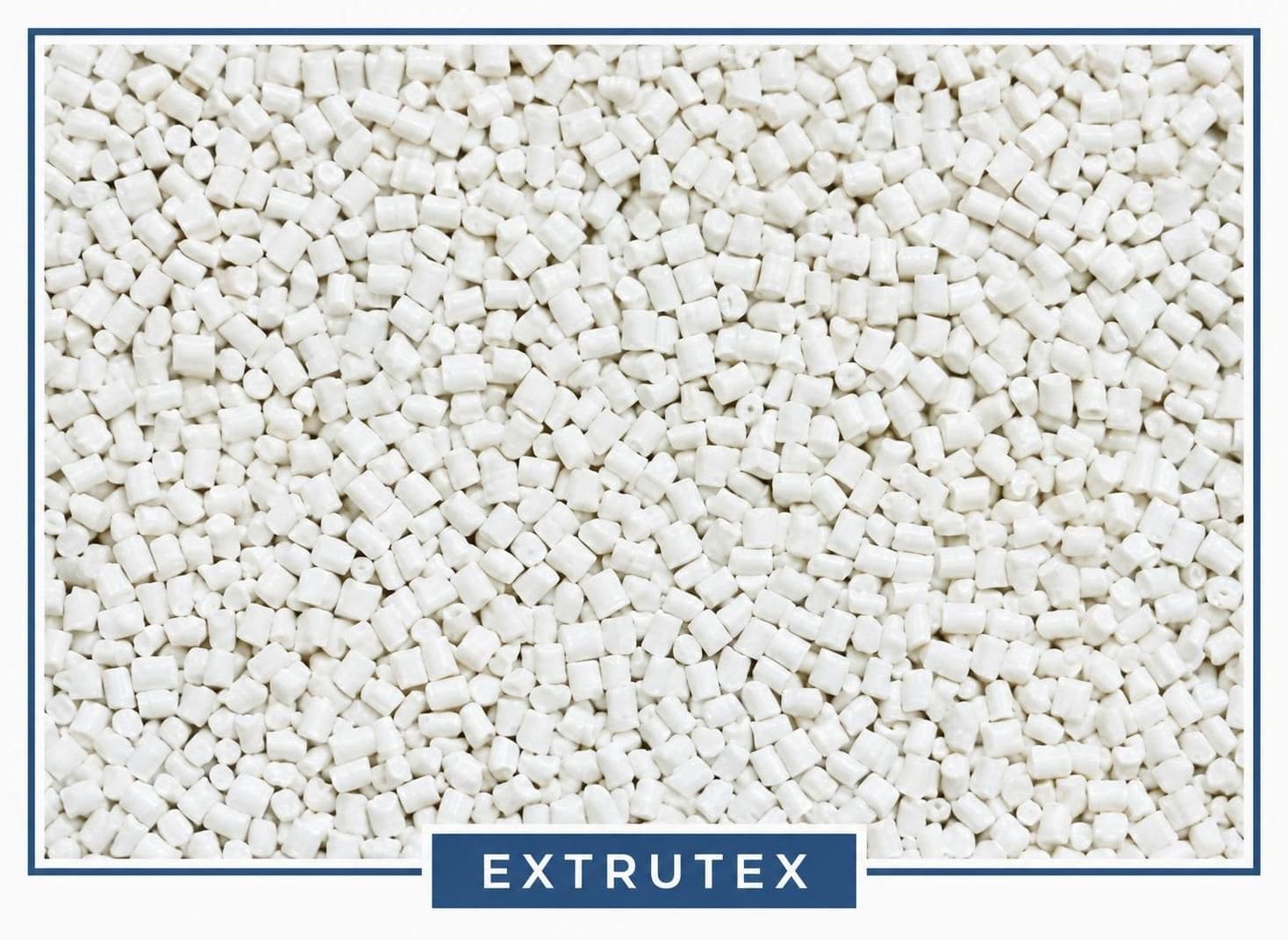
Request a Quotation Contact EXTRUTEXWhite Masterbatch is a concentrated plastic color additive containing white pigment, carrier resin and selected processing additives. It is supplied in pellet form and incorporated into a base polymer during plastic processing. The concentrate disperses throughout the molten polymer, giving the finished product its required white color and optical characteristics.
Titanium dioxide (TiO₂) is the principal white pigment commonly used in white masterbatch because of its strong light-scattering ability, high refractive index and effectiveness in providing opacity. The pigment grade, particle characteristics, surface treatment and dispersion quality influence the performance of the final concentrate.
White masterbatch formulations can also contain carrier polymers and processing aids selected to support pigment distribution, compatibility and production stability. The appropriate formulation depends on the base resin, processing technology and intended application.
In industrial production, a well-selected white masterbatch helps processors achieve a repeatable appearance while controlling pigment consumption and maintaining acceptable production efficiency. It can be used in both virgin and suitable recycled polymer systems, subject to compatibility and final product requirements.
Poor-quality white concentrate can cause uneven coloration, visible streaks, pigment agglomeration, surface defects and inconsistent opacity. These issues can lead to production interruptions, rejected products and additional material consumption.
For this reason, manufacturers should evaluate white masterbatch according to pigment concentration, dispersion, compatibility, thermal stability and the actual processing conditions of their production lines.
EXTRUTEX focuses on matching color concentrate solutions with the practical requirements of plastic manufacturers. The objective is to help customers select a suitable material for their production process rather than recommending one universal formulation for every application.
Suitable formulations help achieve the required white appearance and visual consistency in finished plastic products.
Titanium dioxide-based concentrates provide light-scattering properties that help reduce transparency and improve coverage.
Appropriate dispersion is important for reducing visible pigment agglomerates, white streaks and uneven color distribution.
Grade selection considers the base polymer and processing method to support consistent incorporation into the production material.
Selecting an appropriate concentrate and dosage can help balance color performance, material consumption and manufacturing efficiency.
EXTRUTEX supports customers with application discussions, grade selection and sample evaluation based on their manufacturing requirements.
White masterbatch is used throughout the plastics industry in products where brightness, opacity, appearance and color uniformity are important. The correct grade depends on the polymer, processing technology, product thickness and final performance requirements.
White masterbatch is widely incorporated into polyethylene blown films for packaging, agricultural applications, industrial liners and protective films. It provides white coloration and opacity while helping manufacturers achieve the desired visual appearance.
Film applications require attention to pigment dispersion, film thickness, extrusion stability and surface quality. The concentrate must be compatible with the selected LDPE, LLDPE or HDPE formulation.
White masterbatch is suitable for manufacturing white plastic bags, carrier bags, garbage bags, industrial sacks and other polyethylene packaging. It helps provide a consistent background color and opacity.
Bag manufacturers should consider film thickness, opacity requirements, sealing performance and the mechanical properties of the finished film when choosing a concentrate.
White color concentrates can be used in suitable extrusion coating and lamination applications where a white layer or opaque plastic surface is required.
Processing temperature, substrate compatibility, coating thickness and surface requirements should be considered during grade selection.
White masterbatch can be used in suitable thermoplastic sheets for producing trays, containers, packaging inserts and formed plastic articles.
The selected formulation should maintain acceptable color appearance during sheet extrusion and subsequent heating and forming.
White masterbatch is used in injection-molded household products, containers, lids, caps, closures, storage products and various technical plastic components.
Good pigment distribution is particularly important for molded parts with visible surfaces, complex geometries and consistent color requirements across production batches.
Suitable white concentrates can be incorporated into selected pipe, conduit, tubing and profile formulations to provide a white appearance.
The carrier system and formulation should be compatible with the relevant polymer and extrusion temperature. PVC processing requires a formulation specifically designed for PVC rather than assuming that a PE or PP carrier is suitable.
White masterbatch is used in polypropylene raffia yarn, woven sacks, woven fabrics, packaging straps and other oriented PP products.
These applications require careful consideration of drawability, filament strength, pigment dispersion and processing consistency.
White masterbatch can be used in polypropylene spunbond and meltblown nonwoven materials, depending on the grade and intended production process.
Fiber applications require suitable dispersion, filtration behavior and process compatibility. Specialized grades should be evaluated for high-speed fiber production.
White concentrates are used in suitable thermoplastic sheets for packaging, stationery, display products, protective panels and fabricated plastic components.
The desired opacity and surface appearance should be balanced with the mechanical and forming requirements of the sheet.
White masterbatch is also used in various injection-molded and extruded consumer and industrial products, including storage containers, accessories, components and general-purpose plastic articles.
Carrier resin compatibility is one of the most important considerations when selecting white masterbatch. A concentrate formulated for one polymer family should not automatically be assumed suitable for every other thermoplastic.
| Base Polymer | Common Processing Methods | Typical Applications | Selection Considerations |
|---|---|---|---|
| LDPE | Blown film, extrusion coating | Packaging film, bags, liners | Film dispersion, opacity and sealing |
| LLDPE | Blown film, cast film | Stretch film, bags, packaging | Film properties and carrier compatibility |
| HDPE | Blown film, extrusion, molding | Shopping bags, liners, containers | Processing temperature and opacity |
| PP Homopolymer | Injection molding, raffia, extrusion | Woven bags, molded products, yarn | Dispersion and drawability where relevant |
| PP Copolymer | Injection molding, extrusion | Household products, packaging | Compatibility and appearance |
| PP Nonwoven Grades | Spunbond, meltblown | Nonwoven fabrics | Fiber processing and filtration behavior |
| ABS | Injection molding, extrusion | Appliance parts, housings | Thermal stability and polymer compatibility |
| PS / HIPS | Injection molding, sheet extrusion | Packaging, trays, molded products | Carrier selection and surface quality |
| PET | Fiber, sheet and specialized extrusion | Fibers, sheets and packaging | Moisture control and thermal compatibility |
| PVC | Pipe, profile, sheet and calendering | Pipes, profiles, sheets | PVC-specific formulation and heat stability |
Titanium dioxide is the most widely used white pigment in plastic white masterbatch. Its optical performance makes it suitable for applications that require high whiteness and opacity. The pigment grade and its dispersion within the polymer concentrate are major factors affecting finished product appearance.
Titanium dioxide scatters visible light effectively, helping plastic products become less transparent. This property is particularly important in films, packaging, sheets and molded articles where coverage is required.
The visual appearance of white plastic depends on pigment quality, formulation, processing conditions, product thickness and the optical properties of the base polymer. The correct grade should be selected according to the required color standard.
Uniform distribution of titanium dioxide is essential for reducing visible spots, streaks and localized color variation. Dispersion performance depends on the pigment characteristics, compounding process, carrier resin and processing conditions.
Titanium dioxide pigments are available with different surface treatments and grades intended for different polymer and application requirements. The appropriate pigment should be selected according to the polymer, processing temperature and required optical performance.
Rutile titanium dioxide is commonly used in plastic applications because of its optical properties and suitability for many industrial formulations. The actual pigment grade and concentration should be confirmed from the product technical datasheet.
The required dosage of white masterbatch depends on the titanium dioxide concentration, desired opacity, base resin, product thickness, processing technology and customer quality requirements.
A higher addition rate does not always produce a proportionally better result. Once the required optical performance is achieved, additional pigment may increase material cost without providing a meaningful improvement in the finished product.
Manufacturers should begin with the recommended dosage supplied for the selected grade and then conduct controlled production trials. Different addition rates should be evaluated under consistent processing conditions.
The evaluation should include whiteness, opacity, surface appearance, processing stability and the mechanical properties of the finished product. Once the target is reached, the dosage can be optimized for production economics.
Correct handling and processing help maintain the performance of white masterbatch. Although most thermoplastic white masterbatch products are supplied as ready-to-use pellets, manufacturers should follow the recommended storage and processing conditions for the selected grade.
Store masterbatch in its original packaging in a clean, dry environment. Protect the material from moisture, dust, contamination and excessive heat.
Use a suitable dosing system to maintain consistent addition rates. Accurate feeding helps reduce color fluctuations and material waste during production.
Ensure uniform mixing between the masterbatch and base resin. Suitable mixing and feeding arrangements help maintain stable pigment distribution.
Use processing temperatures appropriate for the base polymer and masterbatch grade. Excessive heat or unsuitable residence time can affect color and product quality.
Clean feeding systems, hoppers, screws and processing equipment when changing colors or materials to minimize contamination.
Monitor color consistency, surface appearance, melt behavior and product dimensions throughout production. Retain samples for comparison between batches.
White masterbatch should be evaluated using a combination of material tests, optical measurements and application-based production trials. Laboratory measurements are useful, but actual processing performance is equally important.
| Evaluation Parameter | Purpose | Importance to Manufacturers |
|---|---|---|
| Titanium Dioxide Content | Determines white pigment concentration | Helps calculate dosage and opacity potential |
| Whiteness / Color Measurement | Evaluates the visual color characteristics | Supports color consistency between batches |
| Opacity | Measures light-blocking performance | Important for films, packaging and sheets |
| Dispersion | Evaluates pigment distribution | Helps prevent spots, streaks and agglomerates |
| Melt Flow Properties | Assesses flow behavior under specified test conditions | Relevant to processing compatibility |
| Thermal Stability | Evaluates behavior under processing heat | Helps maintain stable appearance during production |
| Moisture and Volatiles | Checks material condition | Helps reduce processing defects |
| Application Testing | Evaluates performance in the actual production process | Confirms suitability for the customer's product |
Test methods, measurement conditions and acceptance criteria should be agreed between the supplier and customer. Results from different instruments or testing methods may not be directly comparable.
White masterbatch purchasing decisions should consider the cost of the finished product rather than only the price per kilogram of concentrate. A lower-priced material may require a higher addition rate or produce inconsistent results, while a more suitable grade may achieve the target appearance with better overall material efficiency.
A practical comparison should consider the masterbatch addition percentage, pigment concentration, base resin consumption, production waste and the required appearance of the finished article.
Manufacturers can compare different grades by producing trial batches under controlled conditions and measuring the results against the same quality standard.
Consistent material feeding and suitable dispersion can help reduce color-related defects and unnecessary production adjustments. Maintaining a stable formulation also makes it easier to reproduce previously approved product colors.
The most economical option is the grade that reliably achieves the customer's technical and visual requirements at an acceptable total production cost. EXTRUTEX can assist with application discussions to identify the appropriate product specification.
Every plastic manufacturing process has its own material and product requirements. EXTRUTEX supports customers in evaluating white masterbatch options according to their polymer type, production equipment and intended application.
To help identify a suitable grade, customers should provide the following information:
Based on these details, EXTRUTEX can discuss suitable material options, request relevant technical documentation and support sample evaluation before commercial production.
White masterbatch is used to introduce white color, opacity and brightness into plastic products. Common applications include packaging films, bags, nonwoven fabrics, injection-molded components, sheets and extrusion products.
Titanium dioxide (TiO₂) is the principal white pigment commonly used in plastic white masterbatch. Its light-scattering properties help provide whiteness and opacity.
Some formulations may be designed for use with both polyethylene and polypropylene, but this depends on the carrier resin and formulation. Always confirm compatibility with the selected product grade.
Yes. Suitable white masterbatch grades are commonly used in LDPE, LLDPE and HDPE blown film applications, including bags, liners and packaging films.
The dosage depends on TiO₂ concentration, base resin, film or product thickness, desired opacity and processing conditions. Follow the grade-specific recommendation and confirm it through production trials.
Not necessarily. Pigment quality, dispersion, carrier compatibility and formulation are also important. The correct grade should achieve the required opacity and appearance under the intended production conditions.
Suitable grades can be used with selected recycled polymer streams. However, recycled material may contain varying background colors, contaminants or polymer mixtures. Testing is recommended to establish the required dosage and final appearance.
Visible streaks can result from poor pigment dispersion, unsuitable carrier compatibility, inconsistent feeding or processing conditions. A suitable grade and correct dosing system can help reduce these problems.
Yes, specialized PP-compatible white masterbatch grades are used in nonwoven manufacturing. Fiber production requires careful evaluation of dispersion, filtration behavior and processing stability.
Not always. Different processing methods have different requirements for carrier resin, melt flow, dispersion and thermal behavior. A grade should be selected for the intended processing application.
Provide your base resin, application, processing method, desired whiteness and opacity, estimated consumption and any existing material specifications. This information helps identify a suitable product option.
Contact EXTRUTEX to discuss the availability of product samples, technical datasheets and supporting documentation for the selected white masterbatch grade.
Whether you manufacture packaging films, plastic bags, nonwoven fabrics, injection-molded products or extruded plastic components, EXTRUTEX can help you evaluate white masterbatch options according to your polymer and application requirements.
Contact our team with your resin type, processing method and target product specifications to discuss a suitable solution.
Contact EXTRUTEX Request Product InformationEXTRUTEX White Masterbatch is intended for plastic manufacturers requiring reliable white coloration, opacity and consistent product appearance. White masterbatch is commonly used in polyethylene, polypropylene and other compatible thermoplastic systems for film extrusion, packaging, injection molding, nonwoven fabrics, sheet production and general plastic manufacturing.
Titanium dioxide-based white masterbatch provides the pigment concentration needed to achieve different levels of whiteness and coverage. Selecting the correct formulation requires consideration of carrier resin compatibility, pigment dispersion, processing temperature, product thickness and final quality requirements.
EXTRUTEX supports customers in evaluating white masterbatch for LDPE, LLDPE, HDPE, PP and other suitable polymer applications. Grade selection should be based on the actual production process and verified through technical documentation and application testing.
Related keywords: EXTRUTEX White Masterbatch, White Masterbatch Supplier, Titanium Dioxide Masterbatch, TiO2 White Masterbatch, PE White Masterbatch, PP White Masterbatch, HDPE White Masterbatch, LDPE White Masterbatch, LLDPE White Masterbatch, White Color Masterbatch, High Opacity White Masterbatch, Plastic White Pigment Concentrate, White Masterbatch for Blown Film, White Masterbatch for Injection Molding, White Masterbatch for Nonwoven, White Masterbatch for PP Woven Bags, White Masterbatch for Plastic Packaging, White Masterbatch for Plastic Bags, White Masterbatch for Pipe Extrusion, White Masterbatch for Sheet Extrusion, Titanium Dioxide Plastic Additive.
There are no reviews yet.
By submitting your email, you agree to our company’s terms and conditions.
We are not looking to sell; we are here to provide you with the best support and service.
Contact available 24/7
Please do not contact us for advertising or sales inquiries
All rights of this website are reserved for EXTRUTEX Austria and its partner companies, © 2026
-
(0 customer reviews)