No products in the cart.



All rights of this website are reserved for EXTRUTEX Austria and its partner companies, © 2026

Multiple Payment Methods

Discount for advance payments over 50%

Free Shipping Coordination Services
Payment methods:

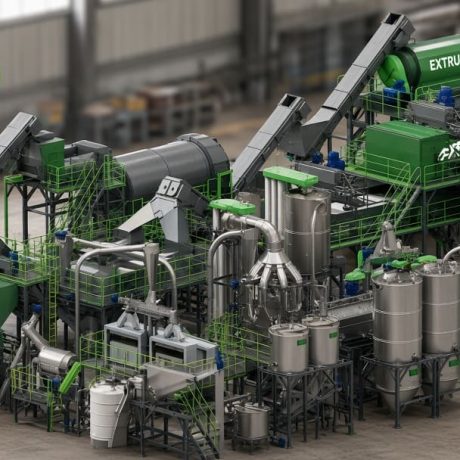
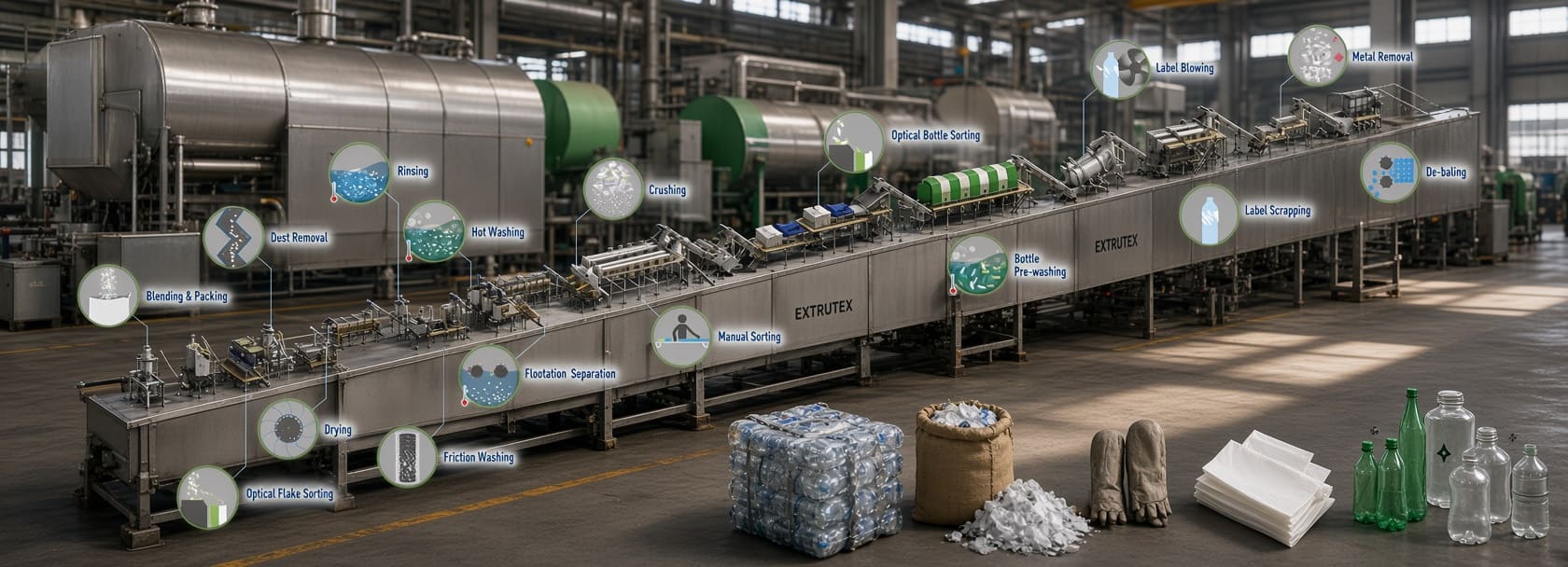
The EXTRUTEX Food Grade PET Bottle Washing Line is engineered for the advanced recycling of post-consumer PET bottles into high-quality recycled PET flakes suitable for demanding downstream applications. The system combines intensive cleaning, automated sorting, efficient water treatment, online quality inspection and intelligent process control to create a highly automated PET recycling solution.
Designed and engineered by EXTRUTEX in Austria and manufactured in Nanjing and Shanghai, China, the system is developed for PET bottle-to-bottle recycling projects where cleanliness, consistency, traceability and stable production are critical.
EXTRUTEX Austrian Design & Engineering · Manufacturing in ChinaPET is one of the most widely used polymers for beverage bottles, food packaging and other transparent packaging products. Its excellent clarity, strength, chemical resistance and relatively low weight have made PET an important packaging material worldwide. However, increasing consumption of PET bottles also creates a growing requirement for efficient collection, sorting and recycling.
Mechanical recycling provides an effective route for recovering valuable PET resources from post-consumer bottles. Instead of allowing used bottles to become waste, properly collected PET can be separated, processed, washed and transformed into high-quality rPET flakes. These flakes can subsequently be processed through extrusion, pelletizing and solid-state polycondensation processes to produce recycled PET materials for demanding applications.
For bottle-to-bottle recycling, however, conventional washing is not sufficient. The incoming material can contain labels, adhesives, caps, dirt, organic contamination, metals, PVC, polyolefins and other foreign materials. A food-grade-oriented recycling plant therefore requires significantly higher process control and cleaning performance than a standard PET washing line.
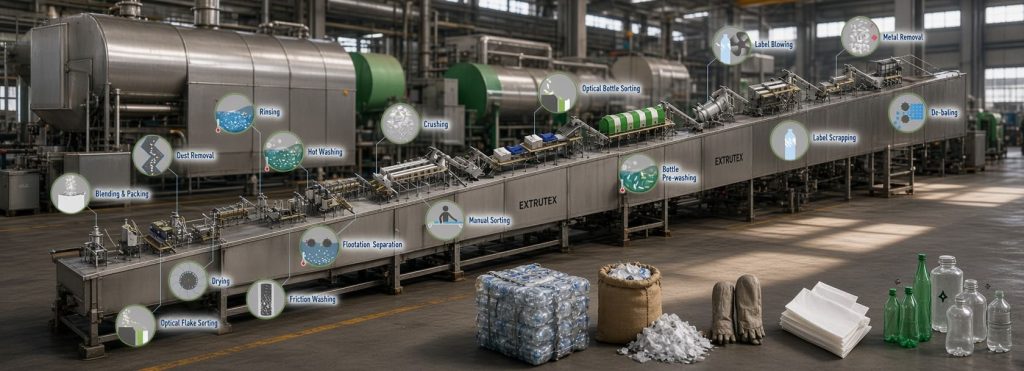
The EXTRUTEX Food Grade PET Bottle Washing Line addresses these requirements through a complete integrated process covering de-baling, metal separation, label removal, pre-washing, optical sorting, crushing, hot washing, friction washing, rinsing, drying, flake sorting, blending and online inspection.
Intensive pre-washing, hot washing, friction washing, rinsing and flushing technologies work together to remove surface contamination, adhesives, organic residues and process chemicals.
Optical bottle sorting and optical flake sorting reduce unwanted materials and improve the consistency of the recycled PET feedstock.
Integrated inspection and process monitoring help operators maintain stable production quality and identify process deviations at an early stage.
The EXTRUTEX system integrates the major stages required for advanced PET bottle recycling into a coordinated production line. The final configuration is selected according to bottle bale composition, contamination level, required flake quality, plant capacity and downstream application.
PET bottles normally arrive at the recycling plant in compressed bales. The first stage of the process is controlled bale opening and feeding. The EXTRUTEX de-baling system is designed to break high-density PET bottle bales efficiently while maintaining a stable material flow.
Controlled feeding is important because the downstream equipment requires a consistent material flow. Automated bale opening reduces manual labor and helps improve plant productivity while providing a reliable feed for the sorting and washing stages.
Metal separators are integrated into strategic points of the process to protect downstream equipment and reduce metallic contamination. Label removal technology then separates loose and attached labels from the PET bottles.
Effective label removal is particularly important for advanced PET recycling because PVC labels and other foreign polymers can negatively affect recycled PET quality. EXTRUTEX systems can be configured with high-performance label removal equipment according to the characteristics of the incoming bottle material.
Pre-washing removes loose soil, dust, beverage residues and other surface contamination before the bottles enter the crushing stage. This reduces the contamination load transferred into the subsequent washing process.
Optical bottle sorting provides another important quality-control step. Automated sorting can identify unwanted colors, materials and foreign containers, helping reduce the amount of non-PET material entering the crusher.
Cleaned PET bottles are reduced into flakes using a high-performance PET crushing system. Controlled particle size is important for effective washing, separation, drying and optical sorting.
Dust removal systems help extract lightweight particles generated during bottle processing. Removing dust early contributes to a cleaner production environment and reduces the contamination load in later washing and sorting stages.
PET flakes can be separated from selected lightweight materials through flotation. Because PET has different density characteristics from common bottle components such as PP and PE, flotation can provide an effective separation stage for caps and other polyolefin materials.
The flotation stage can therefore contribute to improving PET purity before the intensive cleaning process and final flake sorting.
Hot washing is one of the most important stages in a food-grade-oriented PET recycling process. PET bottles can contain adhesives, oils, beverage residues, organic contamination and other difficult impurities that cannot be sufficiently removed by cold-water washing alone.
The EXTRUTEX intensive hot-washing system combines controlled temperature, chemical concentration, mechanical action and residence time to provide intensive cleaning of PET flakes. Process parameters can be optimized according to feedstock quality and the required final flake specification.
Properly designed hot washing can significantly reduce contamination before the final rinsing, drying and sorting stages.
Following hot washing, friction washing provides additional mechanical cleaning. The high-speed interaction between flakes and the washing equipment helps detach residual contamination from the flake surfaces.
Multi-stage rinsing and flushing then remove residual chemicals, suspended particles and remaining contaminants. Clean rinsing water is important for producing a consistent final rPET flake material.
EXTRUTEX can integrate water filtration and process-water recycling systems to reduce water consumption and improve the sustainability of the recycling plant.
After washing, PET flakes contain residual water that must be efficiently removed before optical sorting, blending and packing. High-performance dewatering and drying equipment reduces moisture and prepares the material for the final quality-control stages.
Final dust removal provides an additional cleaning step and helps produce a cleaner, more uniform rPET flake product.
Optical flake sorting provides an additional barrier against unwanted materials. Depending on the selected configuration, the sorting system can identify and reject selected colors, polymers and other foreign flakes.
This stage is particularly valuable for high-quality rPET production because even a relatively small amount of contamination can affect downstream extrusion, pelletizing and final product performance.
After final sorting, the flakes can be blended to create a more consistent material stream. Online inspection and process monitoring help operators evaluate production conditions and identify changes in material quality.
A centralized PLC and SCADA control system can display operating parameters, equipment status, alarms and production information. This provides plant operators with a clear overview of the complete PET recycling process.
| Specification | EXTRUTEX Food Grade PET Washing Line |
|---|---|
| System Type | Food Grade / Bottle-to-Bottle PET Recycling System |
| Input Material | Post-consumer PET bottles and PET bottle bales |
| Input Capacity | 1,500–10,000 kg/h |
| De-baling | Automatic PET bottle bale opening and feeding |
| Sorting | Optical bottle sorting, manual sorting and optical flake sorting |
| Label Removal | High-performance label separation system |
| Washing | Pre-washing, hot washing, friction washing, rinsing and flushing washing |
| Separation | Metal separation and flotation separation |
| Drying | Mechanical dewatering and PET flake drying |
| Quality Control | Online inspection and process monitoring |
| Control System | PLC and SCADA-based centralized control |
| Water Management | Process-water filtration, circulation and recycling options |
| Final Product | High-quality recycled PET flakes (rPET) |
| Engineering | EXTRUTEX Austria |
| Manufacturing | Nanjing and Shanghai, China |
High-quality rPET flakes produced by an advanced PET bottle washing line can be used as an important feedstock for a wide range of downstream recycling applications. After appropriate further processing, including extrusion, melt filtration, pelletizing and, where required, SSP, recycled PET can be converted into materials for demanding packaging and fiber applications.
High-purity PET flakes can be processed into recycled PET pellets for bottle preforms and packaging applications, subject to the required decontamination and regulatory approvals.
Properly processed rPET can be used in food and beverage packaging applications when the complete recycling process and final material comply with the relevant food-contact requirements.
High-purity recycled PET can serve as a feedstock for advanced polyester filament production, including demanding micro-denier applications.
The EXTRUTEX Food Grade PET Bottle Washing Line is designed not only around product quality but also around efficient resource utilization. Water circulation and filtration can reduce the need for fresh process water, while optimized washing stages help reduce unnecessary chemical and energy consumption.
High automation also reduces dependence on manual intervention. Automated sorting, centralized control, online monitoring and optimized material handling allow operators to manage high-capacity recycling plants more efficiently.
By recovering PET bottles that would otherwise become waste and converting them into valuable secondary raw material, the system supports the principles of the circular economy and helps reduce dependence on virgin PET resin.
Modern PET recycling plants require more than individual machines. Stable production depends on coordinated control of the entire process. EXTRUTEX can integrate PLC-based control and SCADA visualization to provide centralized monitoring of the recycling line.
Operators can monitor equipment status, process parameters, alarms and production information through a centralized interface. Historical production data can also support maintenance planning, process optimization and production analysis.
Remote communication capabilities can be incorporated where required, allowing technical teams to support troubleshooting, process optimization and equipment service more efficiently.
PET bottle waste varies significantly between countries and collection systems. Bottle colors, label materials, contamination levels, moisture, bale density and the proportion of non-PET materials can all influence recycling performance.
For this reason, EXTRUTEX does not treat every PET washing plant as an identical system. The process can be engineered according to the customer's raw material analysis, required capacity and final product specification.
From compact PET recycling systems to large industrial plants with capacities up to approximately 10,000 kg/h, the equipment configuration can be developed around the actual production requirements.
EXTRUTEX combines Austrian engineering and design expertise with industrial manufacturing capabilities in China. The system concept, engineering approach, process optimization and technical development are supported by the EXTRUTEX engineering team, while manufacturing is carried out in Nanjing and Shanghai, China.
This combination allows EXTRUTEX to provide advanced PET recycling technology with competitive industrial manufacturing, while maintaining strong attention to process design, equipment integration and long-term plant reliability.
The EXTRUTEX Food Grade PET Bottle Washing Line provides a complete technology platform for converting post-consumer PET bottles into high-purity recycled PET flakes. From automatic de-baling and sorting to intensive hot washing, drying, optical flake sorting and online inspection, every major stage is designed to work as part of one integrated recycling system.
Whether you are planning a 1,500 kg/h compact recycling plant or a large-capacity PET recycling facility approaching 10,000 kg/h, EXTRUTEX can develop the process configuration around your raw material, production capacity and downstream rPET application.
Contact EXTRUTEX for PET bottle washing line engineering, process design, equipment configuration and complete recycling plant solutions.
There are no reviews yet.
By submitting your email, you agree to our company’s terms and conditions.
We are not looking to sell; we are here to provide you with the best support and service.
Contact available 24/7
Please do not contact us for advertising or sales inquiries
All rights of this website are reserved for EXTRUTEX Austria and its partner companies, © 2026
-
(0 customer reviews)