EXTRUTEX EX-45 3D Printing Filament Extrusion Line
EXTRUTEX AUSTRIA DESIGN · CHINA MANUFACTURING
EX-45 3D Printing Filament Extrusion Line
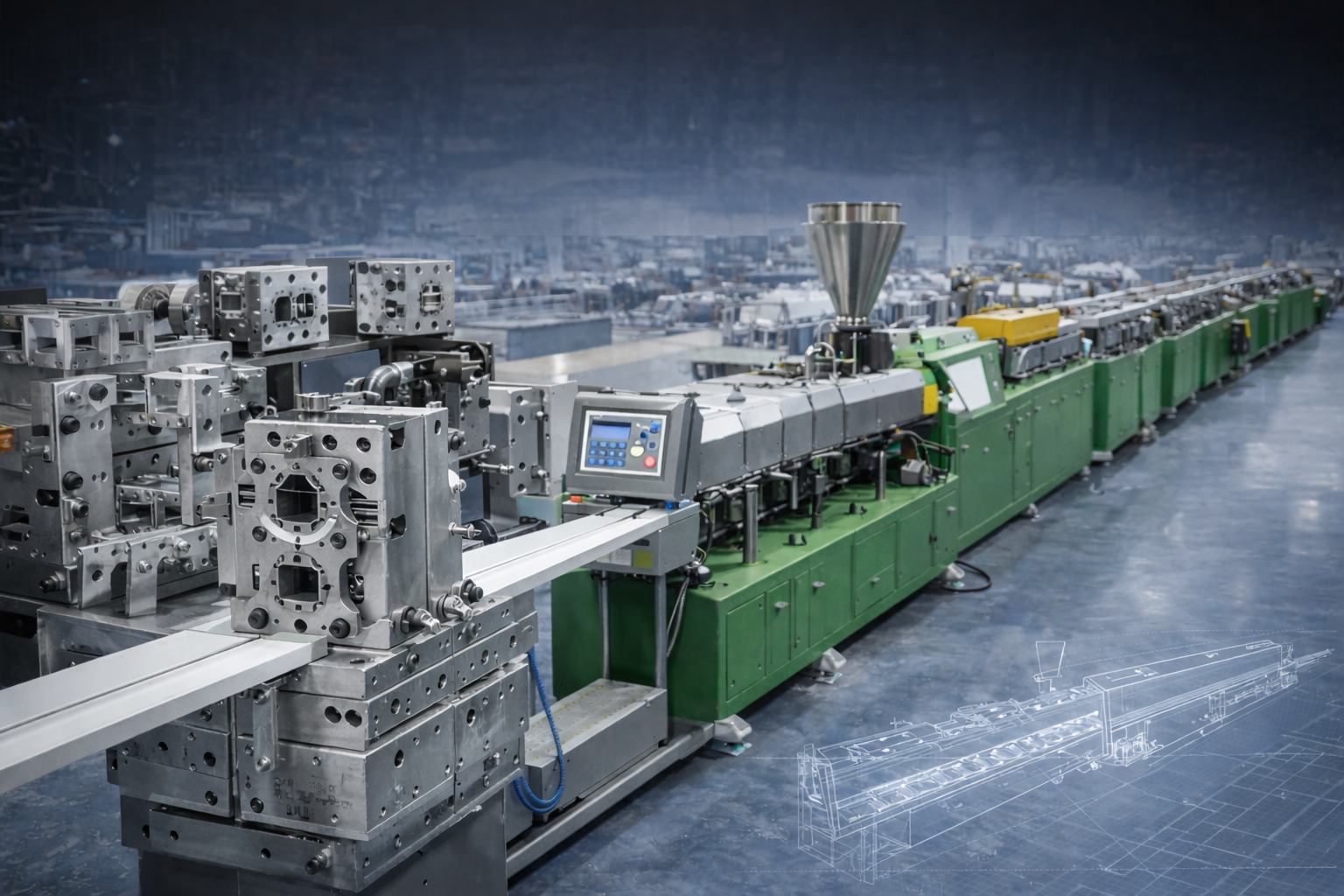
The EXTRUTEX EX-45 is a precision 3D printing filament extrusion line engineered for continuous production of high-quality thermoplastic filament. Designed around a Ø45 mm extruder with a 28:1 L/D ratio, the line is suitable for PLA, ABS, PETG, TPU and other commonly processed 3D printing materials. It produces filament in the 1.75–3.0 mm range at an extrusion output of approximately 25–30 kg/h, with controlled diameter tolerance down to ±0.03 mm.
Product Overview
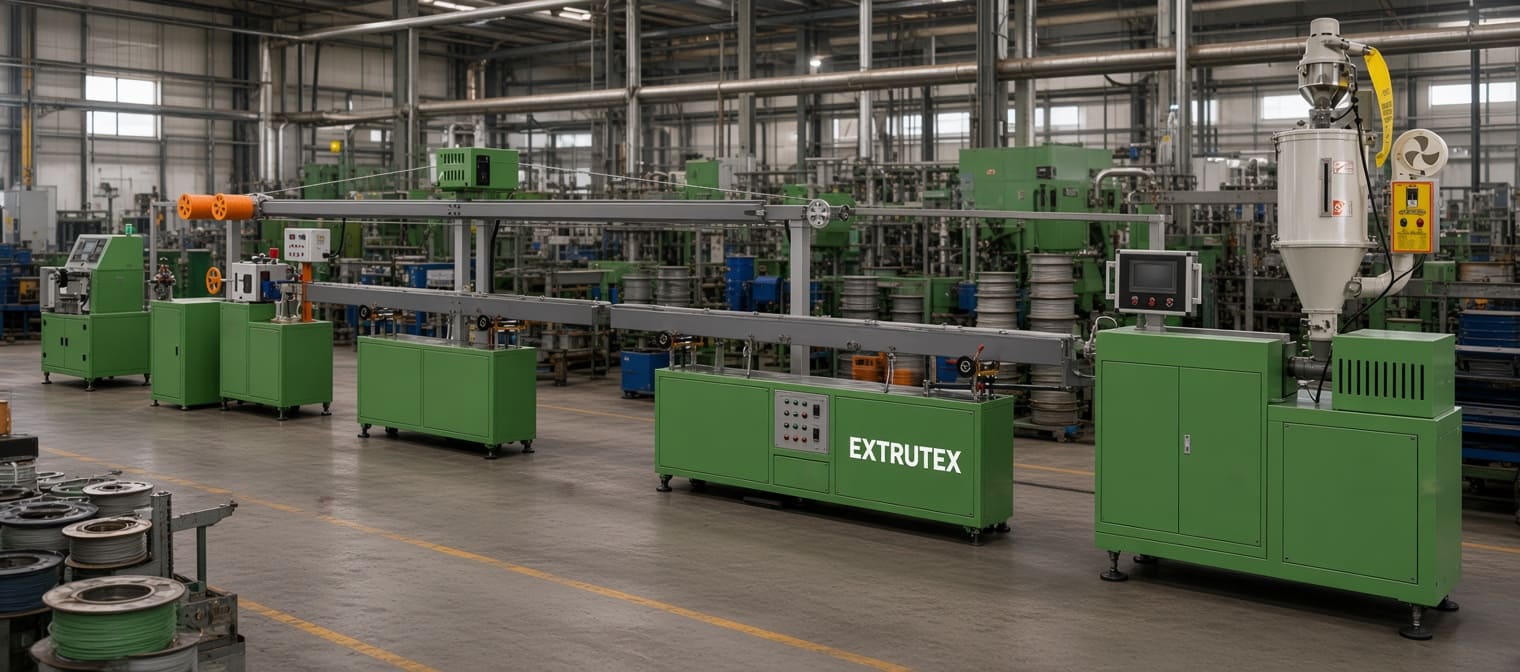
EXTRUTEX developed the EX-45 as a complete production solution rather than simply an extruder. Filament quality depends on the coordination of material preparation, melt processing, die forming, cooling, dimensional measurement, traction, accumulation and winding. The complete line therefore combines these stages into one synchronized production system. This approach gives manufacturers a practical platform for producing consistent filament for desktop, professional and industrial 3D printing applications.
The line is designed for materials with different processing characteristics. PLA requires careful moisture control and stable melt temperature, while ABS and PETG demand controlled thermal conditions to obtain reliable dimensional stability. TPU, with its flexible and elastic behavior, requires especially stable traction and winding tension. The EX-45 provides a flexible mechanical and control configuration so that production parameters can be adjusted according to the material, filament diameter and required surface quality.
A key advantage of the EX-45 is its integrated online diameter monitoring system. Filament diameter is measured continuously during production, allowing operators to monitor dimensional consistency rather than relying only on manual sampling. The supplied system can monitor diameter with a stated measurement resolution of 0.001 mm. Actual finished-product tolerance depends on resin condition, formulation, die configuration, cooling conditions, line speed and process control.
Why the EX-45 Is Designed for Filament Production
Conventional plastic extrusion is normally optimized for relatively large profiles, pipes or sheets. 3D printing filament is different: a small variation in diameter can affect feeding, melt flow and print consistency. The EX-45 therefore emphasizes stable melt pressure, controlled cooling, accurate traction and synchronized winding. The Ø45 mm screw provides sufficient processing capacity for a compact industrial filament line while maintaining a practical footprint for a dedicated production workshop.
The 28:1 screw length-to-diameter ratio provides a useful processing length for melting, homogenization and pressure development. Variable screw speed from 0 to 100 rpm allows the operator to match throughput to the selected resin and filament size. With a nominal extrusion output of 25–30 kg/h, the line can support continuous production while retaining flexibility for different operating conditions.
Multi-material processingPLA, ABS, PETG, TPU and other suitable thermoplastics can be processed with appropriate material-specific settings.
Precision diameter controlSupports 1.75–3.0 mm filament production with a specified finished-product tolerance of ±0.03 mm.
Online measurementContinuous diameter monitoring supports rapid detection of dimensional variation during production.
Servo windingSynchronized traction and winding help maintain controlled tension and orderly filament reels.
Complete Production Process
The EX-45 production line begins with properly prepared polymer material. Hygroscopic materials must be dried according to their resin supplier's recommended temperature and residence time. Moisture can cause bubbles, surface defects, diameter instability and poor mechanical performance, so drying is an important part of the complete production process. After drying, the material is fed to the extruder, where the screw conveys, melts, mixes and pressurizes the polymer.
The homogenized melt is delivered through the filament die, where the polymer is formed into a continuous strand. The newly formed filament then enters the controlled cooling section. Hot-water and cooling stages can be used to manage the transition from molten polymer to stable solid filament. Cooling must be balanced carefully: excessive thermal shock can affect surface quality and dimensional stability, while insufficient cooling can leave the filament too soft for accurate traction.
After cooling, the filament passes through the online diameter measurement system. The measured diameter provides a real-time indication of the process condition. Operators can use this information together with extrusion pressure, melt temperature, screw speed and traction speed to optimize the production process. The traction system then pulls the filament at a controlled speed. The specified line speed range is approximately 30–180 m/min, depending on product diameter, material and process settings.
Finally, the filament reaches the accumulation and winding section. Servo-controlled winding is used to maintain synchronized movement and consistent tension. Proper winding is particularly important for 3D printing filament because the finished reel should unwind smoothly without tangling, overlapping or excessive tension. The result is a continuous manufacturing process from raw polymer preparation to finished filament reel.
Application Materials
The EX-45 is intended for commonly used thermoplastics in the 3D printing industry. Material selection should always follow the processing recommendations of the resin manufacturer, because additives, pigments, fillers, drying requirements and melt-temperature windows can significantly influence the extrusion process.
PLA: widely used for general-purpose filament, prototypes, educational applications and consumer 3D printing.
ABS: suitable for applications requiring greater toughness and temperature resistance than standard PLA.
PETG: offers a useful balance of strength, chemical resistance and ease of processing for many functional-printing applications.
TPU: flexible filament requiring careful control of feeding, traction and winding tension.
Other thermoplastics: the line can be configured for additional suitable materials following an engineering review of melt temperature, viscosity, drying requirements and die design.
Precision Filament Diameter Control
Dimensional consistency is one of the most important quality parameters in filament manufacturing. The EX-45 is designed for filament diameters from 1.75 mm to 3.0 mm. A stated tolerance of ±0.03 mm provides a target for production quality, while the online measurement system provides continuous process feedback. The system is intended to help operators identify changes caused by variations in feed material, temperature, cooling, die pressure or traction.
Stable filament production requires the entire process to work as one system. Increasing screw speed without adjusting cooling or traction may increase diameter. Excessive traction can reduce diameter and create ovality or unstable winding. Material moisture can create bubbles and cause sudden dimensional changes. For this reason, the EX-45 should be operated with a controlled process recipe for each material and diameter.
Extrusion System
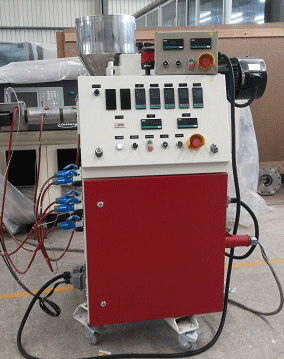
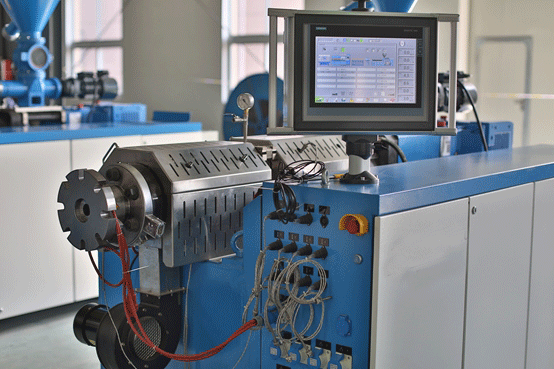
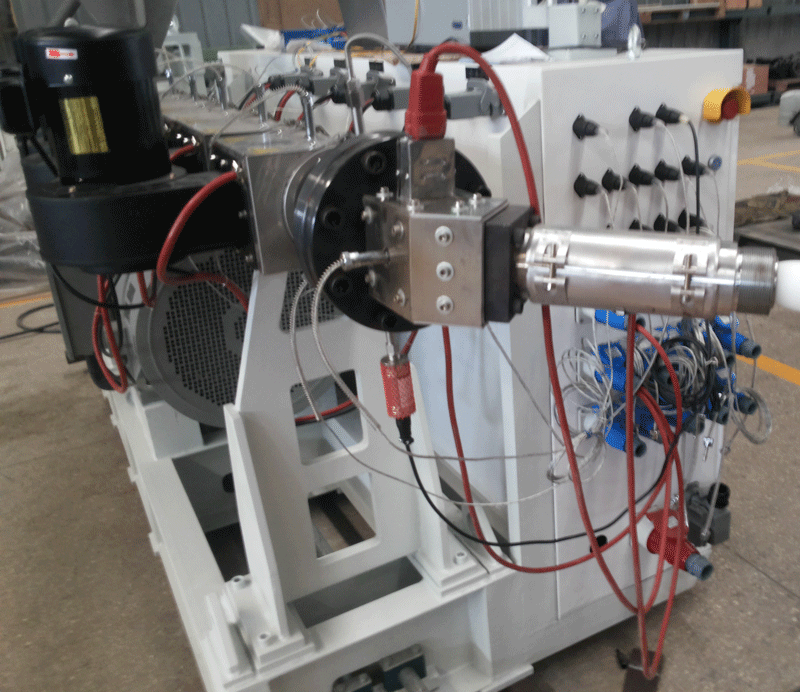
At the center of the line is the Ø45 mm single-screw extruder. The 28:1 L/D configuration gives the screw adequate working length for melting and homogenizing the polymer. Screw speed is variable from 0 to 100 rpm through automatic variable-frequency speed control. The nominal extrusion output is 25–30 kg/h.
Screw and barrel configuration can be selected according to the target materials and production requirements. For engineering plastics, filled materials or special formulations, EXTRUTEX can evaluate screw geometry, compression characteristics, feeding section and material contact surfaces as part of the line engineering process. This makes the EX-45 adaptable to different filament formulations rather than restricting the equipment to one resin family.
Cooling and Calibration
Cooling is critical because filament must leave the forming section with a stable and repeatable diameter. The EX-45 incorporates controlled water cooling stages, including hot-water and cooling tanks. The combination allows the temperature history of the filament to be managed more gradually than with uncontrolled cooling alone.
The cooling system should be supplied with clean and stable process water. Water temperature, flow, residence time and tank condition can affect the final dimensions. The workshop is specified with a supporting 2 m³ cooling-water tank. For demanding applications, additional filtration, temperature control or water circulation equipment can be evaluated according to local site conditions.
Traction, Accumulation and Winding
After dimensional measurement and cooling, the filament is transferred through the traction system. Stable traction is essential because the pulling force directly influences filament diameter. The EX-45 uses synchronized traction and servo-controlled winding to maintain a controlled production rhythm.
The accumulation section provides a buffer between continuous extrusion and winding. This helps isolate minor speed fluctuations and allows the winding system to operate smoothly. The winding unit is designed to produce neat reels suitable for packaging, storage and later use in 3D printers. Winding parameters can be adjusted according to filament material, diameter, reel dimensions and required tension.
Workshop Requirements
A suitable workshop is important for reliable operation. The recommended installation area is above 300 m², with a flat floor and sufficient access around the equipment for operation, maintenance and material handling. The stated workshop dimensions are approximately 25 m × 5 m × 3.5 m, while the main line itself is approximately 15 m × 2.5 m × 2.5 m.
Workshop dimensions: approximately 25 m × 5 m × 3.5 m; recommended floor area above 300 m².
Ambient temperature: ≤50 °C.
Relative humidity: ≤95%.
Power supply: 3-phase, 5-wire, 380 V, 50 Hz.
Supporting facilities: 2 m³ cooling-water tank, air compressor, suitable gear oil and 5-core electrical cable.
Installation note: Electrical, water, compressed-air and foundation requirements should be confirmed against the final machine configuration and the actual installation site before commissioning. Material-specific drying and processing conditions should follow the resin manufacturer's technical data.
Technical Specifications
Parameter
EX-45 Specification
Machine model
EX-45 3D Printing Filament Extrusion Line
Producer
EXTRUTEX
Engineering
Austria Design
Manufacturing
China — Nanjing and Shanghai
Application
3D printing filament extrusion
Compatible materials
PLA, ABS, PETG, TPU and other suitable thermoplastics
Screw diameter
Ø45 mm
Length / diameter ratio
28:1
Screw speed
0–100 rpm, variable-frequency automatic speed control
Extrusion output
25–30 kg/h
Filament diameter range
1.75–3.0 mm
Specified diameter tolerance
±0.03 mm
Online diameter measurement
Real-time measurement; stated accuracy/resolution 0.001 mm
Line speed
30–180 m/min, depending on product and process conditions
Cooling system
Hot-water and cooling tanks
Traction system
Synchronized traction
Winding system
Servo-controlled winding
Center height
1.1 m, adjustable vertically and horizontally
Main line dimensions
Approx. 15 m × 2.5 m × 2.5 m
Three-phase power supply
380 V, 3PH, 50 Hz
Total installed power
50 kW
Average actual power consumption
Approx. 20 kWh/h
Production Line Diagram
The following schematic uses English numbers only inside the machine diagram. The process legend identifies each numbered station.
Removes moisture from hygroscopic filament materials before extrusion.
2
EX-45 Extruder
Conveys, melts, homogenizes and pressurizes the polymer.
3
Filament Die
Forms the molten polymer into continuous filament.
4
Cooling Tanks
Controls filament temperature and stabilizes its dimensions.
5
Online Diameter Measurement
Continuously monitors filament diameter during production.
6
Traction
Maintains controlled line speed and stable filament tension.
7
Accumulation & Servo Winding
Buffers the line and winds finished filament neatly onto reels.
Quality, Operation and Maintenance
Reliable filament production depends on disciplined operation. Before starting the extruder, operators should verify that the material has been dried correctly, the cooling-water system is ready, the die is clean and the measurement and winding systems are correctly configured. Start-up should normally be performed at a controlled speed, allowing the melt temperature and pressure to stabilize before increasing production speed.
Regular maintenance should include inspection of the screw and barrel, heaters, temperature sensors, gearbox, drive system, cooling-water circuit, traction components, diameter sensor and winding mechanism. Cooling water should be maintained within the required cleanliness and temperature range. Wear components should be checked according to operating hours and material type. Filled or abrasive compounds may require more frequent inspection than standard unfilled resins.
The electrical control system should be kept clean and dry, with appropriate protection against dust and moisture. Operators should also verify emergency-stop functions and machine interlocks as part of the site's safety procedure. Actual maintenance intervals should be established from the final machine configuration and operating conditions.
EXTRUTEX Engineering and Manufacturing
EXTRUTEX supplies the EX-45 under an Austria Design engineering concept with manufacturing in China, including production capabilities in Nanjing and Shanghai. The objective is to combine European-oriented engineering and process design with a practical manufacturing platform for international customers. Machine configuration can be reviewed according to the target material, filament diameter, production capacity, automation requirements and local utilities.
From a production standpoint, the EX-45 is intended as a complete filament manufacturing platform. The line architecture allows material preparation, extrusion, cooling, measurement, traction and winding to operate as a coordinated system. This is especially valuable for manufacturers who need repeatable filament quality rather than a basic extrusion machine alone.
Typical Applications
Industrial production of 1.75 mm and 2.85–3.0 mm 3D printing filament.
PLA filament manufacturing for consumer and professional printers.
ABS filament manufacturing for engineering and functional printing.
PETG filament production for general-purpose and functional applications.
TPU flexible filament production with suitable process configuration.
Customized filament production using approved pigments, additives and compatible polymer formulations.
Private-label and contract filament manufacturing.
Conclusion
The EXTRUTEX EX-45 is a complete 3D printing filament extrusion solution focused on stable production, dimensional control and efficient continuous operation. Its Ø45 mm, 28:1 extruder, 25–30 kg/h output, 1.75–3.0 mm filament range, online diameter monitoring, controlled cooling, synchronized traction and servo winding provide the core functions required for professional filament manufacturing.
By integrating the complete process into one coordinated line, the EX-45 gives manufacturers greater control over the relationship between melt processing, cooling, diameter and winding. With appropriate material preparation and process optimization, it can serve as a flexible platform for PLA, ABS, PETG, TPU and other compatible thermoplastics. EXTRUTEX can further evaluate material-specific screw, die, cooling, measurement and winding requirements for projects requiring customized production conditions.
Key Benefits at a Glance
25–30 kg/h OutputContinuous extrusion capacity for industrial filament production.
1.75–3.0 mm FilamentFlexible production range for common 3D printing filament standards.
±0.03 mm Target ToleranceDesigned for controlled and repeatable filament dimensions.
0.001 mm Online MeasurementContinuous dimensional feedback during production.
30–180 m/min Line SpeedAdjustable operating range according to material and diameter.
Servo WindingControlled tension and neat finished reels.
Technical data may be subject to final engineering confirmation. Output, tolerance, power consumption and line speed can vary according to material formulation, moisture content, filament diameter, die configuration, cooling conditions and operating parameters.







-
(0 customer reviews)