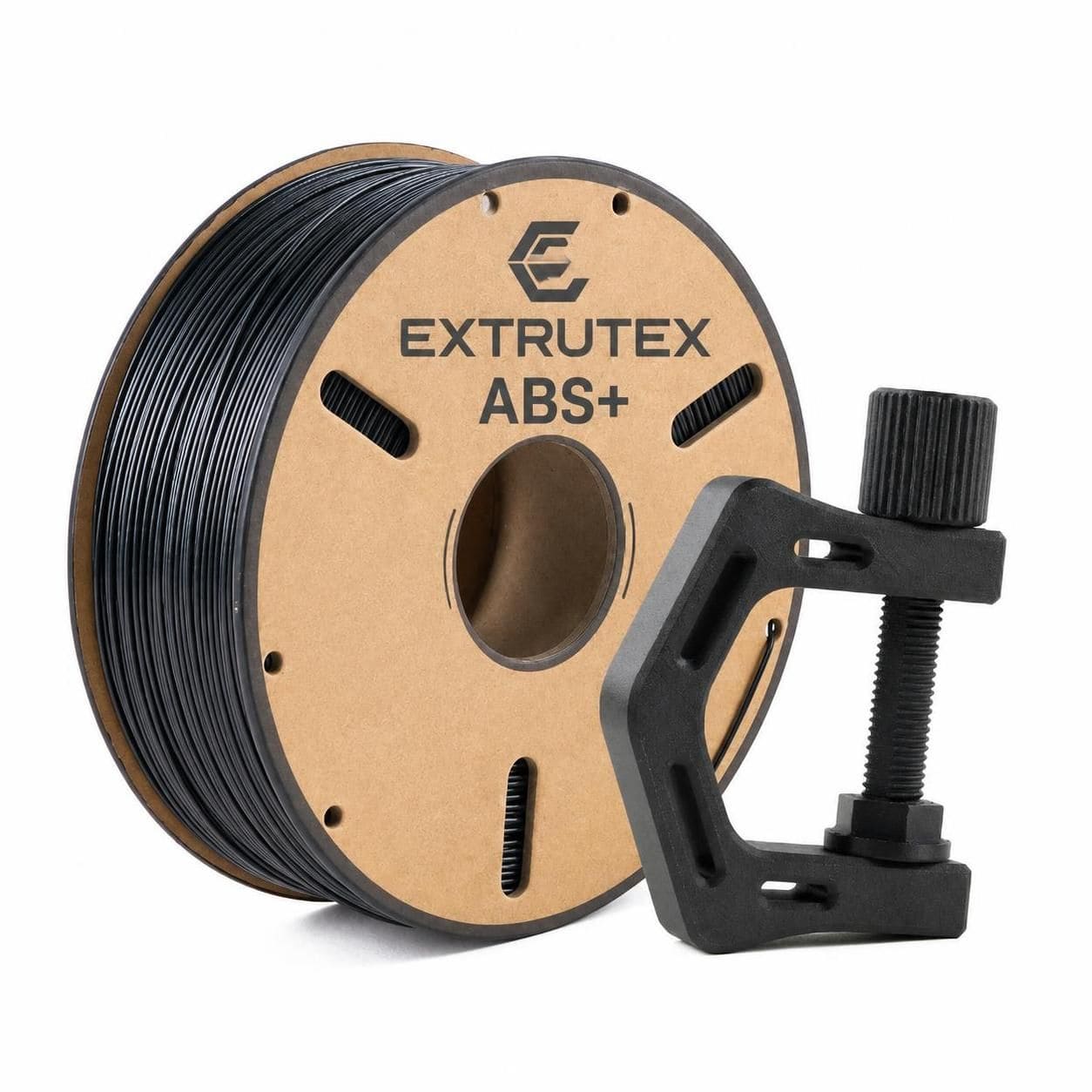
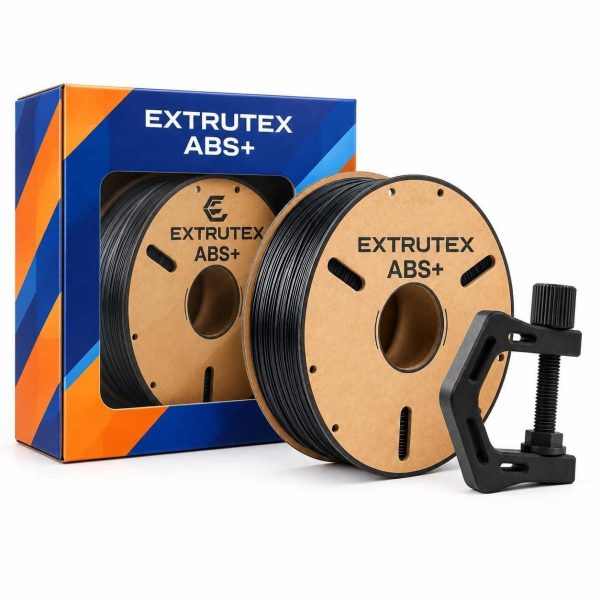
EXTRUTEX ABS-CF Core Carbon Fiber 3D Printer Filament
Industrial-strength ABS filament with 20% core-concentrated carbon fiber reinforcement.
EXTRUTEX ABS-CF Core is a high-performance engineering filament developed for demanding 3D printing applications. Combining an ABS material base with an innovative core-concentrated carbon fiber structure, it is designed to produce strong, stiff and dimensionally stable printed components.
Unlike conventional carbon fiber reinforced filaments that expose more reinforcement fibers at the filament surface, this specialized construction concentrates the carbon fiber reinforcement within the core. The design aims to maintain a smoother outer surface, support reliable material feeding and reduce abrasive contact between exposed fibers and the printer nozzle.
With its combination of mechanical performance, improved layer adhesion and thermal stability, ABS-CF Core is suitable for functional prototypes, industrial components, automotive parts and other applications where ordinary 3D printing materials may not provide sufficient performance.
Key Features of ABS-CF Core Filament
20% Carbon Fiber
Core-concentrated carbon fiber reinforcement for enhanced stiffness and mechanical strength.
Improved Z-Axis Strength
Designed to improve layer bonding and the durability of printed components.
Reduced Nozzle Wear
Minimized surface fiber exposure helps reduce abrasive contact with the nozzle.
HDT up to 90°C
Suitable for applications requiring improved resistance to heat deformation.
Dimensional Stability
Designed for accurate parts and consistent printing performance.
Industrial Applications
Suitable for functional prototypes, engineering parts and demanding printed components.
20% Core-Concentrated Carbon Fiber Technology
The defining characteristic of EXTRUTEX ABS-CF Core is its specialized filament structure. It uses 20% carbon fiber reinforcement concentrated within the filament core. This construction is designed to combine the mechanical benefits of carbon fiber with a more controlled outer filament surface.
Carbon fiber reinforcement can improve the stiffness and strength of thermoplastic materials. In conventional carbon fiber filaments, reinforcement fibers may be exposed at the surface and come into direct contact with the printer nozzle. This can contribute to abrasive wear during extended printing operations.
The core-concentrated structure is designed to reduce this surface exposure. By keeping more of the reinforcement within the filament core, the material aims to provide a smoother external surface while retaining the advantages of carbon fiber reinforcement.
Benefits of the Core-Concentrated Structure
- Reinforced mechanical performance: Carbon fiber reinforcement helps improve the stiffness and strength of printed parts.
- Reduced surface fiber exposure: The specialized structure helps limit direct contact between exposed fibers and the nozzle.
- Improved surface consistency: The outer ABS material supports a more uniform filament surface.
- Reliable material feeding: The filament structure is designed to support consistent feeding through compatible extrusion systems.
- Engineering applications: Suitable for components that require a combination of stiffness, dimensional accuracy and thermal performance.
Mechanical Performance and Layer Adhesion
For functional 3D printed components, material strength is only one part of the equation. Layer adhesion is equally important because FDM and FFF printing processes build objects by depositing material layer by layer.
Weak bonding between layers can create vulnerable areas, particularly when a component experiences mechanical loads in different directions. EXTRUTEX ABS-CF Core is engineered to provide enhanced layer adhesion and improved Z-axis strength, supporting the production of more durable printed components.
The reinforced ABS material is particularly relevant for functional prototypes, mechanical housings, brackets, fixtures, equipment covers and other parts that need to maintain their shape and structural integrity during use.
Thermal Stability and Heat Resistance
EXTRUTEX ABS-CF Core offers a heat deflection temperature of up to 90°C according to the supplied product specification. Heat deflection temperature, or HDT, indicates the temperature at which a material deforms under a specified test load and testing conditions.
This thermal performance makes the material suitable for selected applications where components may be exposed to elevated temperatures. It can be considered for industrial fixtures, automotive-related prototypes, equipment components and functional parts that require more thermal resistance than many standard-purpose filaments.
Actual performance depends on the printed part's geometry, wall thickness, infill, printing orientation, applied load and operating environment. Users should evaluate the material under their intended working conditions before using it in critical applications.
Reduced Nozzle Wear and Printing Reliability
Carbon fiber reinforced filaments can be abrasive, particularly when reinforcement fibers are exposed at the surface of the filament. Repeated contact with the nozzle during printing can contribute to wear, potentially affecting nozzle dimensions and print consistency over time.
The core-concentrated carbon fiber design of ABS-CF Core minimizes surface fiber exposure. This is intended to reduce abrasive contact and help extend nozzle service life compared with conventional carbon fiber filaments with greater surface fiber exposure.
Although the design aims to reduce nozzle wear, users should still follow the printer manufacturer's recommendations for nozzle selection. Compatibility should be confirmed before extended production, and nozzle condition should be inspected regularly.
Recommended Applications
Automotive Components and Prototypes
ABS-CF Core can be considered for automotive development work, including functional prototypes, brackets, housings, mounting components, interior development parts and selected under-the-hood prototypes where the temperature and mechanical requirements are appropriate.
Aerospace Prototyping
The combination of stiffness, dimensional stability and reinforced construction makes this material a candidate for non-flight-critical aerospace prototypes, development fixtures, tooling concepts and engineering evaluation parts. Any flight-critical or safety-critical application requires independent material qualification and validation.
Industrial Machinery Parts
Industrial manufacturers can use carbon fiber reinforced ABS for selected machine covers, equipment housings, brackets, fixtures, jigs and functional prototypes. The material can help produce customized components without requiring conventional tooling for every design iteration.
Engineering and Functional Prototypes
Product developers and engineering teams can use ABS-CF Core to evaluate component fit, stiffness, assembly compatibility and functional design before moving to more advanced manufacturing processes.
Electronic Equipment and Instrumentation
The material can be considered for selected equipment housings, instrument enclosures, mounting structures and protective components. Electrical, thermal and regulatory requirements should be evaluated for each final application.
Technical Specifications
| Product Name | EXTRUTEX ABS-CF Core |
|---|
| Material | Carbon Fiber Reinforced ABS |
|---|
| Carbon Fiber Content | 20% core-concentrated reinforcement |
|---|
| Filament Diameter | 1.75 mm |
|---|
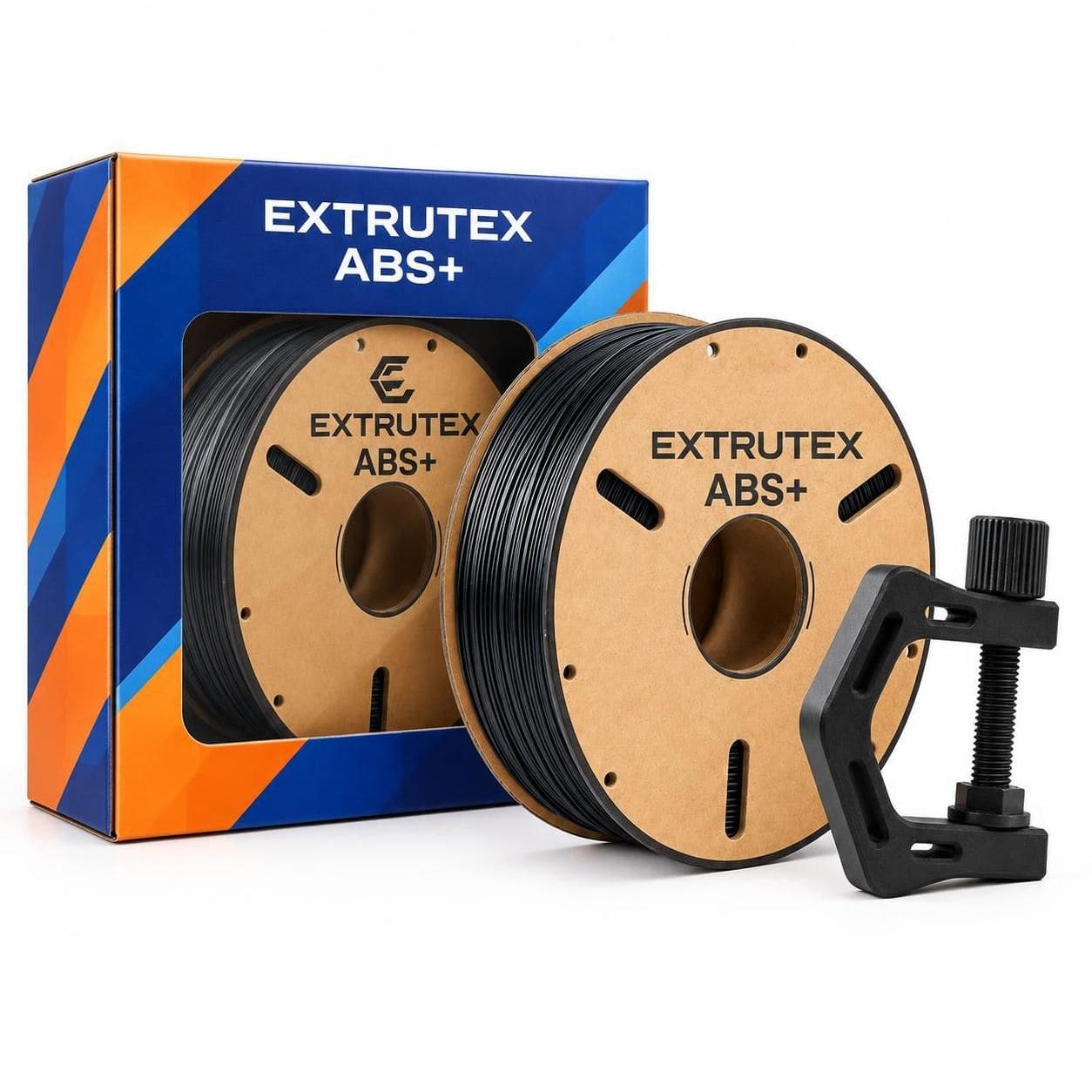
| Net Weight | 1 kg per spool |
|---|
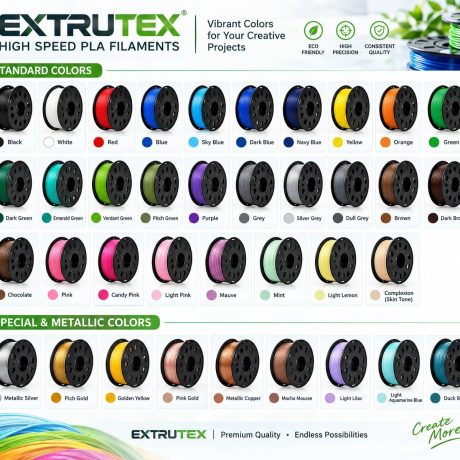
| Available Color | Black only |
|---|
| Heat Deflection Temperature | Up to 90°C |
|---|
| Layer Adhesion | Enhanced layer adhesion and Z-axis strength |
|---|
| Surface Fiber Exposure | Minimized through core-concentrated reinforcement design |
|---|
| Packaging | 1 kg filament spool |
|---|
| Material Applications | Industrial, automotive, aerospace prototyping and functional components |
|---|
Note: Printing temperature, heated bed temperature, recommended print speed, nozzle diameter, dimensional tolerance and detailed mechanical test values should be confirmed using the latest EXTRUTEX technical data sheet before production use.
Printing and Material Handling Considerations
ABS-CF Core is an engineering filament intended for users who need more than basic decorative printing. Proper printer setup, material storage and process control are important for achieving consistent results.
Printer Compatibility
Before printing, confirm that the 3D printer supports 1.75 mm ABS-based engineering filament. The hotend, extruder drive system, build surface and enclosure should be suitable for the selected ABS material and the manufacturer's recommended processing conditions.
Nozzle Selection
The core-concentrated structure is designed to reduce surface fiber exposure and associated nozzle abrasion. Nevertheless, users should check the recommended nozzle specifications and monitor nozzle condition during regular production. A suitable nozzle can help maintain consistent extrusion and dimensional accuracy.
Temperature and Process Settings
Use the recommended printing and bed temperatures supplied with the product's technical data. Avoid assuming that standard ABS settings will always produce the best results with a reinforced ABS formulation. Test prints can help establish appropriate settings for the printer, part geometry and required mechanical performance.
Moisture Management
Store the filament in a dry environment and keep it protected from unnecessary exposure to humidity. Moisture in engineering filaments can affect extrusion stability and printed surface quality. Follow the manufacturer's drying instructions if the material has absorbed moisture.
Part Orientation and Design
For components exposed to mechanical loads, consider the direction of the applied force in relation to the printed layers. Appropriate part orientation, wall thickness, infill strategy and structural design can help improve the performance of the finished component.
Why Choose EXTRUTEX ABS-CF Core?
EXTRUTEX ABS-CF Core is developed for applications where conventional ABS filament may not provide the desired combination of stiffness, strength and thermal performance. Its core-concentrated carbon fiber structure offers a different approach to reinforcement, aiming to retain the benefits of carbon fiber while reducing surface fiber exposure.
EXTRUTEX focuses on plastic processing technology, polymer materials and industrial manufacturing solutions. With design, laboratory and R&D activities in Austria and manufacturing in China, EXTRUTEX combines engineering development with industrial production capabilities.
Whether you are developing functional prototypes, manufacturing custom machine components or evaluating reinforced materials for industrial 3D printing, EXTRUTEX can help you identify a suitable filament solution for your application.
Frequently Asked Questions
1. What is ABS-CF Core filament?
ABS-CF Core is a carbon fiber reinforced ABS filament designed for engineering and industrial 3D printing. It uses a core-concentrated reinforcement structure containing 20% carbon fiber to improve the stiffness and mechanical performance of printed parts.
2. What does 20% core-concentrated carbon fiber mean?
It refers to a filament construction in which 20% carbon fiber reinforcement is concentrated within the core of the filament. The design aims to reduce fiber exposure at the outer surface while retaining the reinforcement benefits of carbon fiber.
3. How is ABS-CF Core different from ordinary ABS?
Ordinary ABS does not contain the same carbon fiber reinforcement. ABS-CF Core combines an ABS base with 20% core-concentrated carbon fiber, providing a reinforced material designed for greater stiffness and demanding functional applications.
4. Does ABS-CF Core reduce nozzle wear?
The core-concentrated construction minimizes surface fiber exposure, which is intended to reduce abrasive contact with the printer nozzle. However, it remains a carbon fiber reinforced material, so users should follow nozzle recommendations and inspect the nozzle periodically.
5. What is the heat deflection temperature?
The supplied specification lists a heat deflection temperature of up to 90°C. HDT is a laboratory measurement under defined testing conditions. It should not be interpreted as a guaranteed continuous operating temperature for every printed component.
6. What filament diameter is available?
EXTRUTEX ABS-CF Core is supplied in a 1.75 mm filament diameter. Confirm that your 3D printer and extrusion system support this filament size before ordering.
7. What spool weight is available?
The standard supplied spool contains 1 kg of filament. This format is suitable for engineering workshops, product development teams and professional 3D printing users.
8. Which colors are available?
Black is the available color for this ABS-CF Core product. Other colors should not be assumed to be available unless EXTRUTEX confirms a specific customization option.
9. Is ABS-CF Core suitable for automotive applications?
It can be considered for automotive prototypes, brackets, housings, fixtures and selected functional components. The suitability of a final part depends on its mechanical loads, temperature exposure, environmental conditions and applicable automotive requirements.
10. Is ABS-CF Core suitable for aerospace applications?
The material can be used for aerospace-related prototyping, tooling concepts and engineering evaluation parts. Safety-critical or flight-critical applications require additional qualification, testing and approval. The supplied product description alone does not establish aerospace certification.
11. Can ABS-CF Core be used for functional prototypes?
Yes. Its reinforced construction, dimensional stability and improved layer adhesion make it suitable for selected functional prototypes and engineering components where greater stiffness is desired compared with ordinary ABS.
12. What printing temperature should I use?
The recommended printing temperature should be taken from the latest EXTRUTEX technical data sheet. Do not rely on a generic ABS temperature without checking the material recommendations and your printer's capabilities.
13. Does carbon fiber reinforcement improve dimensional stability?
Carbon fiber reinforcement can help improve dimensional stability by reducing the tendency of the polymer matrix to deform during cooling. Actual results depend on the print settings, part design, orientation and environmental conditions.
14. Is ABS-CF Core suitable for industrial 3D printers?
It is intended for engineering and industrial applications, provided the printer supports 1.75 mm ABS-based reinforced filament and meets the required processing conditions. Confirm hotend, extruder and nozzle compatibility before production.
15. How should ABS-CF Core filament be stored?
Keep the filament dry and protected from humidity when not in use. Moisture can negatively affect extrusion consistency and surface quality. Follow the manufacturer's storage and drying recommendations for best results.
Contact EXTRUTEX for ABS-CF Core Filament
Looking for carbon fiber reinforced ABS filament for industrial 3D printing, functional prototypes or engineering components?
Contact EXTRUTEX to discuss ABS-CF Core availability, technical specifications, application requirements and material selection.
Visit EXTRUTEX – extruder.co





-
(0 customer reviews)