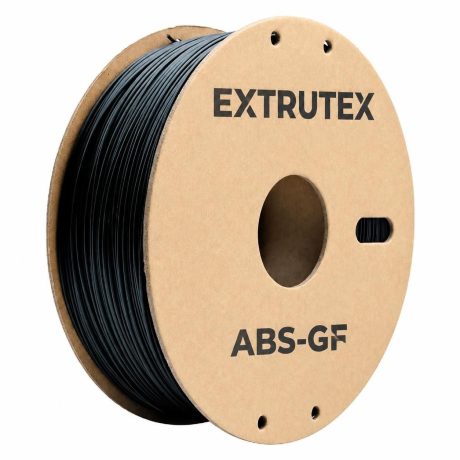
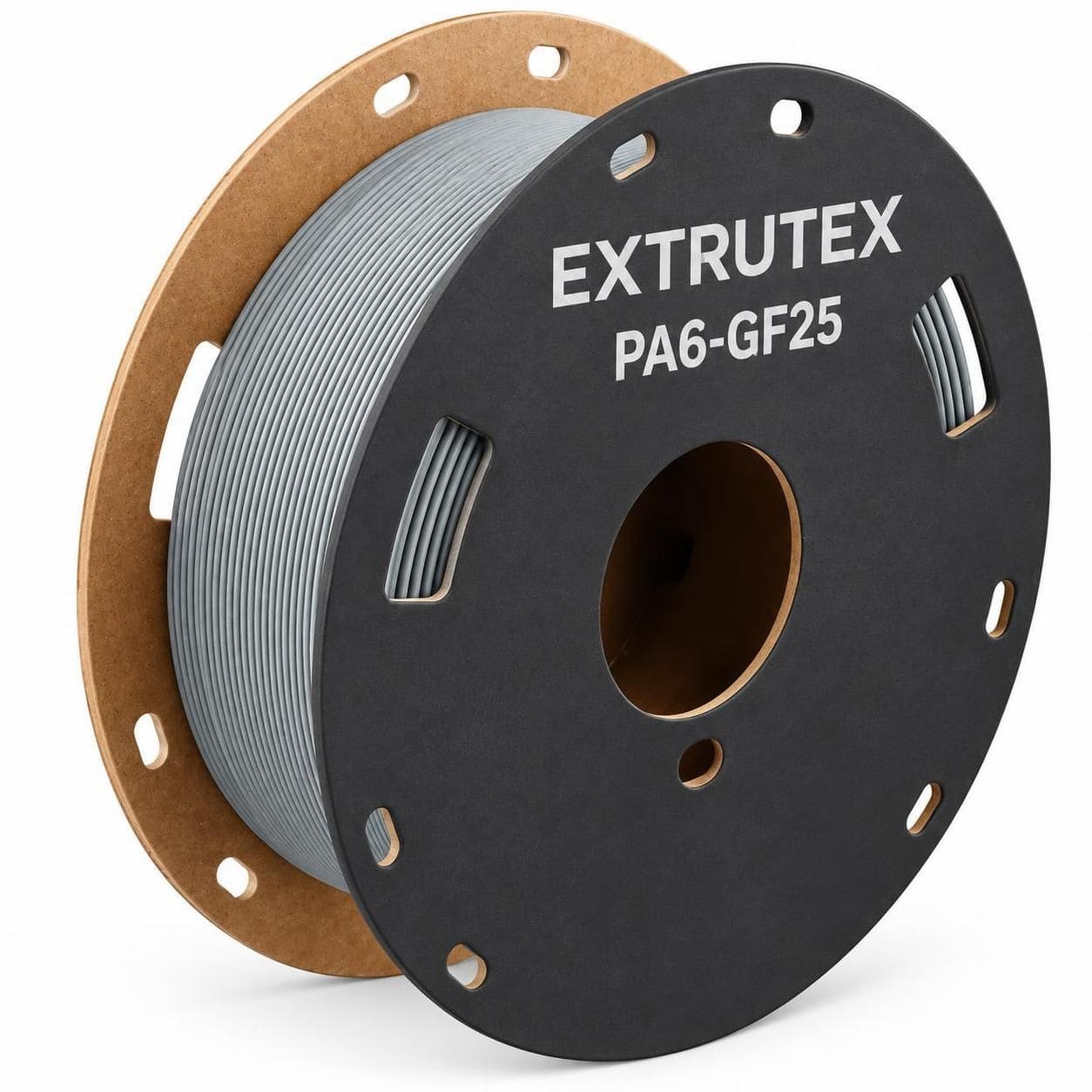
EXTRUTEX PA6-GF25 Glass Fiber Reinforced Nylon Filament
EXTRUTEX PA6-GF25 is an engineering-grade 3D printing filament made from PA6 (Nylon 6) reinforced with glass fiber. Designed for demanding functional applications, it combines the mechanical properties of nylon with the additional stiffness and dimensional stability provided by glass fiber reinforcement.
With a specified density of 1.2 g/cm³, good thermal and mechanical performance, and strong layer adhesion, PA6-GF25 is suitable for functional prototypes, mechanical components, industrial fixtures and parts that need to withstand demanding working conditions.
The filament is supplied in grey, with a 1.75 mm diameter and 500 g or 3 kg spool options.
Key Features of EXTRUTEX PA6-GF25
25% Glass Fiber ReinforcementReinforced PA6 nylon designed to provide increased stiffness and strength compared with unfilled PA6.
Good Thermal PerformanceSuitable for engineering applications where thermal performance is important.
Mechanical DurabilityDesigned for functional parts and components exposed to mechanical stress.
Strong Layer AdhesionDeveloped to maintain good interlayer bonding when printed with appropriate processing conditions.
Dimensional StabilityGlass fiber reinforcement helps improve rigidity and reduce unwanted deformation.
Engineering Material DensitySpecified density of 1.2 g/cm³ for material planning and engineering reference.
Printer CompatibilityRequires a suitable all-metal hotend capable of reaching at least 280°C.
Grey FilamentSupplied in grey, with 500 g and 3 kg spool options.
Glass Fiber Reinforced PA6 Nylon
PA6, also known as Nylon 6, is an engineering thermoplastic valued for its mechanical properties, toughness and versatility. It is widely used in industrial components and functional applications where ordinary-purpose plastics may not provide sufficient performance.
EXTRUTEX PA6-GF25 adds glass fiber reinforcement to the PA6 polymer matrix. The reinforcement increases the rigidity of the material and helps it maintain its shape under mechanical loading. This makes the composite suitable for applications that demand a stiffer material than conventional unfilled nylon.
Glass fiber reinforced nylon is particularly useful in 3D printing when engineers need to produce functional components with more demanding mechanical requirements. The material can be considered for brackets, fixtures, housings, supports, mechanical parts and industrial prototypes.
Performance and Durability
PA6-GF25 is designed for applications where mechanical strength, stiffness and thermal performance matter. The glass fiber reinforcement helps improve rigidity, making it useful for parts that must maintain their shape during operation.
Its PA6 base provides the underlying characteristics of nylon, while the reinforcement modifies the material's mechanical behavior. The resulting composite is intended for practical engineering applications rather than purely decorative printing.
Actual performance depends on the printed part's geometry, wall thickness, infill, build orientation, layer bonding and processing conditions. For components exposed to substantial or repeated loads, testing under representative operating conditions is recommended.
Strong Layer Adhesion for Functional Parts
Layer adhesion is an important consideration when producing functional components using FDM or FFF 3D printing. A printed part is built from successive layers, and the bonding between those layers influences its mechanical performance.
EXTRUTEX PA6-GF25 is described as maintaining good layer adhesion, including in applications involving mechanical stress. Correct processing conditions are essential to achieving reliable bonding between printed layers.
Printer temperature capability, filament condition, print speed, cooling, enclosure environment and part orientation can all influence the final result. For parts with demanding mechanical requirements, print-profile optimization and physical testing are recommended.
Thermal and Mechanical Properties
PA6-GF25 is intended for engineering applications that require a combination of mechanical durability and thermal performance. Glass fiber reinforcement contributes to the rigidity of the material, while the PA6 polymer provides its underlying engineering characteristics.
The supplied product information describes good thermal and mechanical properties but does not provide a specific heat deflection temperature, tensile strength, flexural strength or continuous operating temperature. These values should be obtained from the technical data sheet for the exact grade before making detailed engineering comparisons.
The recommended all-metal hotend temperature capability of 280°C or higher is a printer requirement, not a confirmed printing temperature. Actual processing settings should follow the manufacturer's validated recommendations.
Technical Specifications
| Product Name | EXTRUTEX PA6-GF25 |
|---|
| Base Material | PA6 (Nylon 6) |
|---|
| Reinforcement | Glass fiber |
|---|
| Grade Designation | GF25 |
|---|
| Glass Fiber Content | 25% indicated by grade designation; percentage basis to be confirmed |
|---|
| Filament Diameter | 1.75 mm |
|---|
| Density | 1.2 g/cm³ |
|---|
| Standard Color | Grey |
|---|
| Spool Options | 500 g and 3 kg |
|---|
| Hotend Requirement | All-metal hotend capable of at least 280°C |
|---|
| Nozzle Recommendation | Hardened or wear-resistant nozzle |
|---|
| Pre-Printing Preparation | Filament drying recommended |
|---|
| Post-Processing | Annealing and moisture conditioning recommended |
|---|
| Typical Applications | Functional parts, mechanical components, industrial fixtures and prototypes |
|---|
Specification note: GF25 is retained as the supplied grade designation. Confirm the exact glass fiber percentage basis, diameter tolerance, printing temperature, drying cycle and mechanical test values in the final technical data sheet.
Printing Recommendations
PA6-GF25 is a reinforced engineering filament and requires a printer designed for high-temperature materials. Before printing, check that the machine can maintain the required temperatures and provide a stable printing environment.
1. Use an All-Metal Hotend
An all-metal hotend capable of reaching at least 280°C is recommended. The hotend must be suitable for the processing requirements of the selected PA6-GF25 grade. The 280°C figure describes the recommended hotend capability, not a confirmed nozzle setpoint.
2. Install a Hardened Nozzle
Glass fiber is abrasive and can accelerate wear in standard brass nozzles. A hardened steel or other wear-resistant nozzle is recommended to help maintain consistent extrusion performance and nozzle dimensions over time.
3. Dry the Filament Before Printing
PA6 nylon is moisture-sensitive. Moisture in filament can negatively affect extrusion consistency and the surface quality of printed parts. Use a suitable filament dryer and follow the drying temperature and duration specified for the exact product grade.
4. Optimize the Printing Profile
Use the manufacturer's recommended nozzle temperature, build-plate temperature, print speed, cooling and enclosure settings. Avoid relying on generic PA6 profiles without testing them with the reinforced filament.
5. Consider Part Orientation
For functional parts, consider how the printed layers will be loaded during use. Orient components to support the expected direction of force and reduce unnecessary stress across layer interfaces.
Post-Printing Annealing and Moisture Conditioning
Post-print annealing and moisture conditioning are recommended for PA6-GF25. These processes can influence the final properties and dimensional behavior of nylon-based components.
Annealing
Annealing involves controlled heat treatment after printing. Depending on the material grade and procedure, it can help develop the desired material properties and improve performance in selected applications. The correct temperature, duration and cooling procedure must be determined from the product-specific instructions.
Moisture Conditioning
Moisture conditioning is a controlled process that allows nylon materials to reach a desired moisture equilibrium. It can influence the flexibility, toughness and dimensions of the finished component.
For engineering parts, dimensional measurements should be taken at the appropriate stage of conditioning. This is especially important when producing components with tight dimensional requirements.
Important: Do not apply an arbitrary annealing or moisture-conditioning cycle. Follow the validated process for the specific PA6-GF25 formulation and verify the final dimensions after post-processing.
Recommended Applications
Industrial Jigs and Fixtures
PA6-GF25 can be considered for assembly fixtures, positioning tools, inspection aids and manufacturing supports that require rigidity and dimensional stability.
Mechanical Components
Produce selected mechanical supports, brackets, connectors and functional parts where the stiffness of glass fiber reinforced nylon is beneficial.
Equipment Housings and Supports
The material can be evaluated for rigid housings, mounting components and equipment accessories designed for demanding working environments.
Automotive and Transportation Prototypes
PA6-GF25 may be suitable for selected non-safety-critical automotive prototypes, mounting brackets and functional tooling. Final suitability depends on the actual temperature, load and environmental requirements.
Industrial Tooling
Use the material for custom tools, fixtures and production aids that need a rigid engineering polymer construction.
Functional Prototypes
Engineers can use PA6-GF25 to evaluate component designs before committing to injection molding or other production methods. Its reinforced composition makes it particularly relevant for prototypes that need more than general-purpose filament performance.
PA6-GF25 Compared with Standard PA6
Standard PA6 offers useful engineering properties, but glass fiber reinforcement changes the mechanical behavior of the material. PA6-GF25 is intended for applications where additional stiffness and dimensional stability are desirable.
| Characteristic | Standard PA6 | EXTRUTEX PA6-GF25 |
|---|
| Material | Unreinforced Nylon 6 | Glass fiber reinforced Nylon 6 |
| Stiffness | Typical PA6 behavior | Increased through glass fiber reinforcement |
| Mechanical Use | General engineering components | Rigid functional components and fixtures |
| Dimensional Behavior | Depends on moisture and processing | Reinforcement helps improve dimensional stability |
| Nozzle Wear | Generally less abrasive | Requires wear-resistant nozzle consideration |
| Post-Processing | Depends on grade and application | Annealing and moisture conditioning recommended |
This is a general comparison of reinforced and unreinforced PA6. Actual performance differences should be evaluated using technical data for the specific grades.
Spool Options and Packaging
EXTRUTEX PA6-GF25 is available in two stated spool-weight options to support different printing requirements:
- 500 g spool: Suitable for testing, development, smaller projects and occasional engineering applications.
- 3 kg spool: Suitable for longer print jobs, larger components and users with higher material consumption.
Both options use the specified 1.75 mm filament diameter. Confirm spool dimensions and printer-holder compatibility before ordering.
Storage and Material Handling
PA6 is sensitive to moisture, so proper filament storage and preparation are important. Keep the filament protected from humid environments when not in use.
- Store the spool in sealed, moisture-protective packaging.
- Use a suitable dry storage container after opening.
- Dry the filament according to the grade-specific instructions before printing.
- Keep the filament away from dust, oils and other contaminants.
- Use a suitable filament dryer when required.
- Follow the recommended annealing and moisture-conditioning procedure after printing.
Why Choose EXTRUTEX PA6-GF25?
EXTRUTEX PA6-GF25 is designed for users who need a reinforced nylon filament for practical engineering applications. Its glass fiber reinforcement, specified density and high-temperature printer requirements make it a candidate for demanding functional parts.
EXTRUTEX develops and supplies engineering materials for professional 3D printing, polymer processing and industrial applications. Our product range includes reinforced polymer filaments and specialized materials for technical components, prototypes and production requirements.
EXTRUTEX combines design, laboratory and R&D capabilities in Austria with manufacturing in China. This structure supports material development, product customization and manufacturing coordination for customers in international markets.
Frequently Asked Questions
1. What is PA6-GF25 filament?
PA6-GF25 is a glass fiber reinforced Nylon 6 filament designed for engineering 3D printing. It combines a PA6 polymer base with glass fiber reinforcement to improve stiffness and support dimensional stability in functional parts.
2. What does PA6-GF25 mean?
PA6 refers to Nylon 6, while GF indicates glass fiber reinforcement. The GF25 grade designation indicates a 25-grade glass fiber formulation. The exact percentage basis should be confirmed in the technical data sheet.
3. How much glass fiber does PA6-GF25 contain?
The product grade is identified as PA6-GF25. This designation indicates a 25% glass fiber grade, but the exact percentage basis should be verified with the manufacturer before using it for detailed material calculations.
4. What is the density of EXTRUTEX PA6-GF25?
The supplied density is 1.2 g/cm³. This value can be used as a reference for material planning, although the final technical data sheet should be consulted for the applicable measurement method and tolerance.
5. What filament diameter is available?
The specified filament diameter is 1.75 mm. Diameter tolerance has not been supplied and should be confirmed for the production batch.
6. What spool sizes are available?
EXTRUTEX PA6-GF25 is specified in 500 g and 3 kg spool options. These sizes support both smaller development projects and longer engineering print jobs.
7. What color is available?
The supplied standard color is grey. Contact EXTRUTEX if you require a different color or a customized material specification.
8. Does PA6-GF25 require a high-temperature printer?
Yes. The recommended printer configuration includes an all-metal hotend capable of reaching at least 280°C. The printer must also support the validated processing conditions for the filament.
9. Is a hardened nozzle necessary?
A hardened or wear-resistant nozzle is strongly recommended. Glass fiber reinforcement is abrasive and can wear standard brass nozzles during extended printing.
10. Does PA6-GF25 need to be dried?
Yes, drying is recommended before printing. PA6 is moisture-sensitive, and moisture can affect extrusion consistency and printed surface quality. Use the drying conditions supplied for the specific grade.
11. Is PA6-GF25 suitable for mechanical components?
Yes. It is designed for functional engineering applications and can be evaluated for selected mechanical components, brackets, supports and fixtures. Final suitability depends on the mechanical requirements and print quality.
12. Does glass fiber improve stiffness?
Yes. Glass fiber reinforcement generally increases the stiffness of a polymer composite compared with its unreinforced base material. The actual improvement depends on the formulation, fiber characteristics and printing conditions.
13. Does PA6-GF25 have good layer adhesion?
The supplied product information describes good layer adhesion, including under mechanical stress. Achieving reliable interlayer bonding still depends on correct temperature settings, filament preparation, print speed and printer configuration.
14. Is PA6-GF25 suitable for industrial jigs and fixtures?
It can be considered for manufacturing fixtures, positioning tools, assembly aids and inspection supports. Its reinforced structure is useful when greater stiffness is required than general-purpose materials can provide.
15. Can PA6-GF25 be used for automotive parts?
It may be suitable for selected non-safety-critical automotive prototypes and functional components. Parts exposed to high loads, elevated temperatures or regulated operating conditions require application-specific validation.
16. What is annealing?
Annealing is a controlled heat-treatment process applied after printing. For nylon-based materials, it may be used to influence final material properties. The correct temperature and duration must be determined from the product-specific procedure.
17. Why is moisture conditioning recommended?
Moisture conditioning allows nylon components to reach a controlled moisture equilibrium. This can influence flexibility, toughness and dimensions. The process should be managed carefully when dimensional accuracy is important.
18. Is PA6-GF25 dimensionally stable?
Glass fiber reinforcement helps improve dimensional stability compared with unreinforced PA6. However, moisture, temperature, geometry and printing conditions can still influence the dimensions of the finished part.
19. Is PA6-GF25 suitable for high-temperature applications?
It is intended for engineering applications where thermal performance is important. However, no specific HDT or continuous service temperature has been provided. Consult the technical data sheet and validate the part under actual operating conditions.
20. Can PA6-GF25 replace metal parts?
Some components may be redesigned using glass fiber reinforced nylon as a lighter alternative to metal. This depends on the required strength, stiffness, temperature resistance, fatigue life and safety factors. Engineering testing is essential before replacing a metal component.
21. Is PA6-GF25 suitable for functional prototypes?
Yes. It is suitable for evaluating designs that require a reinforced engineering polymer. It can be used to produce functional prototypes, tooling concepts, mechanical supports and selected production aids.
22. Can standard brass nozzles be used?
Standard brass nozzles are not recommended for extended use with abrasive glass fiber reinforced filament. A hardened or wear-resistant nozzle is a better choice for maintaining consistent nozzle performance.
23. What printing temperature should I use?
The supplied information specifies an all-metal hotend capable of at least 280°C, but does not provide a confirmed nozzle setpoint. Use the validated printing profile for the exact EXTRUTEX PA6-GF25 grade.
24. How should PA6-GF25 be stored?
Store the filament in sealed moisture-protective packaging or a suitable dry storage container. Avoid prolonged exposure to humid environments and follow the recommended drying instructions before printing.
25. Can EXTRUTEX supply PA6-GF25 in customized specifications?
EXTRUTEX can discuss material and product requirements for different applications. Availability depends on the requested formulation, color, spool configuration and production feasibility. Contact our team with your technical requirements for evaluation.
Looking for Reinforced PA6-GF25 Filament?
Contact EXTRUTEX for PA6-GF25 glass fiber reinforced nylon filament, technical information and engineering material solutions for professional 3D printing.
Contact EXTRUTEX or visit extruder.co to explore our engineering materials.




-
(0 customer reviews)