No products in the cart.



All rights of this website are reserved for EXTRUTEX Austria and its partner companies, © 2026




Multiple Payment Methods

Discount for advance payments over 50%

Free Shipping Coordination Services
Payment methods:


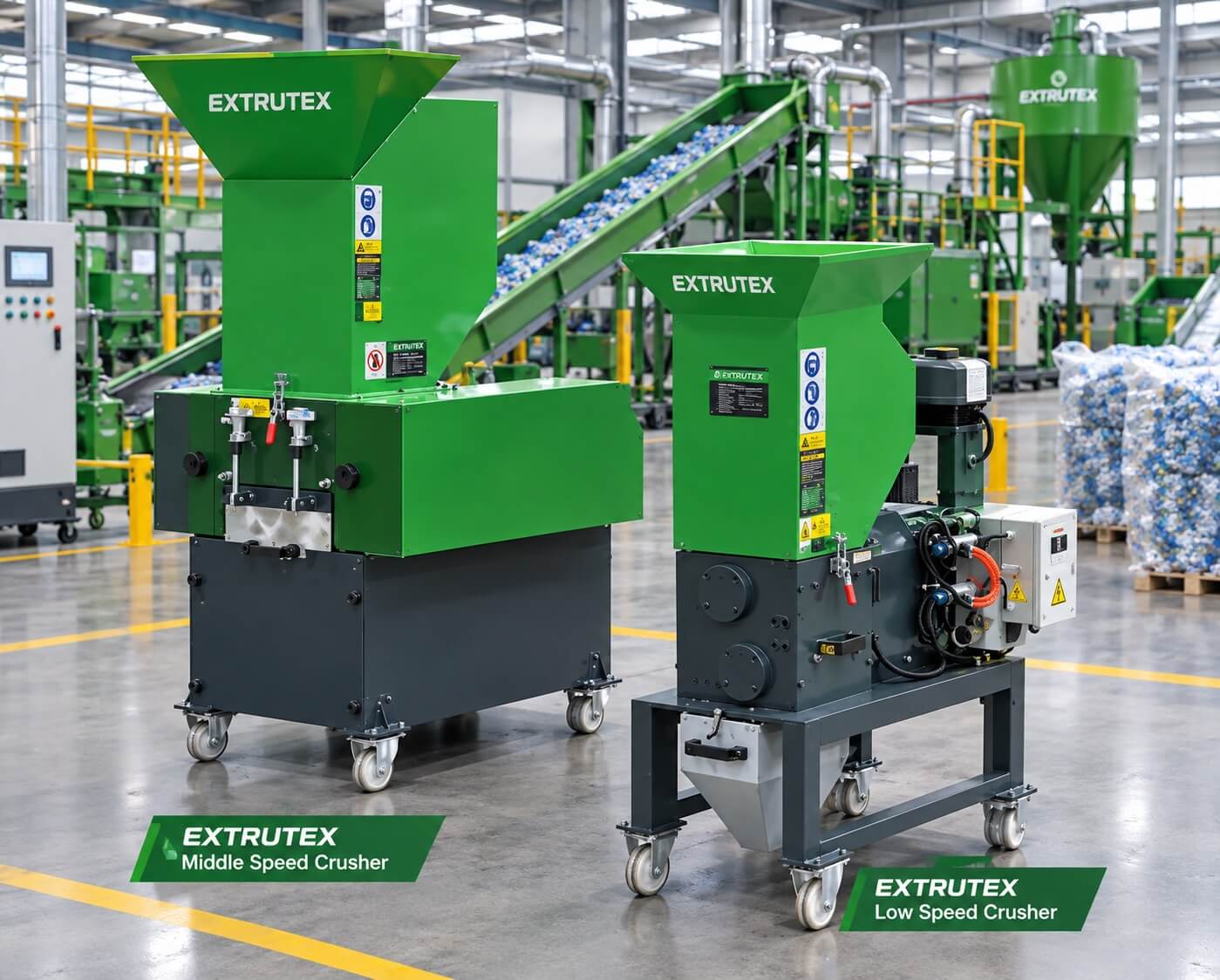
The EX Series Plastic Crushers are designed for efficient size reduction of plastic materials generated during extrusion, injection molding, blow molding and other polymer processing operations. The series provides several chamber sizes, motor power options and processing capacities to accommodate different production requirements.
Available models include the EX-100F-2B, EX-100F-2C, EX-200F-2B, EX-200F-2C, EX-180FE-2B, EX-180FE-2C, EX-240FE-2B and EX-240FE-2C. Depending on the selected model, the listed crushing capacity ranges from 15 kg/h to 80 kg/h, with motor power from 0.75 kW to 1.5 kW.
| Model | Chamber Calibre (mm) |
Crush Capacity (kg/h) |
Speed (r/min) |
Motor Power (kW) |
External Dimensions (mm) |
Weight (kg) |
|---|---|---|---|---|---|---|
| EX-100F-2B | 210 × 200 | 15 | 28–36 | 0.75 | 800 × 320 × 950 | 120 |
| EX-100F-2C | 210 × 200 | 15 | 28–36 | 0.75 | 800 × 320 × 950 | 120 |
| EX-200F-2B | 290 × 270 | 30 | 28–36 | 1.5 | 980 × 350 × 1220 | 250 |
| EX-200F-2C | 290 × 270 | 30 | 28–36 | 1.5 | 980 × 350 × 1220 | 250 |
| EX-180FE-2B | 200 × 180 | 50 | 280 | 1.1 | 880 × 590 × 1750 | 120 |
| EX-180FE-2C | 200 × 180 | 50 | 280 | 1.1 | 880 × 590 × 1750 | 120 |
| EX-240FE-2B | 240 × 180 | 80 | 280 | 1.5 | 890 × 610 × 1750 | 160 |
| EX-240FE-2C | 240 × 180 | 80 | 280 | 1.5 | 890 × 610 × 1750 | 160 |
Plastic processing plants continuously generate scrap material during production. Edge trim, rejected parts, runners, sprues, start-up material and other production waste can occupy valuable storage space if they are not processed efficiently. A plastic crusher provides a practical way to reduce this material into smaller pieces that can be handled, transported or returned to an appropriate recycling process.
The EX Series is designed as a compact size-reduction solution for applications where controlled processing of plastic waste is required. The available models cover different chamber dimensions and processing capacities, allowing users to select equipment according to their material flow and installation requirements.
With models ranging from the compact EX-100F series through the larger EX-200F and EX-FE configurations, the product range can be integrated into different production environments. The specifications include motor power ratings from 0.75 kW to 1.5 kW and stated crushing capacities from 15 kg/h to 80 kg/h.
The primary purpose of a plastic crusher is to reduce larger plastic waste into smaller pieces. Smaller material can be easier to collect, convey, store and prepare for further processing. In recycling-oriented production systems, size reduction can also be an important stage before subsequent separation, conveying, extrusion or compounding operations.
The EX Series offers several chamber configurations to accommodate different processing requirements. The EX-100F models use a chamber calibre of 210 × 200 mm, while the EX-200F models use a larger 290 × 270 mm chamber. The EX-180FE models are specified with a 200 × 180 mm chamber, and the EX-240FE models use a 240 × 180 mm chamber.
Selecting the appropriate chamber size is an important consideration when configuring a plastic size-reduction system. The material type, dimensions of the incoming scrap, required throughput and available installation space should all be considered before selecting a model.
The EX-100F-2B and EX-100F-2C models feature a 210 × 200 mm chamber, a listed crushing capacity of 15 kg/h and a 0.75 kW motor. Their compact dimensions of 800 × 320 × 950 mm make them suitable for installations where equipment footprint is an important consideration.
The EX-200F-2B and EX-200F-2C models have a 290 × 270 mm chamber and a listed capacity of 30 kg/h. They use a 1.5 kW motor and have external dimensions of 980 × 350 × 1220 mm, providing a larger configuration than the EX-100F models.
The EX-180FE-2B and EX-180FE-2C models are specified with a 200 × 180 mm chamber and a listed crushing capacity of 50 kg/h. They use a 1.1 kW motor and have a listed speed of 280 r/min.
The EX-240FE-2B and EX-240FE-2C models provide the highest listed crushing capacity in this specification range, at 80 kg/h. They feature a 240 × 180 mm chamber, a 1.5 kW motor and a listed speed of 280 r/min.
Plastic crushers can be used in a variety of polymer processing environments. In injection molding operations, production scrap such as runners, sprues and rejected components may require size reduction before being directed toward an appropriate recycling or reprocessing operation. The same principle can be applied to suitable plastic waste generated during extrusion and other manufacturing processes.
For extrusion plants, the crusher can be considered as part of a material-handling and recycling workflow. Production waste may be collected and reduced in size before being transferred to another processing stage. Depending on the polymer, contamination level and recycling strategy, the resulting material may subsequently be processed using additional equipment.
The equipment can also be considered for general plastic scrap management. Reducing the physical size of waste can help improve storage efficiency and simplify material handling. Actual processing performance will depend on the characteristics of the material being processed, including polymer type, shape, thickness, density and feeding conditions.
Equipment footprint is an important consideration when adding a crusher to an existing production line. The EX Series includes compact configurations with listed external dimensions beginning at 800 × 320 × 950 mm for the EX-100F models.
The EX-200F models have listed dimensions of 980 × 350 × 1220 mm, while the EX-180FE and EX-240FE models are approximately 1750 mm in height according to the supplied specifications. Before installation, users should consider not only the machine dimensions but also the necessary operating, maintenance, feeding and material discharge space around the equipment.
Installation conditions should be evaluated according to the actual factory layout. Electrical requirements, material flow, operator access, ventilation, maintenance access and downstream equipment should be considered as part of the complete installation.
The EX Series specifications include motor power options of 0.75 kW, 1.1 kW and 1.5 kW. The EX-100F models are specified with a 0.75 kW motor, the EX-180FE models with a 1.1 kW motor, and the EX-200F and EX-240FE models with a 1.5 kW motor.
The listed operating speed differs between the model groups. The EX-100F and EX-200F models are specified at 28–36 r/min, while the EX-180FE and EX-240FE models are listed at 280 r/min. These values are reproduced from the supplied specification table.
Motor selection should always be considered together with the material being processed and the required production rate. Different plastic materials can have significantly different processing characteristics, and actual throughput may vary according to feed size, material form, moisture, contamination and operating conditions.
Effective scrap management is increasingly important in modern plastic manufacturing. Production waste represents both a material cost and a handling requirement. A suitable crushing system can form one part of a recycling strategy by converting larger pieces of plastic waste into a more manageable form.
Once plastic scrap has been reduced in size, it may be easier to move through a production facility or combine with other material streams. Depending on the specific recycling process, crushed material may be transferred to storage, conveyed to another machine, or prepared for further size reduction or processing.
The appropriate recycling route depends on the polymer and the quality requirements of the final product. Materials should be evaluated for contamination, mixed polymers, additives and other factors before being returned to a manufacturing process.
Selecting a plastic crusher should begin with an evaluation of the production application. The most important factors include the type of plastic, the dimensions and shape of the incoming scrap, the desired processing capacity and the available installation area.
For applications with a listed requirement around 15 kg/h, the EX-100F models provide the smallest configuration in this range. For a listed capacity of approximately 30 kg/h, the EX-200F models provide a larger chamber and 1.5 kW motor configuration.
Where a listed capacity of 50 kg/h is required, the EX-180FE models provide a 1.1 kW configuration with a 200 × 180 mm chamber. For applications requiring the highest listed capacity in this range, the EX-240FE models are specified at up to 80 kg/h with a 1.5 kW motor.
A plastic crusher can operate as an independent machine or as one component within a larger recycling and material-processing system. In a production environment, the crusher may be positioned near the source of plastic scrap to reduce unnecessary transportation of bulky waste.
In larger systems, crushed plastic can potentially be transferred to downstream equipment through appropriate conveying and material-handling equipment. The exact configuration depends on the production process, material characteristics and the desired final output.
For extrusion and compounding operations, size reduction may be integrated with other stages such as material conveying, mixing, drying, feeding and extrusion. Each stage should be selected according to the characteristics of the polymer and the intended production process.
Regular inspection and maintenance are important for maintaining consistent equipment operation. Operators should follow the manufacturer's maintenance procedures and recommendations for inspection, cleaning, lubrication and replacement of wear components.
Before carrying out maintenance or cleaning, the machine should be safely stopped and isolated from its power source according to the applicable workplace safety procedures. Operators should also use appropriate personal protective equipment and follow the safety requirements applicable to the installation.
The processing chamber, cutting components and material discharge area should be kept free from accumulated material. Any unusual noise, vibration, overheating or change in processing performance should be investigated before continued operation.
The EX Series provides eight listed model configurations. The smallest models, EX-100F-2B and EX-100F-2C, have a listed crushing capacity of 15 kg/h. The EX-200F models increase the listed capacity to 30 kg/h. The EX-180FE models are specified at 50 kg/h, while the EX-240FE models provide a listed capacity of 80 kg/h.
This range allows plastic processors to select equipment according to their material volume and available space. The specifications also provide different combinations of chamber dimensions, motor power, speed, external dimensions and machine weight.
The two suffix configurations within each model group, identified as -2B and -2C, are retained from the supplied specification. Their listed dimensional, capacity, speed, motor power and weight specifications are the same in the provided table.
The specifications presented above have been converted from the supplied Chinese/English specification table into a completely English format. Model names have been changed from the original SG prefix to the requested EX prefix. For example, SG-100F-2B is presented as EX-100F-2B, SG-200F-2B as EX-200F-2B, and SG-240FE-2C as EX-240FE-2C.
Dimensions are shown in millimetres, crushing capacity is shown in kilograms per hour, motor power is shown in kilowatts, speed is shown in revolutions per minute, and machine weight is shown in kilograms. These units have been standardized throughout the table for easier international use.
The EX Series is intended for manufacturers and processors looking for a dedicated solution for plastic size reduction. With multiple configurations covering different chamber sizes and stated capacities, the series can be evaluated for a range of plastic processing applications.
From compact 15 kg/h configurations to the listed 80 kg/h EX-240FE models, the range provides options for different production requirements. The compact machine dimensions of several models can also be useful when floor space is limited and equipment must be incorporated into an existing production area.
When selecting a crusher, users should evaluate the complete process rather than looking only at nominal capacity. Material characteristics, feeding conditions, desired particle size, operating schedule, available space and downstream recycling requirements can all influence the appropriate equipment configuration.
Contact our technical team to discuss the appropriate EX Series plastic crusher for your application. Provide information about your plastic material, approximate production waste volume, required capacity and installation conditions so that the suitable configuration can be evaluated.
EX Series Plastic Crushers — compact size reduction solutions for plastic processing and recycling applications.
There are no reviews yet.
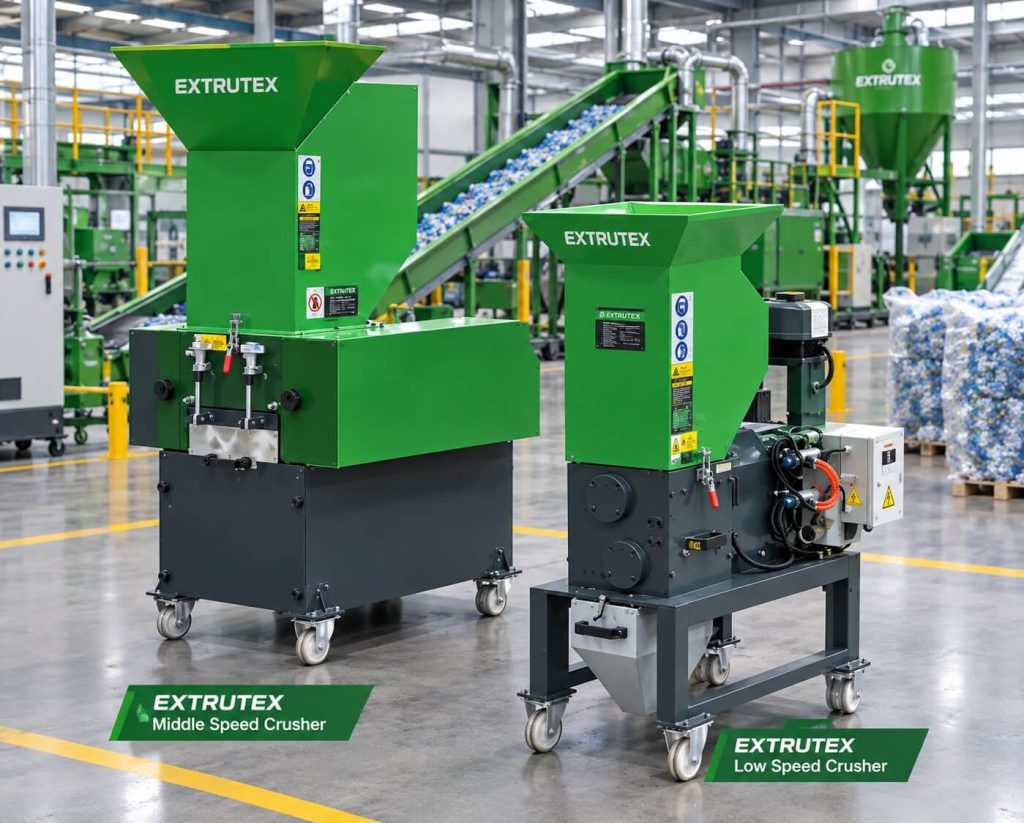
The EX Series Plastic Crushers are designed for efficient size reduction of plastic materials generated during extrusion, injection molding, blow molding and other polymer processing operations. The series provides several chamber sizes, motor power options and processing capacities to accommodate different production requirements.
Available models include the EX-100F-2B, EX-100F-2C, EX-200F-2B, EX-200F-2C, EX-180FE-2B, EX-180FE-2C, EX-240FE-2B and EX-240FE-2C. Depending on the selected model, the listed crushing capacity ranges from 15 kg/h to 80 kg/h, with motor power from 0.75 kW to 1.5 kW.
| Model | Chamber Calibre (mm) |
Crush Capacity (kg/h) |
Speed (r/min) |
Motor Power (kW) |
External Dimensions (mm) |
Weight (kg) |
|---|---|---|---|---|---|---|
| EX-100F-2B | 210 × 200 | 15 | 28–36 | 0.75 | 800 × 320 × 950 | 120 |
| EX-100F-2C | 210 × 200 | 15 | 28–36 | 0.75 | 800 × 320 × 950 | 120 |
| EX-200F-2B | 290 × 270 | 30 | 28–36 | 1.5 | 980 × 350 × 1220 | 250 |
| EX-200F-2C | 290 × 270 | 30 | 28–36 | 1.5 | 980 × 350 × 1220 | 250 |
| EX-180FE-2B | 200 × 180 | 50 | 280 | 1.1 | 880 × 590 × 1750 | 120 |
| EX-180FE-2C | 200 × 180 | 50 | 280 | 1.1 | 880 × 590 × 1750 | 120 |
| EX-240FE-2B | 240 × 180 | 80 | 280 | 1.5 | 890 × 610 × 1750 | 160 |
| EX-240FE-2C | 240 × 180 | 80 | 280 | 1.5 | 890 × 610 × 1750 | 160 |
Plastic processing plants continuously generate scrap material during production. Edge trim, rejected parts, runners, sprues, start-up material and other production waste can occupy valuable storage space if they are not processed efficiently. A plastic crusher provides a practical way to reduce this material into smaller pieces that can be handled, transported or returned to an appropriate recycling process.
The EX Series is designed as a compact size-reduction solution for applications where controlled processing of plastic waste is required. The available models cover different chamber dimensions and processing capacities, allowing users to select equipment according to their material flow and installation requirements.
With models ranging from the compact EX-100F series through the larger EX-200F and EX-FE configurations, the product range can be integrated into different production environments. The specifications include motor power ratings from 0.75 kW to 1.5 kW and stated crushing capacities from 15 kg/h to 80 kg/h.
The primary purpose of a plastic crusher is to reduce larger plastic waste into smaller pieces. Smaller material can be easier to collect, convey, store and prepare for further processing. In recycling-oriented production systems, size reduction can also be an important stage before subsequent separation, conveying, extrusion or compounding operations.
The EX Series offers several chamber configurations to accommodate different processing requirements. The EX-100F models use a chamber calibre of 210 × 200 mm, while the EX-200F models use a larger 290 × 270 mm chamber. The EX-180FE models are specified with a 200 × 180 mm chamber, and the EX-240FE models use a 240 × 180 mm chamber.
Selecting the appropriate chamber size is an important consideration when configuring a plastic size-reduction system. The material type, dimensions of the incoming scrap, required throughput and available installation space should all be considered before selecting a model.
The EX-100F-2B and EX-100F-2C models feature a 210 × 200 mm chamber, a listed crushing capacity of 15 kg/h and a 0.75 kW motor. Their compact dimensions of 800 × 320 × 950 mm make them suitable for installations where equipment footprint is an important consideration.
The EX-200F-2B and EX-200F-2C models have a 290 × 270 mm chamber and a listed capacity of 30 kg/h. They use a 1.5 kW motor and have external dimensions of 980 × 350 × 1220 mm, providing a larger configuration than the EX-100F models.
The EX-180FE-2B and EX-180FE-2C models are specified with a 200 × 180 mm chamber and a listed crushing capacity of 50 kg/h. They use a 1.1 kW motor and have a listed speed of 280 r/min.
The EX-240FE-2B and EX-240FE-2C models provide the highest listed crushing capacity in this specification range, at 80 kg/h. They feature a 240 × 180 mm chamber, a 1.5 kW motor and a listed speed of 280 r/min.
Plastic crushers can be used in a variety of polymer processing environments. In injection molding operations, production scrap such as runners, sprues and rejected components may require size reduction before being directed toward an appropriate recycling or reprocessing operation. The same principle can be applied to suitable plastic waste generated during extrusion and other manufacturing processes.
For extrusion plants, the crusher can be considered as part of a material-handling and recycling workflow. Production waste may be collected and reduced in size before being transferred to another processing stage. Depending on the polymer, contamination level and recycling strategy, the resulting material may subsequently be processed using additional equipment.
The equipment can also be considered for general plastic scrap management. Reducing the physical size of waste can help improve storage efficiency and simplify material handling. Actual processing performance will depend on the characteristics of the material being processed, including polymer type, shape, thickness, density and feeding conditions.
Equipment footprint is an important consideration when adding a crusher to an existing production line. The EX Series includes compact configurations with listed external dimensions beginning at 800 × 320 × 950 mm for the EX-100F models.
The EX-200F models have listed dimensions of 980 × 350 × 1220 mm, while the EX-180FE and EX-240FE models are approximately 1750 mm in height according to the supplied specifications. Before installation, users should consider not only the machine dimensions but also the necessary operating, maintenance, feeding and material discharge space around the equipment.
Installation conditions should be evaluated according to the actual factory layout. Electrical requirements, material flow, operator access, ventilation, maintenance access and downstream equipment should be considered as part of the complete installation.
The EX Series specifications include motor power options of 0.75 kW, 1.1 kW and 1.5 kW. The EX-100F models are specified with a 0.75 kW motor, the EX-180FE models with a 1.1 kW motor, and the EX-200F and EX-240FE models with a 1.5 kW motor.
The listed operating speed differs between the model groups. The EX-100F and EX-200F models are specified at 28–36 r/min, while the EX-180FE and EX-240FE models are listed at 280 r/min. These values are reproduced from the supplied specification table.
Motor selection should always be considered together with the material being processed and the required production rate. Different plastic materials can have significantly different processing characteristics, and actual throughput may vary according to feed size, material form, moisture, contamination and operating conditions.
Effective scrap management is increasingly important in modern plastic manufacturing. Production waste represents both a material cost and a handling requirement. A suitable crushing system can form one part of a recycling strategy by converting larger pieces of plastic waste into a more manageable form.
Once plastic scrap has been reduced in size, it may be easier to move through a production facility or combine with other material streams. Depending on the specific recycling process, crushed material may be transferred to storage, conveyed to another machine, or prepared for further size reduction or processing.
The appropriate recycling route depends on the polymer and the quality requirements of the final product. Materials should be evaluated for contamination, mixed polymers, additives and other factors before being returned to a manufacturing process.
Selecting a plastic crusher should begin with an evaluation of the production application. The most important factors include the type of plastic, the dimensions and shape of the incoming scrap, the desired processing capacity and the available installation area.
For applications with a listed requirement around 15 kg/h, the EX-100F models provide the smallest configuration in this range. For a listed capacity of approximately 30 kg/h, the EX-200F models provide a larger chamber and 1.5 kW motor configuration.
Where a listed capacity of 50 kg/h is required, the EX-180FE models provide a 1.1 kW configuration with a 200 × 180 mm chamber. For applications requiring the highest listed capacity in this range, the EX-240FE models are specified at up to 80 kg/h with a 1.5 kW motor.
A plastic crusher can operate as an independent machine or as one component within a larger recycling and material-processing system. In a production environment, the crusher may be positioned near the source of plastic scrap to reduce unnecessary transportation of bulky waste.
In larger systems, crushed plastic can potentially be transferred to downstream equipment through appropriate conveying and material-handling equipment. The exact configuration depends on the production process, material characteristics and the desired final output.
For extrusion and compounding operations, size reduction may be integrated with other stages such as material conveying, mixing, drying, feeding and extrusion. Each stage should be selected according to the characteristics of the polymer and the intended production process.
Regular inspection and maintenance are important for maintaining consistent equipment operation. Operators should follow the manufacturer's maintenance procedures and recommendations for inspection, cleaning, lubrication and replacement of wear components.
Before carrying out maintenance or cleaning, the machine should be safely stopped and isolated from its power source according to the applicable workplace safety procedures. Operators should also use appropriate personal protective equipment and follow the safety requirements applicable to the installation.
The processing chamber, cutting components and material discharge area should be kept free from accumulated material. Any unusual noise, vibration, overheating or change in processing performance should be investigated before continued operation.
The EX Series provides eight listed model configurations. The smallest models, EX-100F-2B and EX-100F-2C, have a listed crushing capacity of 15 kg/h. The EX-200F models increase the listed capacity to 30 kg/h. The EX-180FE models are specified at 50 kg/h, while the EX-240FE models provide a listed capacity of 80 kg/h.
This range allows plastic processors to select equipment according to their material volume and available space. The specifications also provide different combinations of chamber dimensions, motor power, speed, external dimensions and machine weight.
The two suffix configurations within each model group, identified as -2B and -2C, are retained from the supplied specification. Their listed dimensional, capacity, speed, motor power and weight specifications are the same in the provided table.
The specifications presented above have been converted from the supplied Chinese/English specification table into a completely English format. Model names have been changed from the original SG prefix to the requested EX prefix. For example, SG-100F-2B is presented as EX-100F-2B, SG-200F-2B as EX-200F-2B, and SG-240FE-2C as EX-240FE-2C.
Dimensions are shown in millimetres, crushing capacity is shown in kilograms per hour, motor power is shown in kilowatts, speed is shown in revolutions per minute, and machine weight is shown in kilograms. These units have been standardized throughout the table for easier international use.
The EX Series is intended for manufacturers and processors looking for a dedicated solution for plastic size reduction. With multiple configurations covering different chamber sizes and stated capacities, the series can be evaluated for a range of plastic processing applications.
From compact 15 kg/h configurations to the listed 80 kg/h EX-240FE models, the range provides options for different production requirements. The compact machine dimensions of several models can also be useful when floor space is limited and equipment must be incorporated into an existing production area.
When selecting a crusher, users should evaluate the complete process rather than looking only at nominal capacity. Material characteristics, feeding conditions, desired particle size, operating schedule, available space and downstream recycling requirements can all influence the appropriate equipment configuration.
Contact our technical team to discuss the appropriate EX Series plastic crusher for your application. Provide information about your plastic material, approximate production waste volume, required capacity and installation conditions so that the suitable configuration can be evaluated.
EX Series Plastic Crushers — compact size reduction solutions for plastic processing and recycling applications.
By submitting your email, you agree to our company’s terms and conditions.
We are not looking to sell; we are here to provide you with the best support and service.
Contact available 24/7
Please do not contact us for advertising or sales inquiries
All rights of this website are reserved for EXTRUTEX Austria and its partner companies, © 2026
-
(0 customer reviews)