EXTRUTEX PA12-CF10 Carbon Fiber Reinforced Nylon Filament
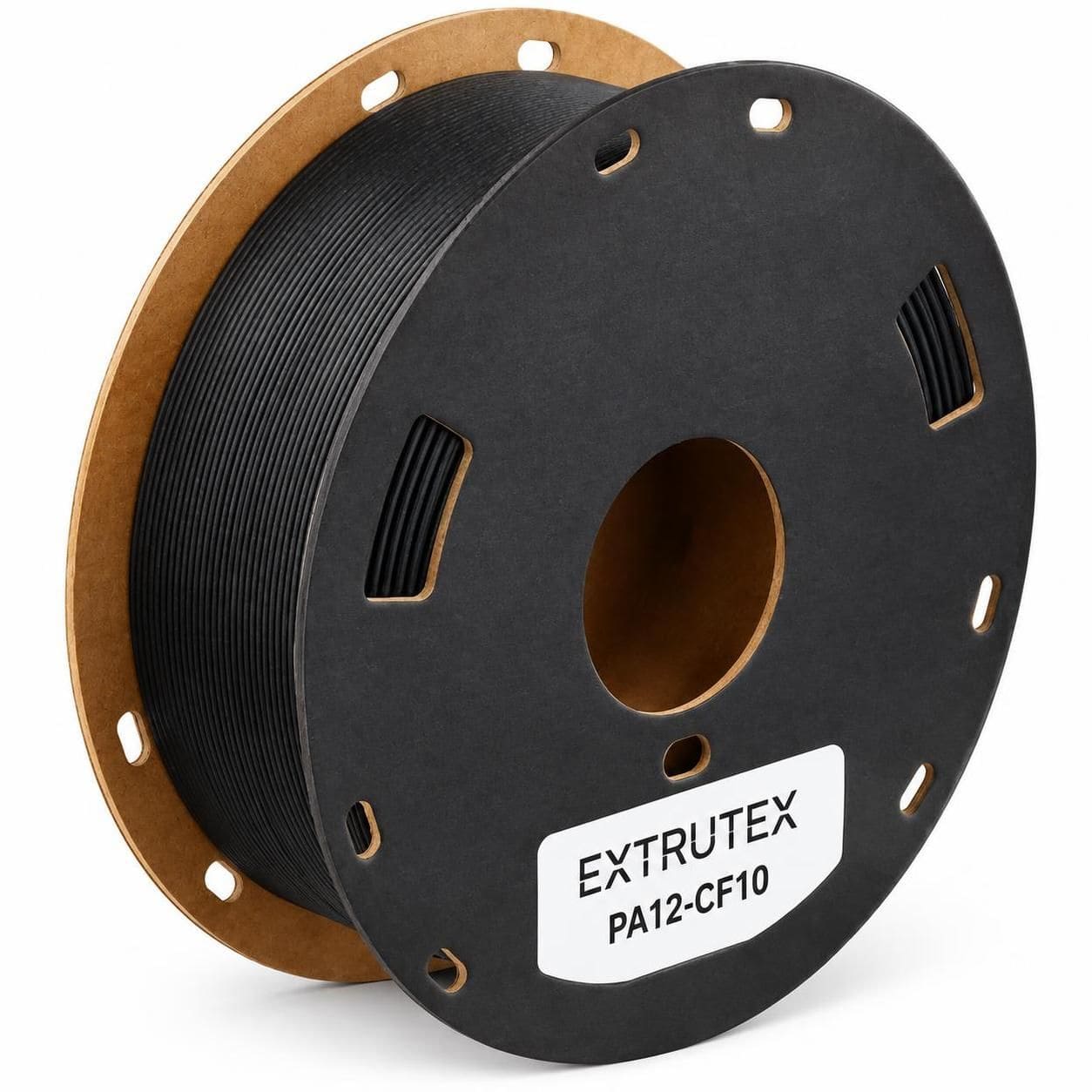
EXTRUTEX PA12-CF10 is an advanced engineering 3D printing filament made from long-chain copolyamide reinforced with carbon fiber. It is designed for applications that require a combination of mechanical performance, improved moisture resistance and dimensional stability. By combining a PA12-based copolyamide matrix with carbon fiber reinforcement, this material offers an alternative to conventional nylon filaments for functional and industrial 3D printing.
The long-chain polyamide formulation is designed to provide better resistance to moisture absorption than conventional PA6 and PA66 materials, while delivering improved mechanical properties compared with standard PA12. Carbon fiber reinforcement contributes additional stiffness and strength, making PA12-CF10 suitable for functional components, engineering prototypes, fixtures and mechanical parts.
EXTRUTEX PA12-CF10 also incorporates Warp-free technology to help reduce warping and dimensional distortion during printing. This supports more consistent results when producing parts with demanding geometries and functional requirements.
Material overview: PA12-CF10 combines long-chain copolyamide, carbon fiber reinforcement and dimensional-stability-focused formulation for demanding engineering 3D printing applications.
Key Features and Advantages
Carbon Fiber ReinforcementCarbon fiber improves the stiffness and mechanical performance of the base copolyamide material.
Improved Moisture ResistanceDesigned to absorb less moisture than conventional PA6 and PA66 nylon materials.
Enhanced Mechanical PerformanceDeveloped to provide improved mechanical properties compared with standard PA12 filament.
Warp-free TechnologyHelps reduce warping and dimensional distortion during the printing process.
Engineering Polymer BaseLong-chain copolyamide provides a suitable foundation for functional and industrial components.
Custom Color OptionsAvailable in standard black, with customized colors available upon request and technical evaluation.
Carbon Fiber Reinforced Long-Chain Copolyamide
PA12-CF10 is based on a long-chain copolyamide reinforced with carbon fiber. Long-chain polyamides are used in engineering applications where a balance of mechanical properties, moisture behavior and dimensional performance is important.
The carbon fiber reinforcement modifies the behavior of the polymer matrix. It contributes increased stiffness and helps improve the performance of printed components compared with an unreinforced material. This makes the filament suitable for applications where standard nylon may not provide the required rigidity or dimensional consistency.
The PA12-CF10 designation identifies this particular material grade. The exact carbon fiber loading and its measurement basis should be confirmed in the product's technical data sheet before being used for detailed engineering calculations.
Technical Specifications
| Property | Specification |
|---|
| Product Name | EXTRUTEX PA12-CF10 |
| Material Type | Carbon fiber reinforced long-chain copolyamide |
| Base Polymer | PA12-based long-chain copolyamide |
| Reinforcement | Carbon fiber |
| Filament Diameter | 1.75 mm |
| Available Spool Weights | 500 g and 3 kg |
| Standard Color | Black |
| Customized Colors | Available upon request |
| Moisture Resistance | Designed for improved moisture resistance compared with PA6 and PA66 |
| Mechanical Performance | Designed to improve mechanical properties compared with standard PA12 |
| Dimensional Stability | Warp-free technology to help reduce printing distortion |
| Hotend Requirement | All-metal hotend capable of at least 280°C |
| Nozzle Requirement | Hardened nozzle |
| Drying Requirement | Filament dryer recommended |
| Post-processing | Annealing and moisture conditioning may be used |
Specifications are based on the supplied product information. Detailed mechanical properties, carbon fiber loading, printing temperature profile, drying cycle and annealing conditions should be confirmed against the final technical data sheet.
Improved Moisture Resistance for Engineering Applications
Moisture absorption is an important consideration when working with nylon-based 3D printing materials. Water absorbed by polyamide filament can affect printing consistency and may influence the mechanical behavior and dimensional stability of printed parts.
PA12-CF10 is formulated to offer better moisture resistance than conventional PA6 and PA66 materials. This characteristic can make it a useful option for applications where components may encounter changing humidity conditions or where dimensional consistency is important.
However, improved moisture resistance does not mean that the filament is completely moisture-proof. Proper storage, drying before printing and suitable post-processing remain important parts of a reliable production process.
Mechanical Performance and Carbon Fiber Reinforcement
Carbon fiber reinforcement is used to enhance the stiffness and mechanical performance of polymer materials. In PA12-CF10, the fibers work together with the copolyamide matrix to create a composite material intended for functional engineering parts.
Compared with standard PA12 filament, PA12-CF10 is designed to provide improved mechanical properties. Its reinforced structure can be useful when printing components that need greater rigidity and resistance to deformation under working loads.
Actual performance depends on part geometry, print orientation, layer bonding, printer calibration and the conditions under which the component is used. For critical load-bearing applications, printed samples should be tested under representative operating conditions.
Warp-free Technology and Dimensional Stability
Warping is a common challenge when printing engineering polymers, particularly when producing large parts, flat surfaces, thin walls or geometries with different material thicknesses.
PA12-CF10 incorporates Warp-free technology to help reduce warping and distortion during printing. Better dimensional stability can support more consistent production of functional prototypes, mechanical components and engineering fixtures.
Successful printing still depends on appropriate thermal management, build-plate preparation, printer enclosure conditions, material dryness and correct slicing parameters. The technology should be considered an aid to dimensional stability rather than a guarantee that warping cannot occur.
Printer Requirements and Printing Preparation
All-Metal Hotend
PA12-CF10 requires an all-metal hotend capable of reaching at least 280°C. The printer must be able to maintain stable temperatures throughout the printing process. Check the manufacturer's specifications to ensure that the hotend is suitable for sustained operation at the required temperature.
Hardened Nozzle
Carbon fiber is abrasive and can accelerate wear in conventional brass nozzles. A hardened nozzle is required or strongly recommended to maintain nozzle geometry and printing consistency over time. Nozzle selection should also consider the fiber content and the manufacturer's recommendations.
Filament Drying
Nylon-based materials can absorb moisture from the surrounding environment. A filament dryer is recommended before printing, particularly when the spool has been exposed to ambient humidity or stored outside its protective packaging.
The exact drying temperature and duration should follow the grade-specific technical data sheet. Avoid using an arbitrary drying cycle, as excessive temperature or unsuitable equipment may damage the spool or filament.
Printer Compatibility
- FDM and FFF 3D printers equipped with a suitable all-metal hotend.
- Hotend capable of reaching at least 280°C.
- Hardened nozzle suitable for abrasive reinforced filament.
- Filament dryer for moisture management.
- Printer configuration suitable for engineering-grade nylon materials.
Post-Processing: Annealing and Moisture Conditioning
Annealing and moisture conditioning are two different post-processing approaches that may be considered for nylon-based engineering materials. They should not be treated as interchangeable procedures.
Annealing
Annealing involves controlled heat treatment after printing. Depending on the material formulation and the selected process, it may help modify crystallinity and influence mechanical or dimensional properties. The correct temperature, duration and cooling procedure must be established for PA12-CF10 using manufacturer guidance or controlled testing.
Moisture Conditioning
Moisture conditioning allows a polyamide component to reach a more controlled moisture state. Polyamide properties can change as moisture content changes, so conditioning may be relevant when a component is intended to operate in a particular environment.
For precision parts, dimensional measurements should be taken at the relevant stage of the conditioning process. Always validate the final dimensions and mechanical performance before using printed components in critical applications.
Typical Applications
- Functional prototypes: Engineering prototypes that require improved stiffness and mechanical performance.
- Mechanical components: Custom mechanical parts and functional assemblies.
- Industrial fixtures: Positioning fixtures, assembly aids and production-support components.
- Jigs and tooling: Custom jigs, inspection aids and workshop tooling.
- Equipment components: Selected non-metallic components used in machinery and industrial equipment.
- Engineering development: Prototype parts for evaluating product geometry, fit and function.
- Low-volume production: Specialized components produced in limited quantities through additive manufacturing.
PA12-CF10 Compared with Other Nylon Filaments
Different nylon materials offer different combinations of moisture behavior, mechanical performance and processing requirements. PA12-CF10 is intended for users who need a reinforced long-chain copolyamide rather than a conventional unreinforced nylon filament.
| Material | General Characteristics |
|---|
| PA6 | Engineering nylon with useful mechanical properties, but relatively sensitive to moisture absorption. |
| PA66 | Engineering polyamide commonly used where strength and thermal performance are important; moisture management is still necessary. |
| Standard PA12 | Long-chain polyamide with generally lower moisture absorption than PA6 and PA66. |
| PA12-CF10 | Carbon fiber reinforced long-chain copolyamide designed for improved mechanical performance, moisture resistance and dimensional stability. |
This comparison is qualitative. Actual properties vary by grade, formulation, printing conditions and test method. For engineering selection, consult the relevant technical data sheets and compare measured values under consistent test conditions.
Packaging, Storage and Material Handling
Proper handling is important for maintaining consistent filament quality. PA12-CF10 should be protected from unnecessary exposure to moisture before and after opening.
- Store unused filament in its original protective packaging.
- Keep opened spools in a sealed moisture-resistant container.
- Use a filament dryer before printing when required.
- Avoid leaving the spool exposed to humid workshop conditions.
- Inspect filament condition before starting a production print.
- Use suitable storage and handling procedures for long-term inventory.
Available Sizes and Customization
EXTRUTEX PA12-CF10 is available in a 1.75 mm filament diameter with different spool weight options to support different printing requirements.
| Option | Availability |
|---|
| Filament Diameter | 1.75 mm |
| Spool Weight | 500 g |
| Spool Weight | 3 kg |
| Standard Color | Black |
| Custom Colors | Available upon request, subject to formulation and production feasibility |
For customized color requirements, larger-volume orders or technical evaluation, contact EXTRUTEX with your application details and preferred material specifications.
Why Choose EXTRUTEX PA12-CF10?
EXTRUTEX supplies advanced polymer materials and 3D printing filaments for industrial, engineering and professional applications. Our product development approach combines material selection, formulation knowledge and practical processing experience.
EXTRUTEX products are manufactured in China, supported by design, laboratory and R&D capabilities in Austria. This combination supports product development, technical evaluation and customization for different market requirements.
Whether you are developing functional prototypes, producing mechanical components or evaluating reinforced nylon materials for industrial applications, EXTRUTEX can help you identify a suitable filament solution.
Frequently Asked Questions
1. What is EXTRUTEX PA12-CF10 filament?
EXTRUTEX PA12-CF10 is a carbon fiber reinforced 3D printing filament based on long-chain copolyamide. It is designed to combine improved mechanical performance with better moisture resistance than conventional PA6 and PA66 materials. Carbon fiber reinforcement contributes additional stiffness, while Warp-free technology helps reduce warping during printing.
2. What does PA12-CF10 mean?
PA12 refers to the PA12-based long-chain copolyamide material family, while CF indicates carbon fiber reinforcement. The CF10 designation identifies the specific grade. The exact carbon fiber loading and whether the number represents a weight percentage should be confirmed using the manufacturer's technical documentation.
3. Is PA12-CF10 stronger than standard PA12?
PA12-CF10 is designed to offer improved mechanical properties compared with standard PA12. Carbon fiber reinforcement contributes additional stiffness and can improve the suitability of the material for functional engineering components. Actual strength and stiffness depend on the formulation, print settings, part orientation and testing method.
4. Is PA12-CF10 more moisture-resistant than PA6 and PA66?
Yes. The material is designed to provide better moisture resistance than conventional PA6 and PA66 materials. This can be useful for applications where humidity and dimensional consistency are important. However, it is not completely moisture-proof, and proper drying and storage are still recommended.
5. Does PA12-CF10 absorb moisture?
Like other polyamide-based materials, PA12-CF10 can absorb moisture from the surrounding environment. Its formulation is intended to reduce moisture sensitivity compared with PA6 and PA66. For consistent printing, keep the filament protected and dry it when necessary.
6. What is Warp-free technology?
Warp-free technology is a formulation approach intended to reduce warping and dimensional distortion during 3D printing. It helps improve the consistency of printed components, particularly when producing functional parts. Actual results still depend on printer calibration, thermal conditions, geometry and material preparation.
7. What filament diameter is available?
EXTRUTEX PA12-CF10 is supplied in a nominal filament diameter of 1.75 mm. The printer's filament feed system should be compatible with this diameter. A diameter tolerance has not been specified here and should be confirmed through the product technical data sheet.
8. What spool weights are available?
The stated spool options are 500 g and 3 kg. These options support different material consumption requirements, from smaller engineering trials and prototype work to longer production runs. Confirm spool dimensions and printer-holder compatibility before ordering the larger format.
9. What colors are available?
Black is the standard color. Customized colors may also be available depending on the required formulation, production feasibility and order quantity. Contact EXTRUTEX with your preferred color reference and application requirements for evaluation.
10. What hotend is required for PA12-CF10?
An all-metal hotend capable of reaching at least 280°C is required according to the supplied product information. The printer should maintain stable temperatures and be suitable for engineering-grade nylon materials. Always check the manufacturer's hotend specifications before printing.
11. Does PA12-CF10 require a hardened nozzle?
Yes. A hardened nozzle is required or strongly recommended because carbon fiber reinforcement is abrasive. Conventional brass nozzles can wear more quickly, potentially affecting extrusion consistency and dimensional accuracy. Select a nozzle suitable for abrasive composite filaments.
12. Is a filament dryer necessary?
A filament dryer is recommended. Although PA12-CF10 is designed for improved moisture resistance, polyamide materials can still absorb moisture during storage and handling. Dry filament helps reduce moisture-related printing problems and supports more consistent extrusion quality.
13. What drying temperature should be used?
The exact drying temperature and duration should be confirmed in the grade-specific technical data sheet. A universal drying cycle should not be assumed because different filament formulations and spool materials can have different thermal limitations. Use suitable drying equipment and follow the manufacturer's instructions.
14. Can PA12-CF10 be used for functional prototypes?
Yes. Its carbon fiber reinforcement, improved mechanical performance and dimensional-stability-focused formulation make it suitable for functional prototype development. It can be considered for parts that need more stiffness than standard PA12 can provide, subject to validation of the specific design and operating conditions.
15. Is PA12-CF10 suitable for industrial jigs and fixtures?
PA12-CF10 can be considered for industrial jigs, fixtures, assembly aids and other production-support components. Its reinforced structure may be useful where rigidity and dimensional consistency are important. The suitability of a printed fixture should be evaluated against its actual loads, temperatures and operating environment.
16. Can PA12-CF10 be used for mechanical parts?
Yes, it is intended for engineering and mechanical applications where reinforced nylon properties are useful. Potential applications include custom brackets, housings, supports and other functional components. For safety-critical or heavily loaded parts, conduct appropriate mechanical testing before deployment.
17. What is annealing?
Annealing is a controlled heat-treatment process applied after printing. Depending on the material and process, it can influence polymer crystallinity and certain mechanical or dimensional properties. The correct annealing temperature, duration and cooling conditions for PA12-CF10 must be established using manufacturer guidance or controlled testing.
18. What is moisture conditioning?
Moisture conditioning is a controlled process that allows a polyamide component to reach a specified moisture state. Moisture can influence the mechanical behavior and dimensions of nylon parts. Conditioning may be relevant when components need to perform consistently in a particular environment.
19. Are annealing and moisture conditioning the same process?
No. Annealing uses controlled heat treatment, while moisture conditioning controls the moisture state of the polyamide. They serve different purposes and can influence material behavior in different ways. The appropriate process depends on the final application and the required properties.
20. Is PA12-CF10 suitable for large prints?
Its Warp-free technology is intended to help reduce warping and dimensional distortion, which may be beneficial for larger components. However, large prints still require suitable thermal management, printer calibration, build-plate preparation and proper material drying. Test the intended geometry before committing to a long production print.
21. Can PA12-CF10 replace PA6-CF or PA66-CF?
It may be an alternative for applications where improved moisture resistance is a priority, but the materials should not be considered direct replacements without evaluation. Mechanical properties, thermal performance, chemical resistance and printing behavior vary between formulations. Compare technical data and validate the material in the intended application.
22. Can PA12-CF10 be used in humid environments?
Its improved moisture resistance may make it worth evaluating for applications exposed to changing humidity. Nevertheless, moisture can still influence polyamide materials. The final part should be tested under the actual environmental conditions, including humidity, temperature and mechanical loading.
23. Does carbon fiber make the filament more abrasive?
Yes. Carbon fiber reinforcement makes the filament more abrasive than many unfilled polymer filaments. A hardened nozzle helps reduce wear during printing. Users should also follow the printer manufacturer's recommendations for abrasive composite materials.
24. How should PA12-CF10 be stored?
Store the filament in its original protective packaging when possible. After opening, keep it in a sealed moisture-resistant container and avoid prolonged exposure to humid air. Dry the filament before printing when required. Good storage practices help maintain material quality between printing sessions.
25. Is PA12-CF10 suitable for low-volume production?
It can be considered for low-volume production of specialized engineering components, especially where reinforced polymer properties and additive manufacturing flexibility are valuable. The suitability depends on production volume, part geometry, required tolerances, mechanical loading and the economics of the printing process.
26. Can EXTRUTEX provide customized PA12-CF10 colors?
Customized colors may be available upon request, subject to formulation and production feasibility. Share your preferred color, spool weight, filament diameter and expected quantity with EXTRUTEX so the requirements can be reviewed before an order is confirmed.
27. How can I select the right spool size?
The 500 g spool is useful for initial testing, smaller prototypes and occasional printing. The 3 kg option may be more convenient for users with higher material consumption or longer production runs. Check the spool dimensions and printer compatibility before selecting a larger format.
28. Where is EXTRUTEX PA12-CF10 manufactured?
EXTRUTEX products are manufactured in China, with design, laboratory and R&D capabilities in Austria. This structure supports material development, technical evaluation and product customization for international customers.
Request PA12-CF10 Technical Information
Looking for a carbon fiber reinforced nylon filament for engineering prototypes, functional components or industrial 3D printing? Contact EXTRUTEX to discuss PA12-CF10 specifications, spool options, customized colors and application requirements.
Visit EXTRUTEX to explore our engineering polymers, 3D printing materials and industrial plastic solutions.




-
(0 customer reviews)