No products in the cart.




All rights of this website are reserved for EXTRUTEX Austria and its partner companies, © 2026


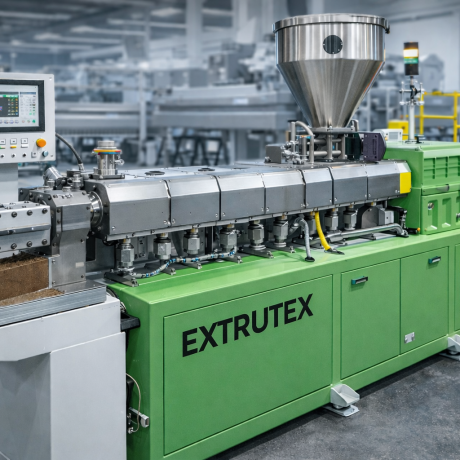
EXTRUTEX EXCT-65 Co-Rotating Twin-Screw Extruder

Multiple Payment Methods

Discount for advance payments over 50%

Free Shipping Coordination Services
Payment methods:

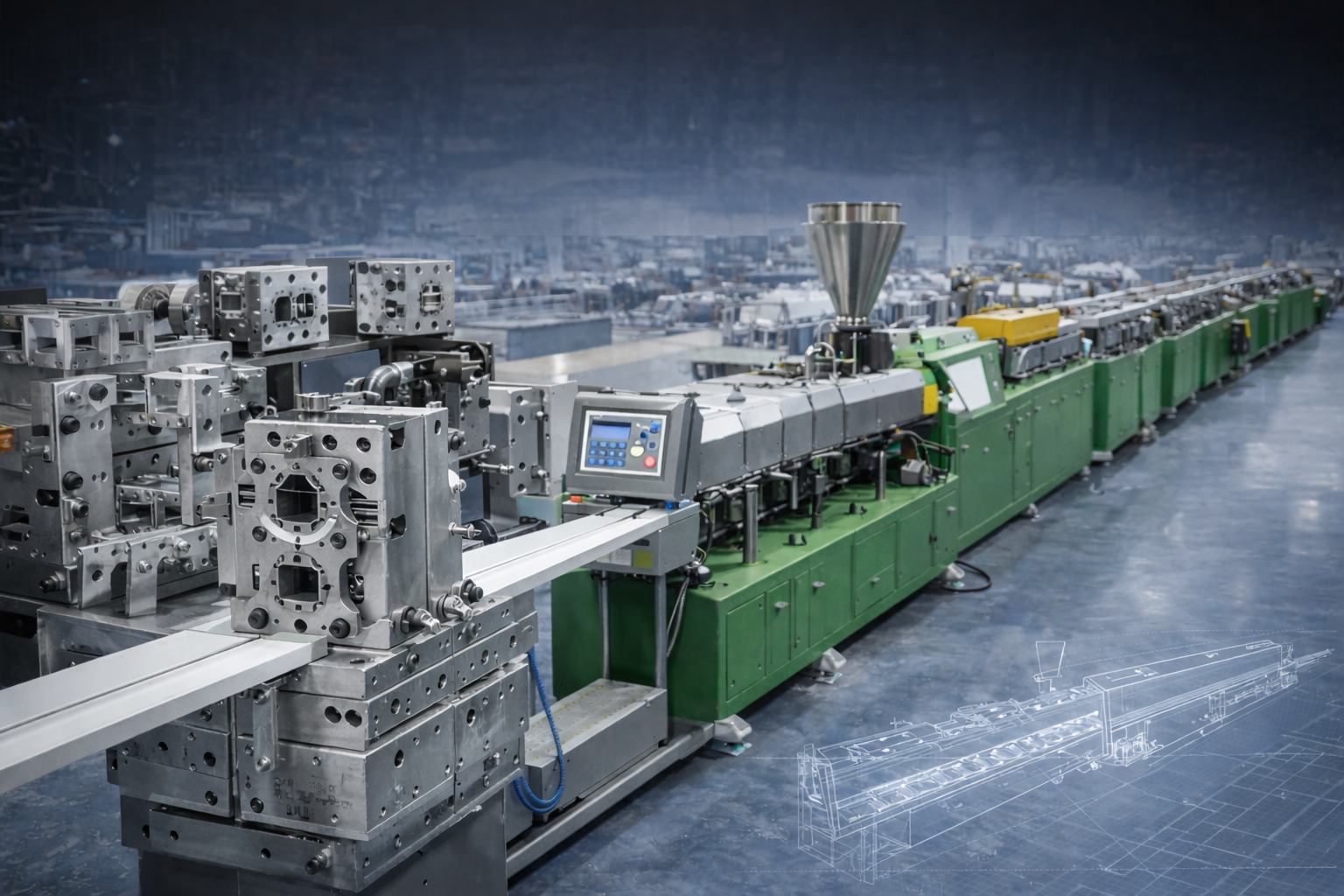
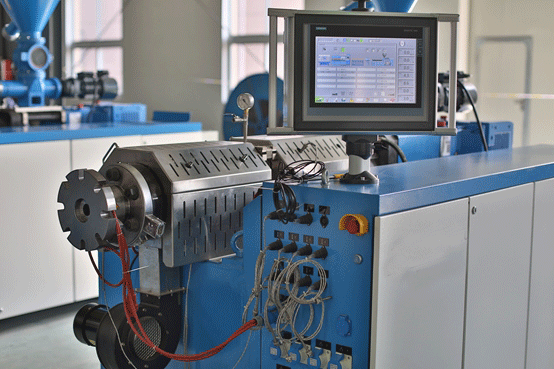
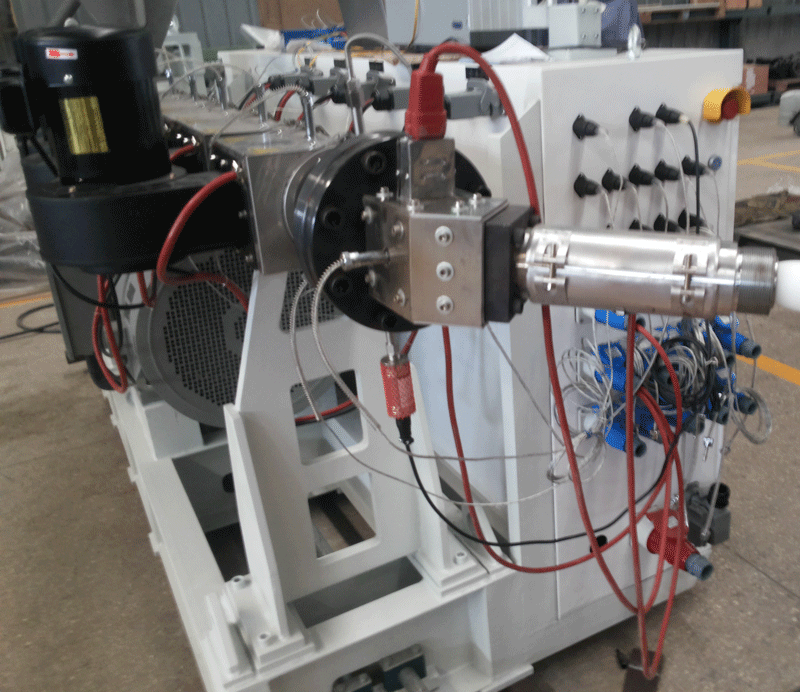
The EXTRUTEX EXCT-65 is a modular co-rotating twin-screw extruder designed for continuous polymer compounding, intensive mixing, dispersion, homogenization, masterbatch production, recycling and a wide range of thermoplastic processing applications.
With a 65 mm screw diameter, the EXCT-65 provides a substantial processing platform for manufacturers requiring higher production capacity while maintaining the flexibility of a modular twin-screw system.
The machine combines a co-rotating twin-screw configuration, modular barrel sections, configurable screw and kneading elements, independently controlled temperature zones and a practical clamshell barrel design.
The clamshell barrel allows rapid access to the screws and internal processing chamber, making cleaning, inspection, maintenance, screw-element changes and product changeover considerably more convenient.
With a nominal production range of approximately 150–300 kg/h, the EXCT-65 is suitable for pilot-to-industrial production, specialized compounding and continuous manufacturing applications.
| Specification | EXCT-65 |
|---|---|
| Model | EXCT-65 |
| Screw Diameter | 65 mm |
| L/D Ratio | 28–48 |
| Screw Speed | 300–500 rpm |
| Main Motor Power | 55 / 75 kW |
| Production Capacity | 150–300 kg/h |
| Screw Type | Co-Rotating Twin Screw |
| Barrel Design | Modular Clamshell |
| Processing Mode | Continuous |
| Application | Compounding, Mixing, Dispersion, Masterbatch, Recycling & Specialty Materials |
Actual output depends on polymer type, formulation, screw configuration, feeding system, screw speed, temperature profile, residence time and downstream pressure.
The 65 mm screw diameter provides the EXCT-65 with a larger processing volume and higher throughput capability compared with the smaller EXCT models.
The co-rotating twin-screw system allows the machine to combine several processing functions within one continuous extrusion process.
The screws can be configured using different conveying, kneading and mixing elements to establish the desired processing profile.
Depending on the application, the EXCT-65 can provide zones for:
Feeding
Conveying
Melting
Plasticization
Kneading
Distributive mixing
Dispersive mixing
Filler incorporation
Additive dispersion
Homogenization
Degassing
Devolatilization
Pressure building
Melt filtration
Discharge
The modular architecture allows the processing configuration to be developed around the material rather than using one fixed screw arrangement for every formulation.
The EXCT-65 is designed for an approximate production range of 150–300 kg/h.
This capacity makes the machine suitable for larger pilot operations, specialized industrial production and continuous polymer compounding.
The actual production rate depends on the characteristics of the processed material and the selected process configuration.
Important factors include:
Polymer type
Bulk density
Melt viscosity
Filler concentration
Additive loading
Moisture content
Screw configuration
Screw speed
Feeding accuracy
Barrel temperature
Residence time
Required mixing intensity
Discharge pressure
Filtration system
For this reason, the final EXCT-65 configuration should be selected according to the specific formulation and production objective.
The EXCT-65 provides a screw-speed range of approximately 300–500 rpm.
The operating speed can be adjusted according to the required combination of throughput, mixing intensity, residence time and mechanical energy.
Different materials respond differently to screw speed.
For applications requiring intensive dispersion, higher screw speeds may be appropriate when permitted by the material and process conditions.
For formulations requiring gentler processing or longer residence time, lower operating speeds may be selected.
The modular screw configuration allows screw speed and element arrangement to be optimized together.
The EXCT-65 is available with 28–48 L/D configurations.
The available processing length provides flexibility for both relatively simple and more complex formulations.
A shorter configuration can be used for applications involving basic conveying, melting and mixing.
Longer configurations provide additional processing space for applications requiring multiple sequential stages.
A typical extended process may be arranged as:
Metering → Feeding → Conveying → Melting → Kneading → Dispersion → Homogenization → Degassing → Pressure Building → Filtration → Discharge
The exact configuration can be adapted according to the material and final product requirements.
The clamshell barrel provides one of the major operational advantages of the EXCT-65.
The hinged barrel can be opened to provide direct access to the twin screws and internal processing sections.
This makes a number of routine operations easier and faster:
Product changeover
Screw inspection
Cleaning
Removal of residual polymer
Screw-element replacement
Preventive maintenance
Troubleshooting
Process development
Inspection of kneading elements
For plants producing multiple compounds, easy access to the processing chamber can help simplify changeover procedures.
The same feature is particularly valuable for R&D and process optimization because engineers can inspect and modify the screw configuration without extensive machine disassembly.
The EXCT-65 uses a modular barrel concept in which individual barrel sections can be configured according to their position and function in the extrusion process.
Different barrel sections can be dedicated to specific operations.
Possible processing sections include:
Introduces and transports the raw materials into the main processing area.
Provides the thermal and mechanical conditions required for polymer plasticization.
Provides distributive and dispersive mixing of polymer components, fillers and additives.
Provides additional mechanical energy where intensive mixing or dispersion is required.
Can be used for introducing additional fillers, fibers or additives downstream of the primary melting zone where appropriate.
Provides a dedicated area for removing moisture, air and volatile components.
Stabilizes the melt before the final pressure-building section.
Generates the pressure required for filtration and downstream equipment.
This modular structure allows the EXCT-65 to be adapted to different processing sequences.
The EXCT-65 can use independently controlled temperature zones along the barrel.
Each zone can be adjusted according to its specific processing function.
The temperature profile is important because polymer processing often involves several different thermal stages.
For example, the feeding area may require controlled temperatures to prevent premature melting, while the melting zone requires conditions suitable for plasticization.
Mixing zones may require carefully controlled melt temperatures to achieve the desired viscosity and dispersion.
The downstream sections can then be optimized for degassing, homogenization and pressure stabilization.
Electrical heating and controlled cooling can be provided for the individual barrel zones according to the machine configuration.
The EXCT-65 uses a configurable screw system that allows different screw and kneading elements to be combined.
This enables engineers to establish specific processing zones within the same extruder.
Conveying elements transport materials through the barrel and control the movement of the material through each processing section.
Melting sections provide controlled plasticization of the polymer before intensive mixing.
Kneading blocks increase mechanical interaction and can provide higher mixing intensity when required.
Mixing elements provide controlled distributive and dispersive mixing of polymer components.
Downstream elements can improve melt uniformity before discharge.
The screw configuration around a vacuum zone can support devolatilization and removal of volatile components.
The final screw sections can generate the pressure required for filtration and discharge.
This modular screw architecture gives the EXCT-65 considerable flexibility for different formulations.
The EXCT-65 can be configured to perform the principal stages of a continuous compounding process.
The process begins with controlled feeding of polymer and formulation components.
Depending on the formulation, the system can handle:
Polymer pellets
Powders
Mineral fillers
Pigments
Additives
Fibers
Recycled materials
Multiple feeding points can be considered where additional materials need to be introduced downstream.
The first screw sections transport the materials through the barrel.
The conveying configuration can be selected according to the required feed rate, filling level and residence time.
Stable conveying contributes to consistent processing conditions and formulation control.
The polymer is progressively converted from a solid material into a homogeneous melt.
Thermal energy from the barrel and mechanical energy generated by the screws work together to achieve controlled melting.
The melting configuration can be adjusted according to polymer type and formulation.
Once the polymer is molten, intensive mixing sections can disperse fillers, pigments and additives throughout the polymer matrix.
Both distributive mixing and dispersive mixing can be incorporated into the screw configuration.
This makes the EXCT-65 suitable for formulations such as:
Filled polymers
Masterbatch
Polymer blends
Additive concentrates
Reinforced compounds
Mineral-filled materials
Recycled compounds
Some materials contain moisture, trapped air or volatile components.
A dedicated degassing zone can be incorporated into the EXCT-65 configuration where required.
Vacuum-assisted devolatilization can help remove unwanted volatile components from the melt.
This can be particularly important when processing recycled polymers or moisture-sensitive materials.
Following intensive mixing and degassing, the melt can pass through a homogenization section.
The objective is to achieve a consistent and stable melt before the final discharge stage.
When required, the EXCT-65 can be integrated with a melt-screening or filtration system.
This can help remove contaminants and unmelted particles before the melt enters the pelletizing or forming equipment.
For recycling applications, melt filtration can be an important part of the overall process.
The homogenized melt can be transferred to an appropriate downstream system.
Depending on the final product, the EXCT-65 can be integrated with:
Strand pelletizing systems
Water-ring pelletizers
Melt filtration systems
Sheet dies
Profile dies
Customized extrusion equipment
The downstream configuration is selected according to the material and final product.
The EXCT-65 is suitable for a broad range of thermoplastic processing applications.
Typical applications include:
Polymer compounding
Masterbatch production
Color masterbatch
Filler masterbatch
Calcium carbonate compounds
Mineral-filled compounds
Polymer blending
Additive dispersion
Reinforced plastics
Glass-fiber reinforced compounds
Engineering plastics
Recycled polymer compounds
Recycling and re-compounding
Specialty polymer formulations
R&D and process development
Pilot production
Continuous industrial production
The final screw configuration and processing parameters should be selected according to the specific formulation.
The EXCT-65 can also be configured for recycling and re-compounding applications.
Recycled polymers can contain moisture, contaminants, variable particle sizes and inconsistent material properties.
The modular processing system allows suitable stages to be incorporated for:
Feeding → Melting → Mixing → Degassing → Filtration → Homogenization → Pelletizing
A vacuum degassing zone can be used where required, while downstream melt filtration can help remove unwanted solid contaminants.
The appropriate configuration depends on the source and quality of the recycled material.
The EXCT-65 provides a bridge between pilot-scale development and industrial production.
Its 150–300 kg/h capacity range provides sufficient production capability for commercial trials, specialty products and continuous manufacturing while retaining the flexible architecture associated with the EXTRUTEX modular twin-screw series.
Engineers can evaluate different:
Screw configurations
Screw speeds
Feeding rates
Temperature profiles
Mixing intensities
Residence times
Degassing conditions
Filtration systems
This allows the processing parameters to be established according to the formulation and production target.
The internal components of the EXCT-65 can be selected according to the material and processing environment.
Standard screw, kneading and barrel components can use suitable nitrided steel materials.
For applications involving highly abrasive fillers or corrosive formulations, enhanced wear- and corrosion-resistant materials and surface treatments can be specified.
This is particularly relevant when processing:
Calcium carbonate
Glass fiber
Mineral fillers
Wood fiber
Ceramic fillers
High-filler compounds
Recycled materials
The component material should be selected according to the actual formulation, operating conditions and expected service requirements.
Provides a larger processing platform for higher-capacity polymer compounding.
Suitable for pilot, specialized and continuous industrial production.
Provides flexible control of mixing intensity and processing conditions.
Allows different processing lengths and multi-stage configurations.
Provides flexibility in selecting the drive configuration for the required process.
Fast and convenient access to screws and processing zones.
Allows conveying, melting, kneading, mixing, dispersion, degassing and pressure-building sections to be configured according to the application.
Provides separate thermal control of different barrel sections.
Suitable for masterbatch, filled compounds, polymer blends, recycling, specialty compounds and other thermoplastic applications.
The EXTRUTEX EXCT-65 is a 65 mm co-rotating twin-screw extruder developed for flexible, continuous polymer compounding and advanced thermoplastic processing.
With 300–500 rpm screw speed, 28–48 L/D configurations, 55/75 kW motor options and an approximate production capacity of 150–300 kg/h, the EXCT-65 provides a higher-capacity platform while maintaining the modularity and accessibility of the EXTRUTEX EXCT series.
Its modular screw and barrel system allows the complete processing sequence to be configured around the material, from feeding and conveying through melting, kneading, mixing, dispersion and homogenization to degassing, filtration and final discharge.
The clamshell barrel provides convenient access to the screws and processing chamber, supporting easier cleaning, maintenance, inspection and product changeover.
EXTRUTEX EXCT-65 — A modular 65 mm co-rotating twin-screw platform for controlled, flexible and high-capacity polymer compounding.
When production needs exceed the ordinary, the EXTRUTEX ATP 114-32S steps in — a masterclass in single-screw extrusion engineering.
Built with Austrian precision and forged for endurance, this machine transforms PVC and UPVC granules into flawless, smooth, dimensionally stable sheets at a rate few can match.
The ATP 114-32S represents the next generation of sheet extrusion — optimized for wide sheets, thick sections, and continuous high-capacity output.
It’s designed for manufacturers who demand more than performance — they demand perfection.
The EXTRUTEX ATP 114-32S integrates a special geometric screw design that optimizes material melting, mixing, and degassing.
This unique geometry ensures exceptional melt homogeneity, superior plasticization, and reduced thermal stress, even at high throughputs.
A bimetallic barrel paired with molybdenum-coated screws delivers outstanding wear resistance and a long operational life, while the 32 L/D ratio ensures excellent output consistency for rigid and semi-rigid PVC sheets.
Its AC vector drive motor and high-torque gearbox provide smooth, vibration-free power delivery, allowing precise control of melt pressure and sheet uniformity.
The multi-zone temperature control system, governed by a PLC-based control panel, maintains the thermal balance critical for quality surface finish and dimensional accuracy.
The ATP 114-32S is engineered for large-scale PVC sheet production — foamed or rigid — and can be configured with automatic feeders, melt pressure sensors, and integrated flat die systems for complete process control from hopper to haul-off.
| Parameter | Specification |
|---|---|
| Model | EXTRUTEX ATP 114-32S |
| Application | UPVC / PVC Rigid Sheet Extrusion |
| Screw Diameter | 114 mm |
| L/D Ratio | 32:1 |
| Output Range | 270 – 450 kg/h |
| Installed Power | 107 kW |
| Drive Type | AC Vector Drive Motor |
| Screw Design | Special Geometric Design for PVC Melting and Mixing |
| Barrel Material | Nitrided / Bimetallic with Molybdenum Coating |
| Gearbox Type | High Torque, Low Noise Design |
| Heating Zones | Multi-Zone (6 to 8 Zones Adjustable) |
| Cooling System | Air / Water Integrated Cooling System |
| Control System | PLC with Touch Screen Operation |
| Degassing System | Optional Single / Double Vented Design |
| Feeding System | Automatic Volumetric / Gravimetric Feeder |
| Melt Temperature Range | 170 – 195 °C (adjustable) |
| Applications | PVC Foam Board, Rigid PVC Sheet, Advertising Panels, UPVC Flat Panels |
| Output Stability | ±1.5% Consistency |
| Country of Origin | Austria (Designed by EXTRUTEX) |
The ATP 114-32S excels where productivity meets precision.
Its robust torque, thermal uniformity, and melt stability guarantee consistent sheet thickness and perfect surface clarity — even under continuous, 24-hour production cycles.
With 107 kW of engineered efficiency, it delivers the ideal balance between power consumption and throughput, resulting in reduced operating costs and maximized profitability.
Every component — from gearbox to barrel — is built to EXTRUTEX’s uncompromising European standards, making this extruder not just a machine, but a long-term production partner.

There are no reviews yet.
The EXTRUTEX EXCT-65 is a modular co-rotating twin-screw extruder designed for continuous polymer compounding, intensive mixing, dispersion, homogenization, masterbatch production, recycling and a wide range of thermoplastic processing applications.
With a 65 mm screw diameter, the EXCT-65 provides a substantial processing platform for manufacturers requiring higher production capacity while maintaining the flexibility of a modular twin-screw system.
The machine combines a co-rotating twin-screw configuration, modular barrel sections, configurable screw and kneading elements, independently controlled temperature zones and a practical clamshell barrel design.
The clamshell barrel allows rapid access to the screws and internal processing chamber, making cleaning, inspection, maintenance, screw-element changes and product changeover considerably more convenient.
With a nominal production range of approximately 150–300 kg/h, the EXCT-65 is suitable for pilot-to-industrial production, specialized compounding and continuous manufacturing applications.
| Specification | EXCT-65 |
|---|---|
| Model | EXCT-65 |
| Screw Diameter | 65 mm |
| L/D Ratio | 28–48 |
| Screw Speed | 300–500 rpm |
| Main Motor Power | 55 / 75 kW |
| Production Capacity | 150–300 kg/h |
| Screw Type | Co-Rotating Twin Screw |
| Barrel Design | Modular Clamshell |
| Processing Mode | Continuous |
| Application | Compounding, Mixing, Dispersion, Masterbatch, Recycling & Specialty Materials |
Actual output depends on polymer type, formulation, screw configuration, feeding system, screw speed, temperature profile, residence time and downstream pressure.
The 65 mm screw diameter provides the EXCT-65 with a larger processing volume and higher throughput capability compared with the smaller EXCT models.
The co-rotating twin-screw system allows the machine to combine several processing functions within one continuous extrusion process.
The screws can be configured using different conveying, kneading and mixing elements to establish the desired processing profile.
Depending on the application, the EXCT-65 can provide zones for:
Feeding
Conveying
Melting
Plasticization
Kneading
Distributive mixing
Dispersive mixing
Filler incorporation
Additive dispersion
Homogenization
Degassing
Devolatilization
Pressure building
Melt filtration
Discharge
The modular architecture allows the processing configuration to be developed around the material rather than using one fixed screw arrangement for every formulation.
The EXCT-65 is designed for an approximate production range of 150–300 kg/h.
This capacity makes the machine suitable for larger pilot operations, specialized industrial production and continuous polymer compounding.
The actual production rate depends on the characteristics of the processed material and the selected process configuration.
Important factors include:
Polymer type
Bulk density
Melt viscosity
Filler concentration
Additive loading
Moisture content
Screw configuration
Screw speed
Feeding accuracy
Barrel temperature
Residence time
Required mixing intensity
Discharge pressure
Filtration system
For this reason, the final EXCT-65 configuration should be selected according to the specific formulation and production objective.
The EXCT-65 provides a screw-speed range of approximately 300–500 rpm.
The operating speed can be adjusted according to the required combination of throughput, mixing intensity, residence time and mechanical energy.
Different materials respond differently to screw speed.
For applications requiring intensive dispersion, higher screw speeds may be appropriate when permitted by the material and process conditions.
For formulations requiring gentler processing or longer residence time, lower operating speeds may be selected.
The modular screw configuration allows screw speed and element arrangement to be optimized together.
The EXCT-65 is available with 28–48 L/D configurations.
The available processing length provides flexibility for both relatively simple and more complex formulations.
A shorter configuration can be used for applications involving basic conveying, melting and mixing.
Longer configurations provide additional processing space for applications requiring multiple sequential stages.
A typical extended process may be arranged as:
Metering → Feeding → Conveying → Melting → Kneading → Dispersion → Homogenization → Degassing → Pressure Building → Filtration → Discharge
The exact configuration can be adapted according to the material and final product requirements.
The clamshell barrel provides one of the major operational advantages of the EXCT-65.
The hinged barrel can be opened to provide direct access to the twin screws and internal processing sections.
This makes a number of routine operations easier and faster:
Product changeover
Screw inspection
Cleaning
Removal of residual polymer
Screw-element replacement
Preventive maintenance
Troubleshooting
Process development
Inspection of kneading elements
For plants producing multiple compounds, easy access to the processing chamber can help simplify changeover procedures.
The same feature is particularly valuable for R&D and process optimization because engineers can inspect and modify the screw configuration without extensive machine disassembly.
The EXCT-65 uses a modular barrel concept in which individual barrel sections can be configured according to their position and function in the extrusion process.
Different barrel sections can be dedicated to specific operations.
Possible processing sections include:
Introduces and transports the raw materials into the main processing area.
Provides the thermal and mechanical conditions required for polymer plasticization.
Provides distributive and dispersive mixing of polymer components, fillers and additives.
Provides additional mechanical energy where intensive mixing or dispersion is required.
Can be used for introducing additional fillers, fibers or additives downstream of the primary melting zone where appropriate.
Provides a dedicated area for removing moisture, air and volatile components.
Stabilizes the melt before the final pressure-building section.
Generates the pressure required for filtration and downstream equipment.
This modular structure allows the EXCT-65 to be adapted to different processing sequences.
The EXCT-65 can use independently controlled temperature zones along the barrel.
Each zone can be adjusted according to its specific processing function.
The temperature profile is important because polymer processing often involves several different thermal stages.
For example, the feeding area may require controlled temperatures to prevent premature melting, while the melting zone requires conditions suitable for plasticization.
Mixing zones may require carefully controlled melt temperatures to achieve the desired viscosity and dispersion.
The downstream sections can then be optimized for degassing, homogenization and pressure stabilization.
Electrical heating and controlled cooling can be provided for the individual barrel zones according to the machine configuration.
The EXCT-65 uses a configurable screw system that allows different screw and kneading elements to be combined.
This enables engineers to establish specific processing zones within the same extruder.
Conveying elements transport materials through the barrel and control the movement of the material through each processing section.
Melting sections provide controlled plasticization of the polymer before intensive mixing.
Kneading blocks increase mechanical interaction and can provide higher mixing intensity when required.
Mixing elements provide controlled distributive and dispersive mixing of polymer components.
Downstream elements can improve melt uniformity before discharge.
The screw configuration around a vacuum zone can support devolatilization and removal of volatile components.
The final screw sections can generate the pressure required for filtration and discharge.
This modular screw architecture gives the EXCT-65 considerable flexibility for different formulations.
The EXCT-65 can be configured to perform the principal stages of a continuous compounding process.
The process begins with controlled feeding of polymer and formulation components.
Depending on the formulation, the system can handle:
Polymer pellets
Powders
Mineral fillers
Pigments
Additives
Fibers
Recycled materials
Multiple feeding points can be considered where additional materials need to be introduced downstream.
The first screw sections transport the materials through the barrel.
The conveying configuration can be selected according to the required feed rate, filling level and residence time.
Stable conveying contributes to consistent processing conditions and formulation control.
The polymer is progressively converted from a solid material into a homogeneous melt.
Thermal energy from the barrel and mechanical energy generated by the screws work together to achieve controlled melting.
The melting configuration can be adjusted according to polymer type and formulation.
Once the polymer is molten, intensive mixing sections can disperse fillers, pigments and additives throughout the polymer matrix.
Both distributive mixing and dispersive mixing can be incorporated into the screw configuration.
This makes the EXCT-65 suitable for formulations such as:
Filled polymers
Masterbatch
Polymer blends
Additive concentrates
Reinforced compounds
Mineral-filled materials
Recycled compounds
Some materials contain moisture, trapped air or volatile components.
A dedicated degassing zone can be incorporated into the EXCT-65 configuration where required.
Vacuum-assisted devolatilization can help remove unwanted volatile components from the melt.
This can be particularly important when processing recycled polymers or moisture-sensitive materials.
Following intensive mixing and degassing, the melt can pass through a homogenization section.
The objective is to achieve a consistent and stable melt before the final discharge stage.
When required, the EXCT-65 can be integrated with a melt-screening or filtration system.
This can help remove contaminants and unmelted particles before the melt enters the pelletizing or forming equipment.
For recycling applications, melt filtration can be an important part of the overall process.
The homogenized melt can be transferred to an appropriate downstream system.
Depending on the final product, the EXCT-65 can be integrated with:
Strand pelletizing systems
Water-ring pelletizers
Melt filtration systems
Sheet dies
Profile dies
Customized extrusion equipment
The downstream configuration is selected according to the material and final product.
The EXCT-65 is suitable for a broad range of thermoplastic processing applications.
Typical applications include:
Polymer compounding
Masterbatch production
Color masterbatch
Filler masterbatch
Calcium carbonate compounds
Mineral-filled compounds
Polymer blending
Additive dispersion
Reinforced plastics
Glass-fiber reinforced compounds
Engineering plastics
Recycled polymer compounds
Recycling and re-compounding
Specialty polymer formulations
R&D and process development
Pilot production
Continuous industrial production
The final screw configuration and processing parameters should be selected according to the specific formulation.
The EXCT-65 can also be configured for recycling and re-compounding applications.
Recycled polymers can contain moisture, contaminants, variable particle sizes and inconsistent material properties.
The modular processing system allows suitable stages to be incorporated for:
Feeding → Melting → Mixing → Degassing → Filtration → Homogenization → Pelletizing
A vacuum degassing zone can be used where required, while downstream melt filtration can help remove unwanted solid contaminants.
The appropriate configuration depends on the source and quality of the recycled material.
The EXCT-65 provides a bridge between pilot-scale development and industrial production.
Its 150–300 kg/h capacity range provides sufficient production capability for commercial trials, specialty products and continuous manufacturing while retaining the flexible architecture associated with the EXTRUTEX modular twin-screw series.
Engineers can evaluate different:
Screw configurations
Screw speeds
Feeding rates
Temperature profiles
Mixing intensities
Residence times
Degassing conditions
Filtration systems
This allows the processing parameters to be established according to the formulation and production target.
The internal components of the EXCT-65 can be selected according to the material and processing environment.
Standard screw, kneading and barrel components can use suitable nitrided steel materials.
For applications involving highly abrasive fillers or corrosive formulations, enhanced wear- and corrosion-resistant materials and surface treatments can be specified.
This is particularly relevant when processing:
Calcium carbonate
Glass fiber
Mineral fillers
Wood fiber
Ceramic fillers
High-filler compounds
Recycled materials
The component material should be selected according to the actual formulation, operating conditions and expected service requirements.
Provides a larger processing platform for higher-capacity polymer compounding.
Suitable for pilot, specialized and continuous industrial production.
Provides flexible control of mixing intensity and processing conditions.
Allows different processing lengths and multi-stage configurations.
Provides flexibility in selecting the drive configuration for the required process.
Fast and convenient access to screws and processing zones.
Allows conveying, melting, kneading, mixing, dispersion, degassing and pressure-building sections to be configured according to the application.
Provides separate thermal control of different barrel sections.
Suitable for masterbatch, filled compounds, polymer blends, recycling, specialty compounds and other thermoplastic applications.
The EXTRUTEX EXCT-65 is a 65 mm co-rotating twin-screw extruder developed for flexible, continuous polymer compounding and advanced thermoplastic processing.
With 300–500 rpm screw speed, 28–48 L/D configurations, 55/75 kW motor options and an approximate production capacity of 150–300 kg/h, the EXCT-65 provides a higher-capacity platform while maintaining the modularity and accessibility of the EXTRUTEX EXCT series.
Its modular screw and barrel system allows the complete processing sequence to be configured around the material, from feeding and conveying through melting, kneading, mixing, dispersion and homogenization to degassing, filtration and final discharge.
The clamshell barrel provides convenient access to the screws and processing chamber, supporting easier cleaning, maintenance, inspection and product changeover.
EXTRUTEX EXCT-65 — A modular 65 mm co-rotating twin-screw platform for controlled, flexible and high-capacity polymer compounding.
When production needs exceed the ordinary, the EXTRUTEX ATP 114-32S steps in — a masterclass in single-screw extrusion engineering.
Built with Austrian precision and forged for endurance, this machine transforms PVC and UPVC granules into flawless, smooth, dimensionally stable sheets at a rate few can match.
The ATP 114-32S represents the next generation of sheet extrusion — optimized for wide sheets, thick sections, and continuous high-capacity output.
It’s designed for manufacturers who demand more than performance — they demand perfection.
The EXTRUTEX ATP 114-32S integrates a special geometric screw design that optimizes material melting, mixing, and degassing.
This unique geometry ensures exceptional melt homogeneity, superior plasticization, and reduced thermal stress, even at high throughputs.
A bimetallic barrel paired with molybdenum-coated screws delivers outstanding wear resistance and a long operational life, while the 32 L/D ratio ensures excellent output consistency for rigid and semi-rigid PVC sheets.
Its AC vector drive motor and high-torque gearbox provide smooth, vibration-free power delivery, allowing precise control of melt pressure and sheet uniformity.
The multi-zone temperature control system, governed by a PLC-based control panel, maintains the thermal balance critical for quality surface finish and dimensional accuracy.
The ATP 114-32S is engineered for large-scale PVC sheet production — foamed or rigid — and can be configured with automatic feeders, melt pressure sensors, and integrated flat die systems for complete process control from hopper to haul-off.
| Parameter | Specification |
|---|---|
| Model | EXTRUTEX ATP 114-32S |
| Application | UPVC / PVC Rigid Sheet Extrusion |
| Screw Diameter | 114 mm |
| L/D Ratio | 32:1 |
| Output Range | 270 – 450 kg/h |
| Installed Power | 107 kW |
| Drive Type | AC Vector Drive Motor |
| Screw Design | Special Geometric Design for PVC Melting and Mixing |
| Barrel Material | Nitrided / Bimetallic with Molybdenum Coating |
| Gearbox Type | High Torque, Low Noise Design |
| Heating Zones | Multi-Zone (6 to 8 Zones Adjustable) |
| Cooling System | Air / Water Integrated Cooling System |
| Control System | PLC with Touch Screen Operation |
| Degassing System | Optional Single / Double Vented Design |
| Feeding System | Automatic Volumetric / Gravimetric Feeder |
| Melt Temperature Range | 170 – 195 °C (adjustable) |
| Applications | PVC Foam Board, Rigid PVC Sheet, Advertising Panels, UPVC Flat Panels |
| Output Stability | ±1.5% Consistency |
| Country of Origin | Austria (Designed by EXTRUTEX) |
The ATP 114-32S excels where productivity meets precision.
Its robust torque, thermal uniformity, and melt stability guarantee consistent sheet thickness and perfect surface clarity — even under continuous, 24-hour production cycles.
With 107 kW of engineered efficiency, it delivers the ideal balance between power consumption and throughput, resulting in reduced operating costs and maximized profitability.
Every component — from gearbox to barrel — is built to EXTRUTEX’s uncompromising European standards, making this extruder not just a machine, but a long-term production partner.
By submitting your email, you agree to our company’s terms and conditions.
We are not looking to sell; we are here to provide you with the best support and service.
Contact available 24/7
Please do not contact us for advertising or sales inquiries
All rights of this website are reserved for EXTRUTEX Austria and its partner companies, © 2026
-
(0 customer reviews)